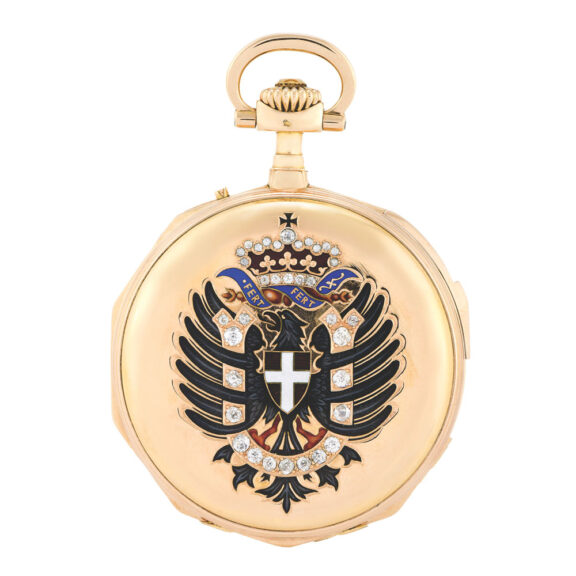
King Umberto I of Italy minute repeating watch Circa 1890
- Kenmerk
- HA0261
- Diameter
- 52 mm
- Estimate
- € 25.000 - 40.000
- Price sold
- € 30.750
Gold and enamel diamond-set pocket watch
–
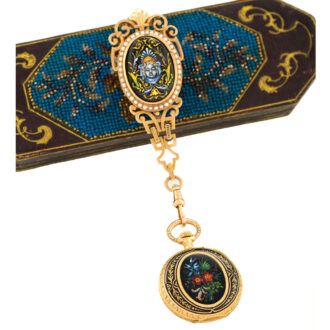
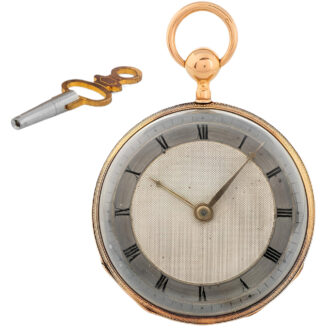
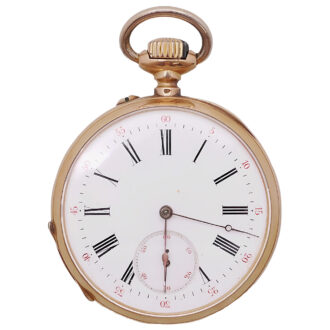
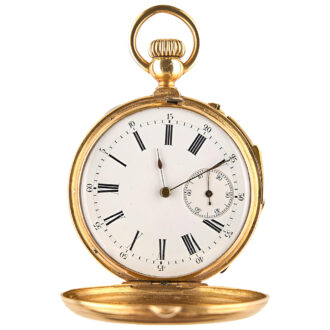
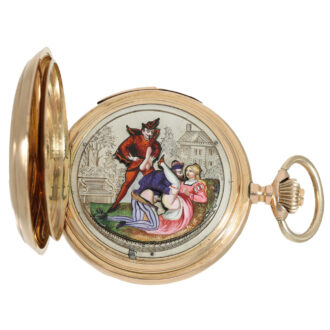
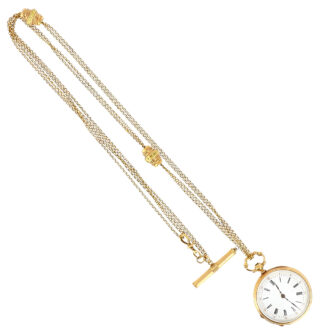
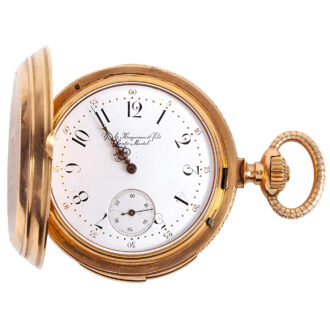
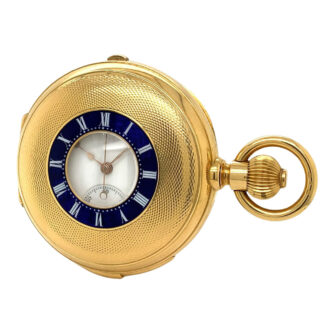
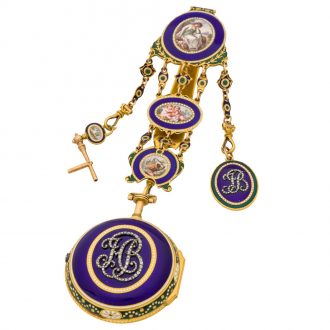
A very fine and rare 18 Carat rose gold and enamel diamond-set minute repeating, hunting cased keyless royal presentation pocket watch. Made by Louis Audemars, le Brassus in the Swiss Vallée de Joux for Umberto I, King of Italy, retailed by C. Morel Jeune, 65 Rue de Rome in Marseille, Circa 1890. Four body, bassine et filets and polished case with faceted band, the hinged and sprung front cover with the champlevé enamelled diamond-set coat of arms of Umberto I, King of Italy and a hinged gold cuvette.
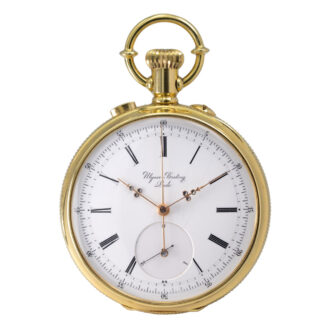
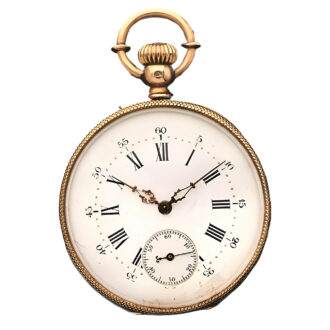
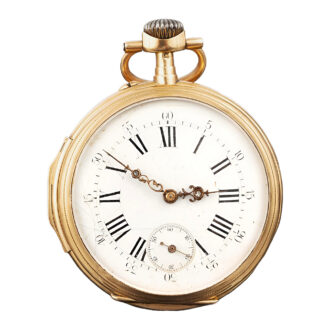
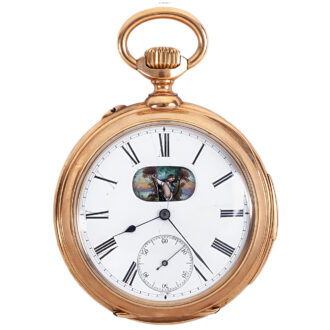
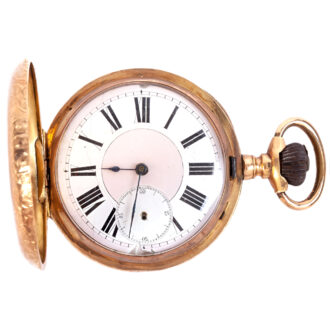
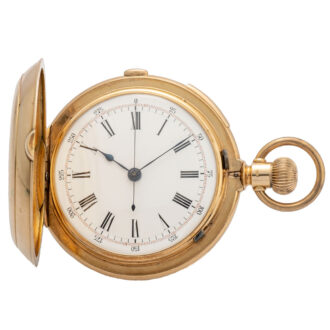
White enamel dial with radial Arabic numerals, outer minute track, subsidiary seconds and blued steel spade hands. Gilt brass movement with 25 jewels, counterpoised straight-line lever escapement, cut bimetallic compensation balance, blued steel Breguet balance spring, index regulator, repeating on gongs with two polished steel hammers and activated by a slide in the band.
Movement and case signed, cuvette signed by the retailer.
–
Diameter: 52 mm
–
Signed: C. Morel Jeune
–
Such watches were usually bought by sovereigns in order to be presented to important visitors or in recognition of loyalty. Other watches with the same provenance were sold in Geneva on October 14, 1990: one made by Vacheron & Constantin, the other by Patek Philippe. Another, sold in Geneva on October 19, 1997, was made by Patek Philippe. King Umberto I (1844-1900) was born on March 14, 1844, in Turin (Piedmont), Kingdom of Sardinia, Duke of Savoy and King of Italy. His marriage to his cousin Margherita Teresa Giovanna, Princess of Savoy, on April 22, 1868, and the birth of their son, the future Vittorio Emanuele III, on November 11, 1869, also gained him public sympathy in spite of prevailing anti-monarchist sentiment. Umberto I led his country out of its isolation and into the Triple Alliance with Austria and Germany. He supported nationalistic and imperialistic policies that led to disaster for Italy and helped create the atmosphere in which he was assassinated in Monza by an anarchist on July 29, 1900.
Signed: C. MOREL JEUNE
Share this page: