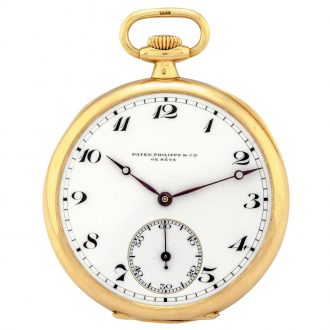
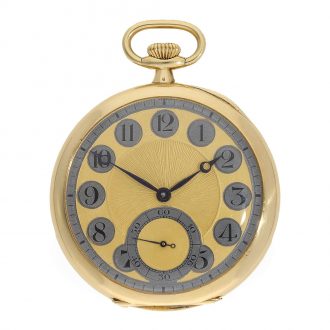
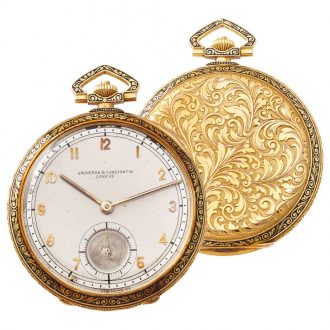
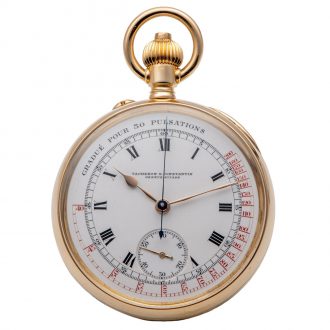
Fine and rare Swiss 18K gold tourbillon lever watch Circa 1922
- Kenmerk
- SB1221
- Diameter
- 53 mm
- Estimate
- € 150.000 - 300.000
- Price sold
- € 133.500
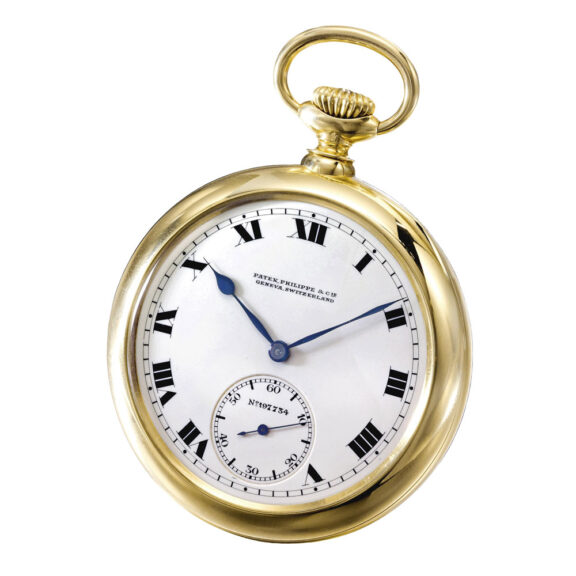
Gold open faced tourbillon watch by Patek Philippe
–
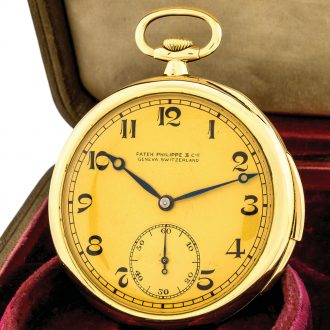
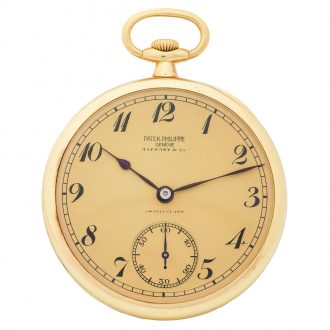
A fine and rare Swiss 18 carat gold open faced tourbillon lever pocket watch, circa 1922. Sold on May 4, 1927. Lever movement, 18 jewels. White enamel dial with Roman hours and outer minute divisions, subsidiary Arabic seconds. Plain case, concealed hinged back. Dial signed, case and movement signed and numbered. Comes with an Extract from the Archives.
–
Diameter: 53 mm
–
Signed: Patek, Philippe & Cie Geneva, Switzerland
–
This timepiece was awarded prizes during the Chronometer Pocket Watches Contest in 1924, 1925 and 1926.
–
It is extraordinary to note that this watch underwent the rigorous tests of l’Observatoire de Genève, with prizes awarded during the Chronometers Pocket Watches Contest in 1924, 1925, and 1926. Indeed, the present watch is recorded in R. Meis, Das Tourbillon, for winning the prestigious first place prize in 1924. The Geneva Observatory alongside the Neuchâtel and Kew Observatories were the most prominent European institutions assessing and rating timepiece movements for accuracy. Testing at the Geneva Observatory initially lasted 40 days and required the watch to be tested in different positions and at varying temperatures to check its ability to maintain outstanding accuracy. Accuracy in timekeeping has been critical to advances in Science and, in 1873, the Observatory in Geneva held its first annual Chronometer competition. Patek Philippe won the much coveted 1st prize for the first time in 1884. J. Golay-Audemars, one of the best régleurs at Patek Philippe at the time, oversaw the regulation of this movement during the 1924 contest. This famous régleur was prominently featured amongst prize-winning movements at the Geneva Observatory, documented from 1917 to as late as 1934.
–
The tourbillon was originally invented to improve the accuracy of pocket watches, it is considered one of the most challenging of all horological complications. Invented in 1801 by Abraham-Louis Breguet, a tourbillon counters the effects of gravity by mounting the escapement and balance wheel in a rotating cage to negate the effect of gravity when the timepiece, and thus the escapement, is in constant motion. At the time of the tourbillon’s invention, gravity and movement were known to have an adverse effect on the accuracy of timepieces, horologists knew that pocket watches suffered from the effects of gravity since they were usually carried in the same pocketed position, continuously moved during the day and then held in a different position while being read, all of which affected their accuracy. In a tourbillon, the entire escapement assembly rotates, including the balance wheel, the escape wheel, the hairspring, and the pallet fork, to average out the effect of gravity in the different positions and thereby improve the watch’s timekeeping.
Signed: Patek, Philippe & Cie Geneva, Switzerland
Share this page: