Swiss 18Kgold minute repeater for Indian market Circa 1890
- Kenmerk
- SB0097
- Diameter
- 55 mm
- Estimate
- € 40.000 - 70.000
- Price sold
- -
Gold and enamel full hunter by F. White & Co.
–
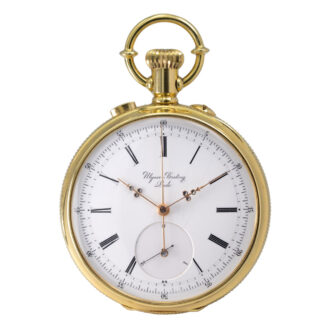
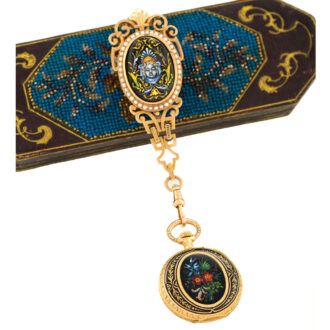
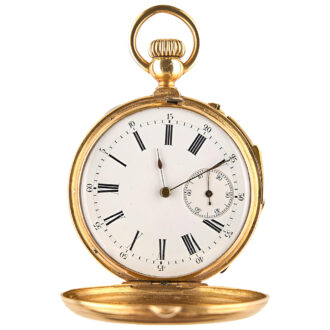
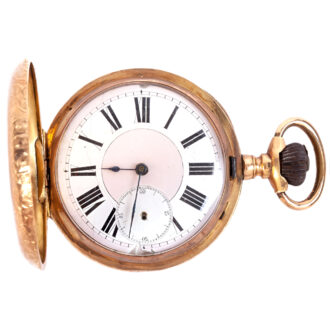
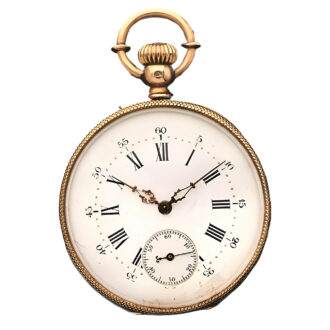
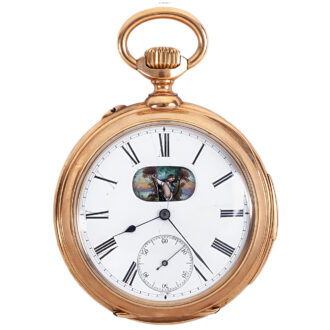
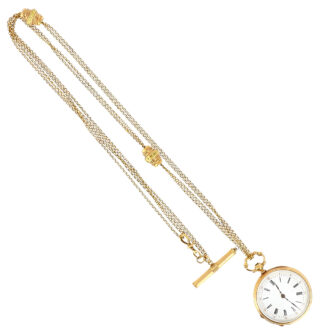
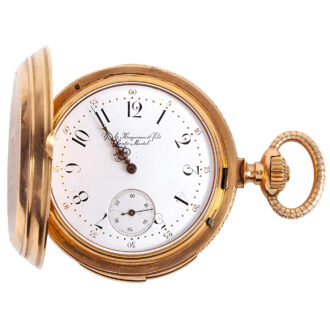
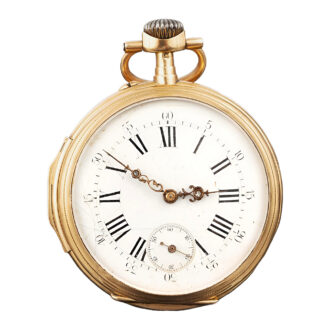
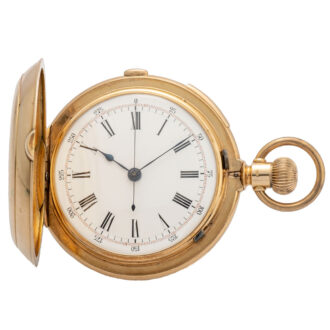
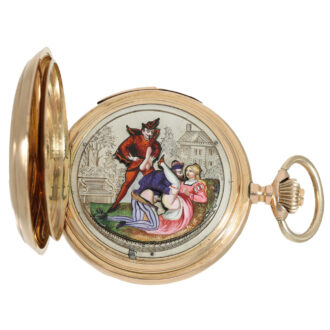
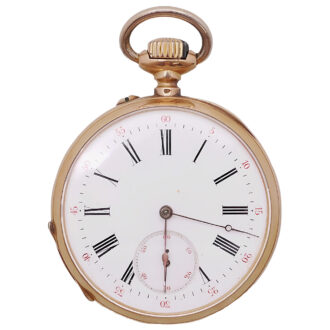
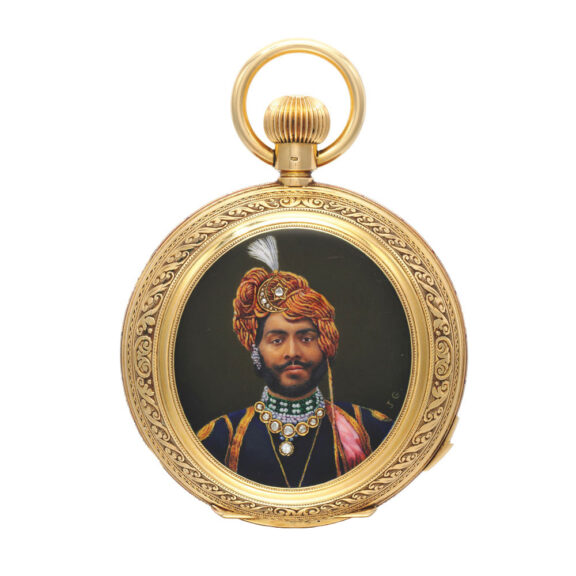
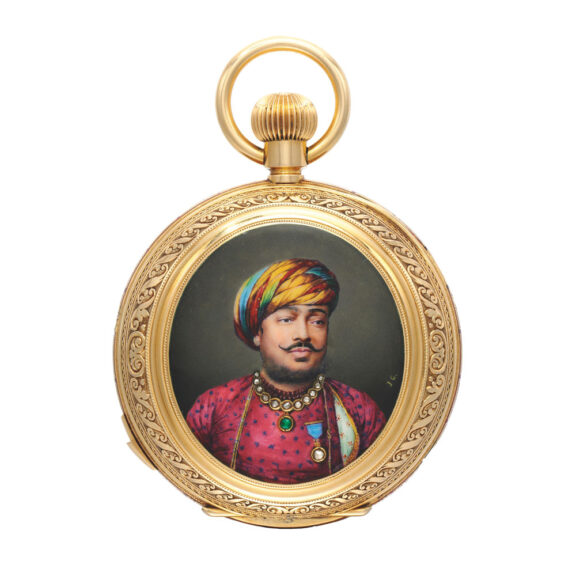
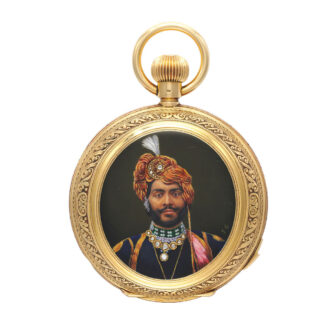
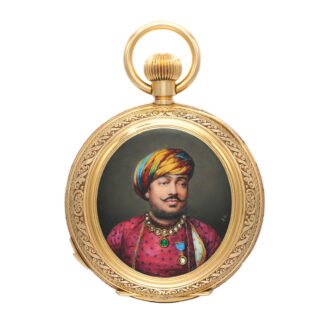
A fine Swiss gold and enamel hunting cased minute repeating clock watch made for the Indian market, circa 1890. Two trains minute repeating keyless movement, full ruby jewelled. Presentation inscription to the 18 carat gold cuvette. White enamel dial, Roman numerals, outer Arabic minute track and subsidiary seconds. 18 carat gold hunter case, band with champlevé translucent orange enamel, both sides with polychrome enamel portraits of turbaned dignitaries dressed in embroidered robes and impressive jewels over opaque grey backgrounds, both signed ‘J.G.’ (John Graff). Cuvette signed and numbered.
–
–
A fine Swiss gold and enamel hunting cased minute repeating clock watch made for the Indian market, circa 1890. Two trains minute repeating keyless movement, full ruby jewelled. Presentation inscription to the 18 carat gold cuvette. White enamel dial, Roman numerals, outer Arabic minute track and subsidiary seconds. 18 carat gold hunter case, band with champlevé translucent orange enamel, both sides with polychrome enamel portraits of turbaned dignitaries dressed in embroidered robes and impressive jewels over opaque grey backgrounds, both signed ‘J.G.’ (John Graff). Cuvette signed and numbered.
–
Diameter: 55 mm
–
Signed: F. White & Co. Bombay
–
This example is believed to represent His Highness Thakore saheb Dajiraj of Wadhwan (with the feather to the turban) and his younger brother His Highness Thakore saheb Basingh Chandrasingh of Wadhwan, who succeed him after his death in 1855.
–
–
Signed: F. White & Co. Bombay
–
This example is believed to represent His Highness Thakore saheb Dajiraj of Wadhwan (with the feather to the turban) and his younger brother His Highness Thakore saheb Basingh Chandrasingh of Wadhwan, who succeed him after his death in 1855.
–
Watches made for the Indian market, known as ‘Rajah watches’, frequently made use of photographs sent from Indian dignitaries so that artists in Geneva could render the portraits in enamel. Of the half dozen most esteemed artists specializing in this work, John Graff (1836-1902) rose to the top of his field. These subjects presented a particular challenge to enamellers, as the colour schemes favoured by the subjects’ dress were so vivid that work by less talented Western artists appeared gaudy. Graff’s portraits however, are a testament to his understanding of colour and portray the dignitaries in their intended grandeur. Furthermore, the portraits were based on often-blurry photographs sent from India, rather than seeing the subject first-hand or working from a clear likeness. Because of his mastery in the field, John Graff’s signature on watches and snuff boxes is highly sought-after. Five examples of ‘Rajah Watches’ with enamel portraits of high dignitaries signed John Graff are illustrated in Eugène Jaquet & Alfred Chapuis, Technique and History of the Swiss Watch, plate 139.
–
Literature: Sorabji Jehangir, the Princes and Chiefs of India, Vol. 3, p.71
–
Literature: Sorabji Jehangir, the Princes and Chiefs of India, Vol. 3, p.71
Signed: F. White & Co. Bombay
Share this page: