Swiss 18K gold watch with regulator type dial Circa 1840
- Kenmerk
- SB0124
- Diameter
- 47 mm
- Estimate
- € 12.500 - 25.000
- Price sold
- -
Ultra thin cylinder by Sylvain Jean-Mairet
–
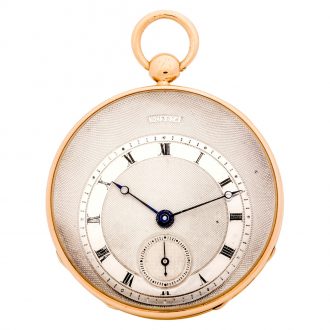
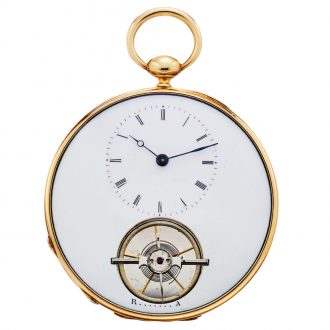
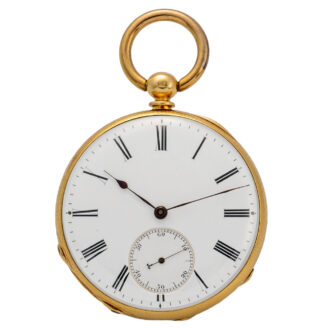
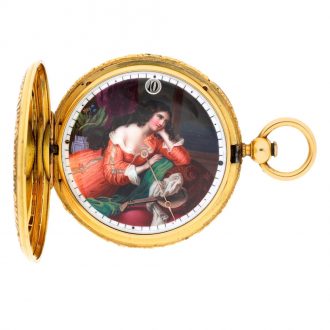
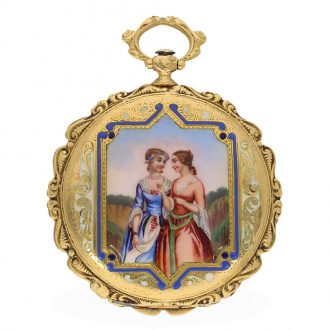
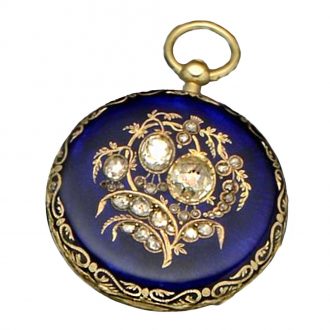
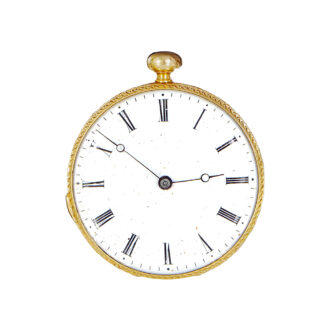
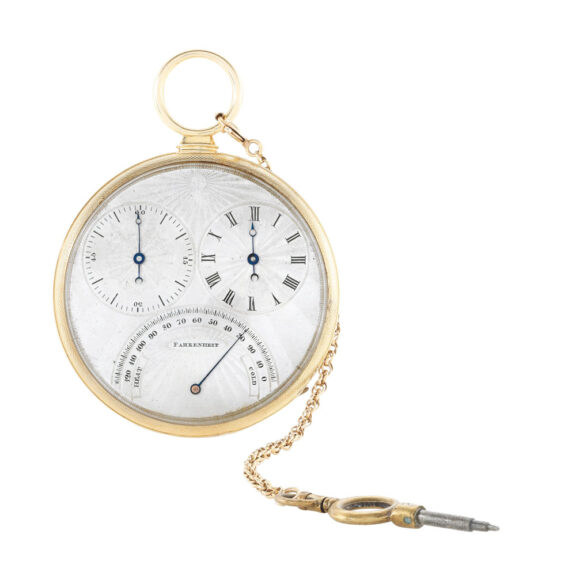
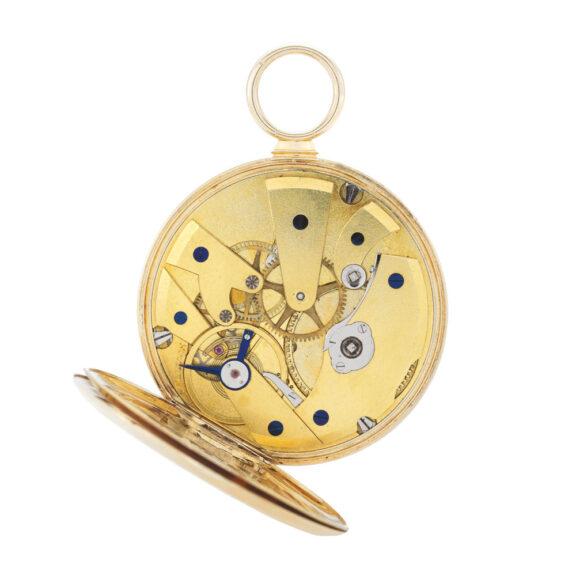
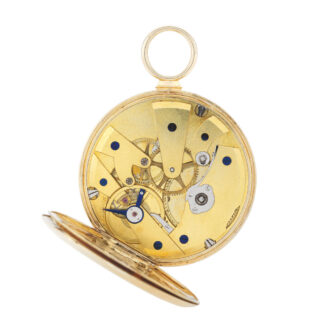
An ultra thin Swiss gold open faced pocket watch with regulator type dial and thermometer Circa 1840. Ruby cylinder escapement, temperature compensation curb. Gold cuvette with inscription.
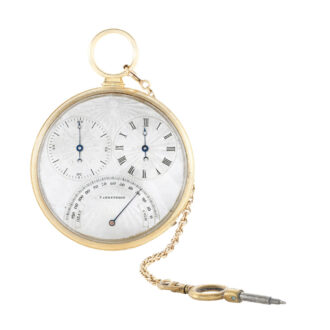
Silvered rayons de soleil guilloché dial, eccentric dials for hours and minutes, Roman and Arabic numerals and fan form Fahrenheit scale for thermometer. Engine turned case.
–
–
An ultra thin Swiss gold open faced pocket watch with regulator type dial and thermometer Circa 1840. Ruby cylinder escapement, temperature compensation curb. Gold cuvette with inscription.
Silvered rayons de soleil guilloché dial, eccentric dials for hours and minutes, Roman and Arabic numerals and fan form Fahrenheit scale for thermometer. Engine turned case.
–
Diameter: 47 mm
–
Signed: Sylvain Mairet
–
Sylvain Mairet was born in 1805 and raised by his uncle, F.I. Favre-Bulle, a watchmaker in his own right. After working in London from 1831 to 1834, for firms such as Hunt & Roskell and Vuillamy, he returned to his native Switzerland and settled in Le Locle. In 1867, he received a gold medal to commemorate his influence on watchmaking in the Canton of Neuchâtel. His watch cases, among the flattest of the period, have a highly distinctive bow which is hinged directly in the pendant. This extremely elegant bow has since been used by only one horologist: George Daniels, in England. Daniels further improved the system by using the pendant as a winding and time-setting device. At the 1855 Universal Exhibition in Paris, he showed two watches in the Palais de l’Industrie. One had Grande Sonnerie and keyless winding, first using in a watch he finished on April 20, 1850. This device was later adopted for independent seconds, watches and clockwatches which also feature two going trains and two barrels. Sylvain Mairet was also the inventor of a lever escapement with pointed pallets and lift on the escape wheel teeth. A slot in the bevelled portion of the pallet allows for better oil-retention in the parts subject to friction. This system was adopted so that the locking pallet might be adjusted in order to lessen the drop and equalise the impulses.
–
Literature: Sabrier, Jean-Claude, Frédéric Houriet, The Father of Swiss Chronometry (2006).
–
Signed: Sylvain Mairet
–
Sylvain Mairet was born in 1805 and raised by his uncle, F.I. Favre-Bulle, a watchmaker in his own right. After working in London from 1831 to 1834, for firms such as Hunt & Roskell and Vuillamy, he returned to his native Switzerland and settled in Le Locle. In 1867, he received a gold medal to commemorate his influence on watchmaking in the Canton of Neuchâtel. His watch cases, among the flattest of the period, have a highly distinctive bow which is hinged directly in the pendant. This extremely elegant bow has since been used by only one horologist: George Daniels, in England. Daniels further improved the system by using the pendant as a winding and time-setting device. At the 1855 Universal Exhibition in Paris, he showed two watches in the Palais de l’Industrie. One had Grande Sonnerie and keyless winding, first using in a watch he finished on April 20, 1850. This device was later adopted for independent seconds, watches and clockwatches which also feature two going trains and two barrels. Sylvain Mairet was also the inventor of a lever escapement with pointed pallets and lift on the escape wheel teeth. A slot in the bevelled portion of the pallet allows for better oil-retention in the parts subject to friction. This system was adopted so that the locking pallet might be adjusted in order to lessen the drop and equalise the impulses.
–
Literature: Sabrier, Jean-Claude, Frédéric Houriet, The Father of Swiss Chronometry (2006).
Signed: Sylvain Mairet
Share this page: