Swiss automaton made for the Indian market Circa 1890
- Kenmerk
- SB1301
- Diameter
- 58 mm
- Estimate
- € 75.000 - 140.000
- Price sold
- -
Gold, enamel and diamond-set Jacquemart watch by Louis-Elysse Piguet
–
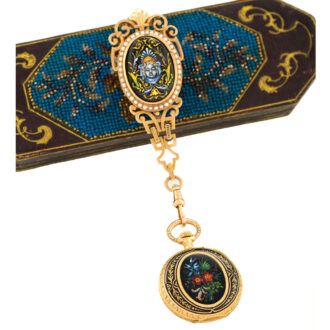
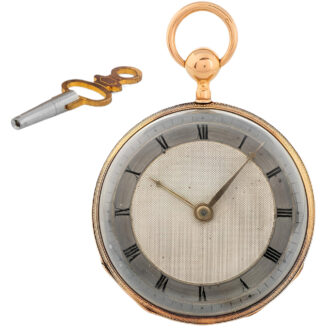
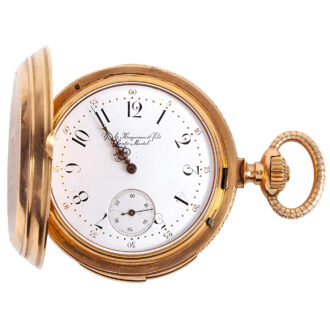
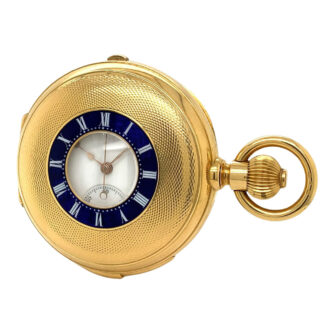
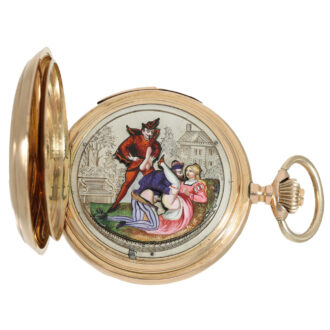
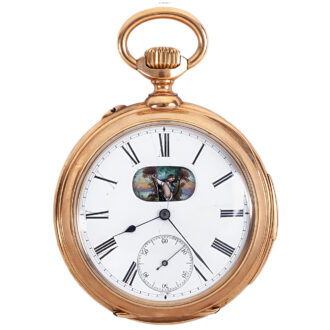
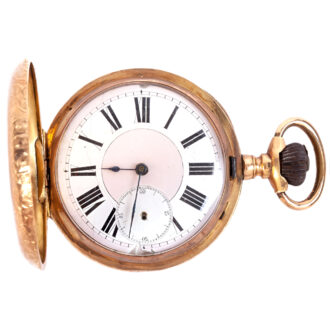
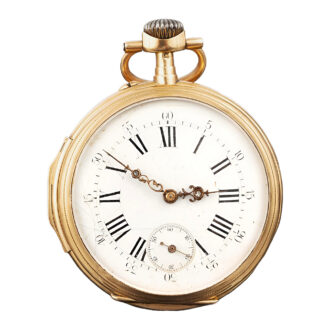
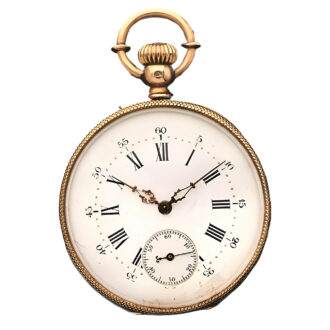
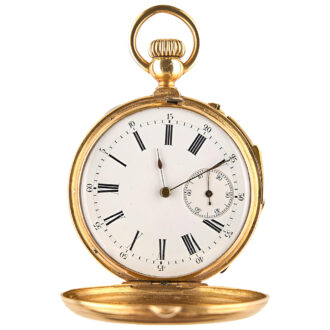
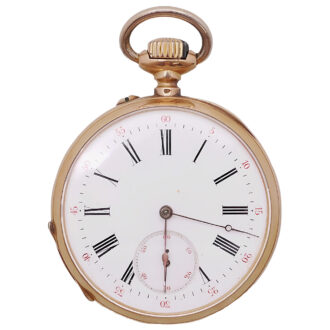
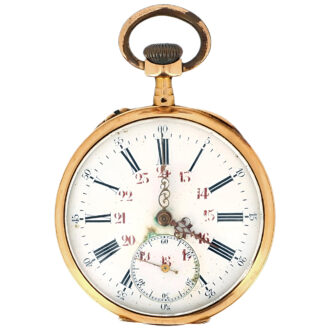
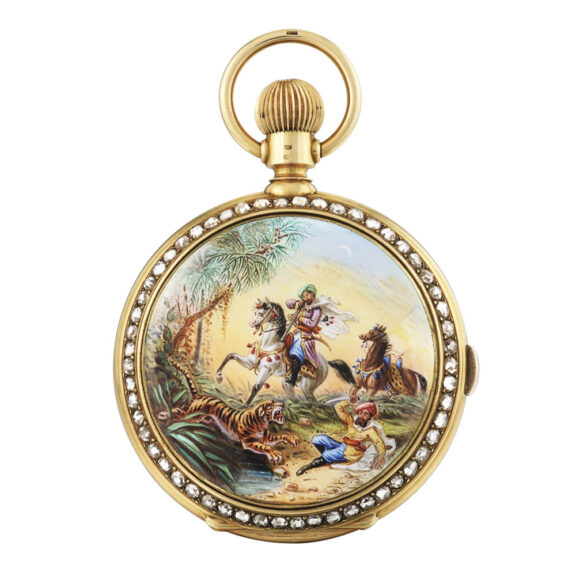
A Swiss 18 carat gold, enamel and diamond-set open faced two-train minute repeating automaton clock watch made for the Indian market, circa 1890. Keyless winding lever, 34 jewel two-train gilt and nickel plated lever movement with tandem winding, bimetallic compensation balance, three polished steel hammers for hours, minutes and striking on three gongs, stamped with Brandt patent number 7832. Cuvette engraved with the details of the watch. Small white enamel dial for the indication of time, Roman numerals, subsidiary sunken seconds, flanked by polychrome enamel figures, two striking bells above a third chiselling a sculpture in sync with the striking bell, polychrome enamel Swiss mountain scene and translucent sunset sky. The case back with a polychrome enamel scene depicting a tiger hunt, with one hunting figure astride a horse, diamond-set bezel, lever for strike/silence at 12. Case and cuvette numbered.
–
Diameter: 57.5 mm
–
Signed: Louis-Elysée Piguet
–
This watch, signed by Louis-Elysée Piguet, exemplifies the maker’s technical artistry and talent.
–
Piguet founded his firm in 1858, and during his prolific and successful career, he improved chronographs and invented the fixed-star wheel repeating mechanism. He also notably made innovative keyless winding systems, as in the present piece. His work earned him the respect of his peers, and he served on several horological committees and worked with LeCoultre Piguet when the latter received the commission for ‘La Marveilleuse’, a watch with 24 complications.
–
The enamel work on this watch is attributed to P.-Amédée Champod (1834-1913), the noted enameller who specialized in Indian hunting scenes featuring tigers, lions, and horses. Champod studied painting with Sauerländer, Huguenin, M. Constantin, and Charles Glardon, and expressed interest in creating large paintings, however, his economic situation led him to make a career for himself as an enameller. He established a reputation for creating beautifully rendered enamelled scenes, as displayed here, particularly in the portrayal of the horses and the expressions on the hunters’ faces. The artist clearly displays his attention to detail on the reverse side of this piece, delicately painting the reflection of the building in the water below. Champod received a silver medal for his work at the Paris World Exhibition in 1900, and he continued to demonstrate a mastery of composition seen in the present watch throughout his career. He created several excellent Indian Tiger Hunt scenes, such as this one, throughout his career. His Tiger Hunt pieces appear in notable horological scholarship.
–
This watch is stamped with the Swiss patent number 7832, which was granted to Louis Brandt & Frère (Omega) on December 30th, 1893, for their carillon repeating system.
–
While European makers created many beautifully enamelled pieces for the Chinese Market, much rarer are those pieces which combine both enamel scenes and automatons.
Signed: Louis-Elysée Piguet
Share this page: