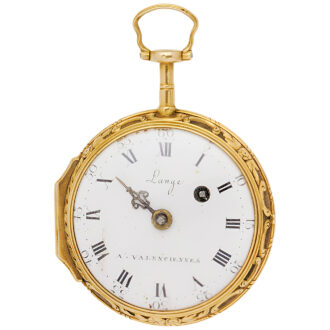
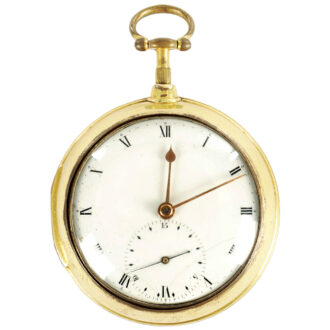
Rare French 20K gold verge with matching chatelaine Circa 1750
- Kenmerk
- FF0008
- Diameter
- 37 mm
- Estimate
- € 11.000 - 22.000
- Price sold
- -
Gold and enamel verge watch with chatelaine
–
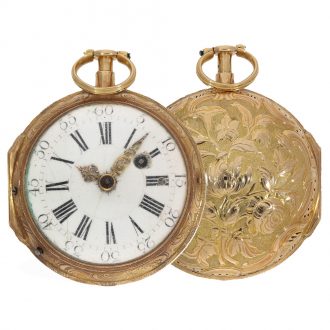
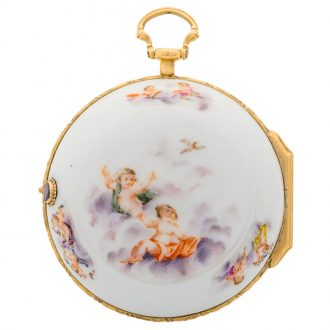
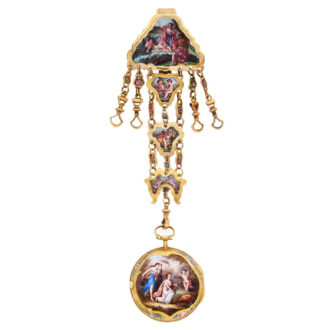
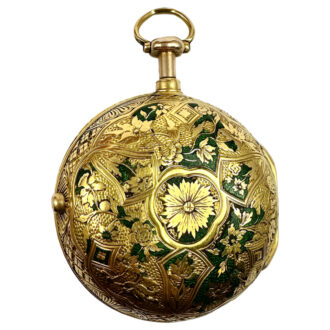
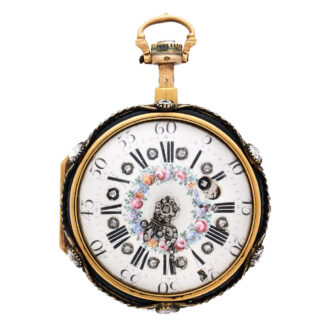
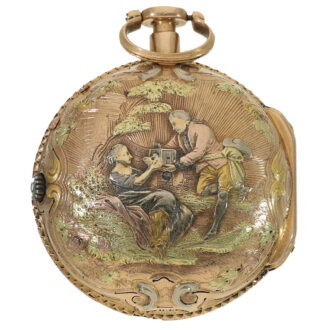
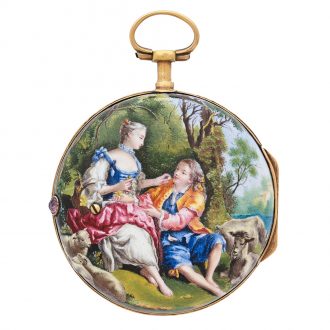
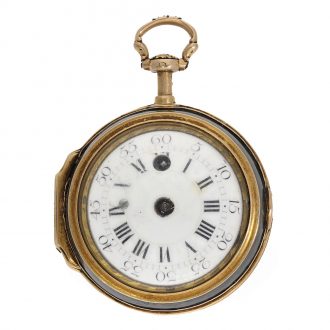
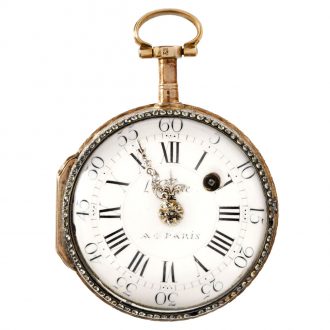
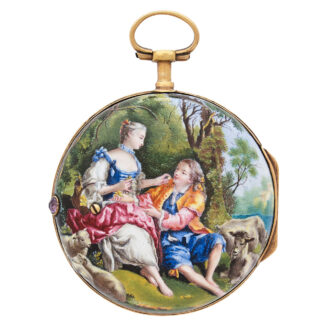
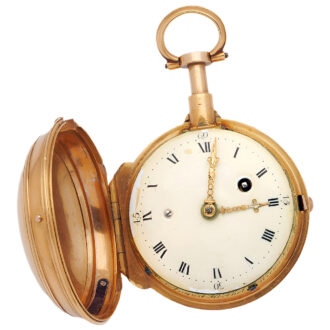
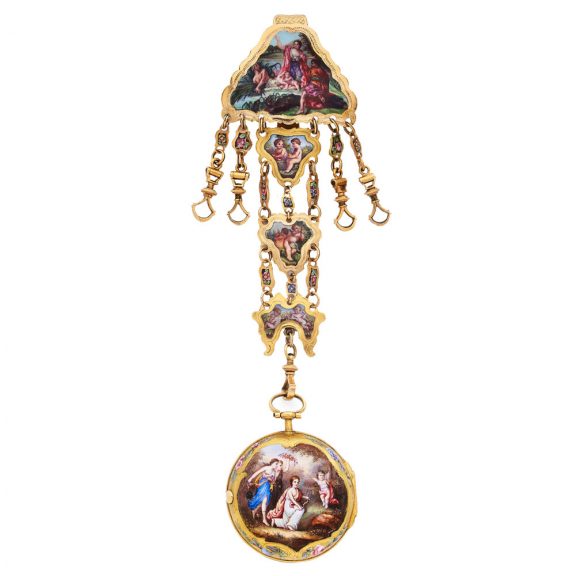
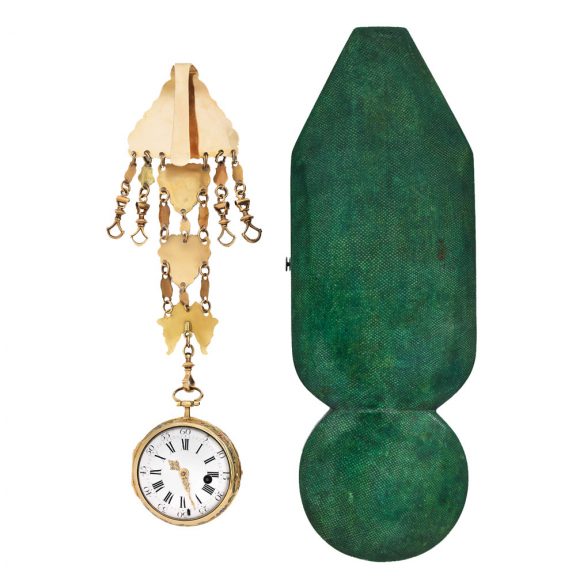
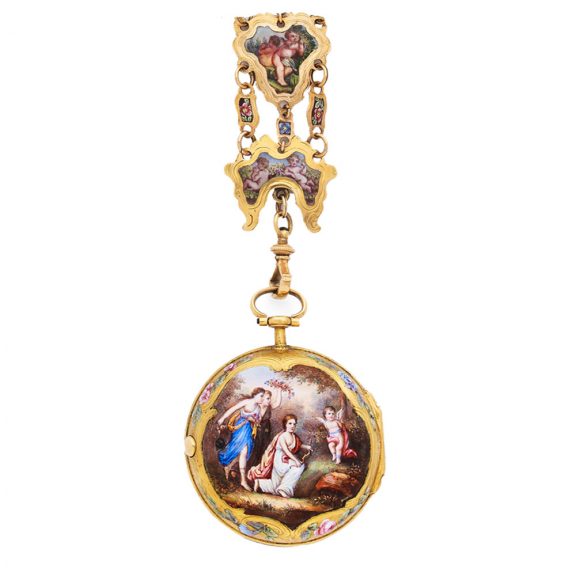
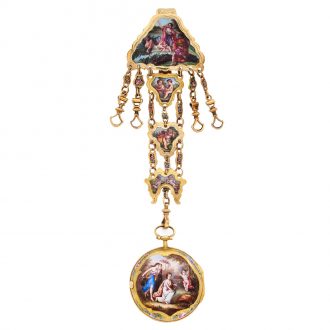
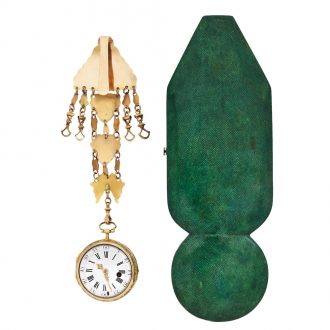
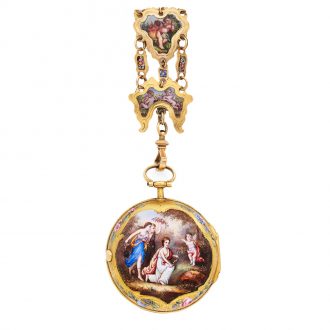
A French gold and painted enamel open-faced watch made by Jul. Le Roy in Paris, circa 1750. It comes with a matching chatelaine in gold and painted enamel scenes, housed in a shagreen box from the same period. The watch features a full plate fire gilt movement with key winding and verge escapement, an engraved and pierced balance cock, fusee and chain, adjustment disc, and is signed Jul. Le Roy à Paris. The 20-carat round case is hinged and fully enamelled. The back shows a mythological scene of Venus breaking Cupid’s bow. The glasses have champlevé enamel with polychrome rose and foliage decoration.
–
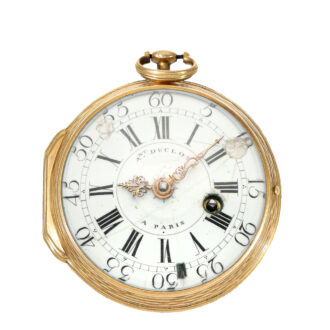
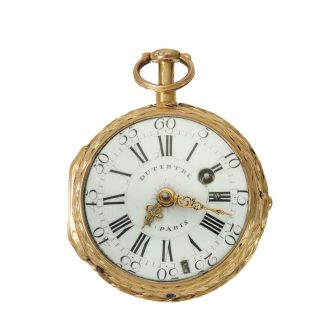
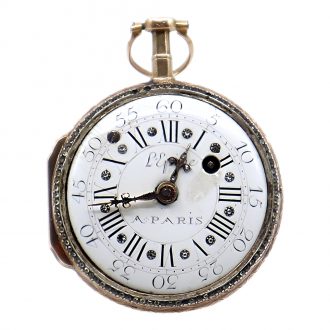
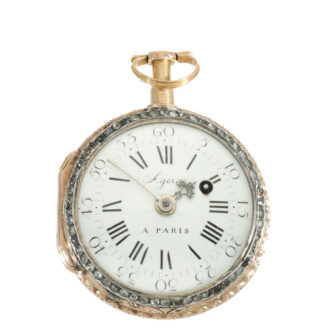
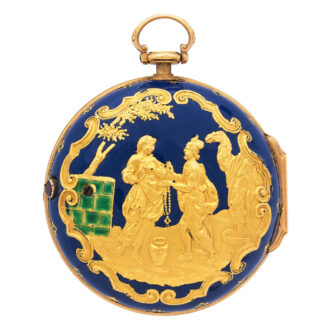
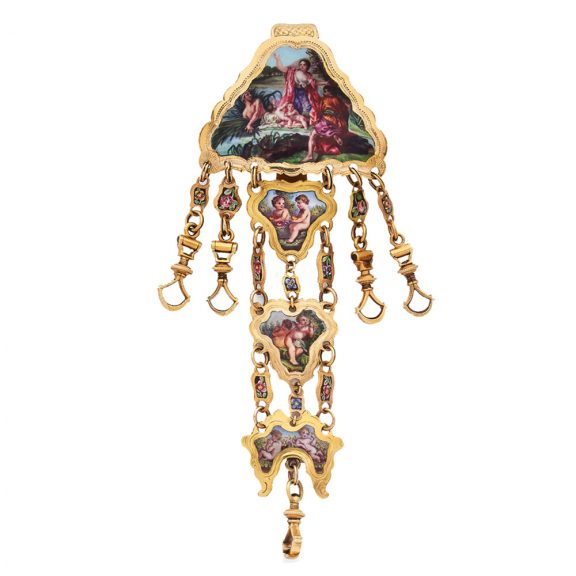
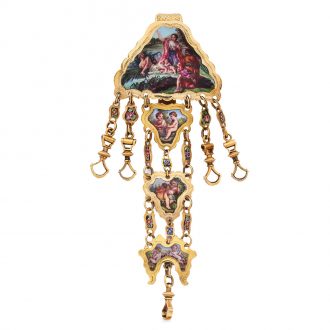
The white enamel dial displays Roman numerals for hours, Arabic numerals for five-minute intervals, decorative stylized hands, an opening for the winding square, and a railway minute track. The gold chatelaine includes several stylized cartouches decorated with enamelled pastilles and painted enamel. The upper link shows a woman surprised by a stranger, while the lower links depict Cupids painted on enamel. Each side has two chains for hanging charms, and the spatula is fixed to the back.
–
Diameter: 37 mm
–
Chatelaine: 20 cm
–
Weight: 118.4 g
–
Signed: Jul. Le Roy à Paris
–
Venus breaking Cupid’s bow
The legend of Venus breaking Cupid’s bow is an allegorical theme in Greco-Roman mythology, illustrating the complex dynamics between love and its consequences. Venus (Aphrodite in Greek), goddess of love and beauty, she is also the mother of Cupid (Eros), the god of love, often depicted as a young boy with a bow and arrows. According to legend, Cupid’s arrows have the power to make people fall in love, often in unpredictable and uncontrollable ways.
–
In some tales, Venus is exasperated by the chaotic effects of her son’s arrows, which provoke blind and sometimes destructive passions. To show her frustration or reprimand Cupid, she breaks his bow, temporarily stopping his capricious interventions in human affairs.
Cupid is said to have made 12 special arrows, which he shot into the hearts of 12 mortal women loved by the god Zeus (as depicted in the ancient Greek epic The Dionysiacae).
–
The Mythological Legend of Leda and the Swan
One of these women was Leda, Queen of Sparta and wife of King Tyndareus. After Cupid shot her with his arrow, Zeus appeared to her as a swan, which explains the depiction of Leda and the Swan in the painting. Their lovemaking resulted in the birth of twins, Castor and Pollux, who were later immortalised as the constellation Gemini.
–
Cupid is often depicted as a mischievous god, bringing chaos as well as joy with his arrows of love. In Leda’s case, Cupid’s arrow caused her to betray her marriage. Cupid’s fitting punishment would have been the breaking of his bow by his mother Venus, as depicted in this watch.
–
This image symbolizes Venus’ superior power over love, suggesting love can be both inspired and controlled, unlike Cupid’s unbridled and impulsive love. The scene of Venus breaking Cupid’s bow is a common motif in art and poetry, representing the tension between instinctive love and a more reflective, harmonious love.
Signed: Jul. Le Roy à Paris
Share this page: