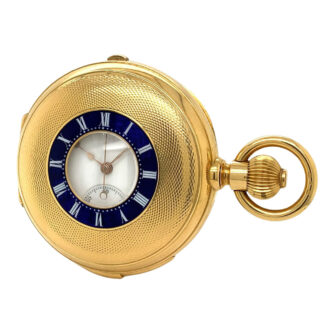
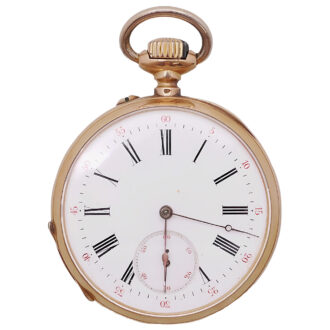
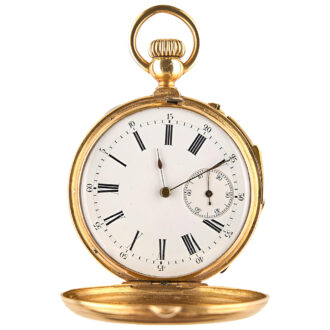
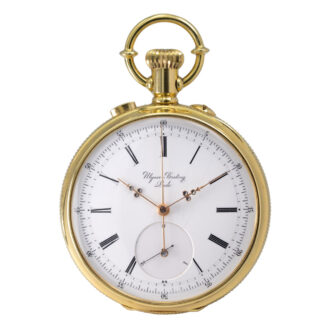
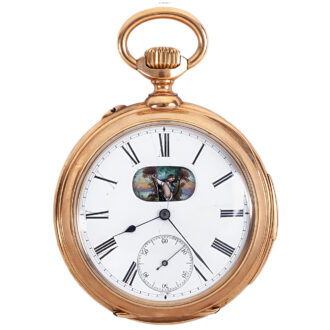
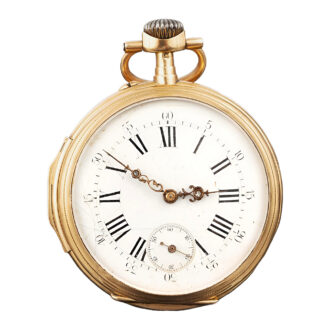
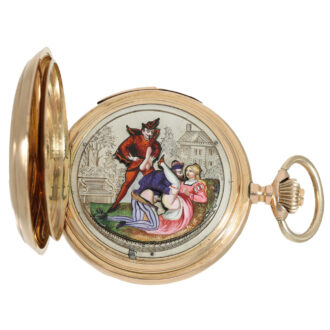
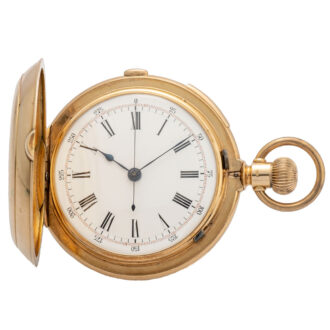
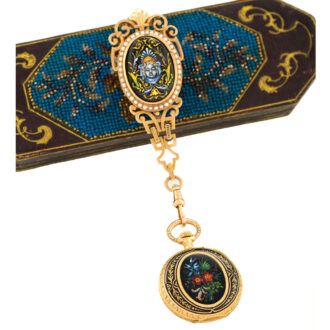
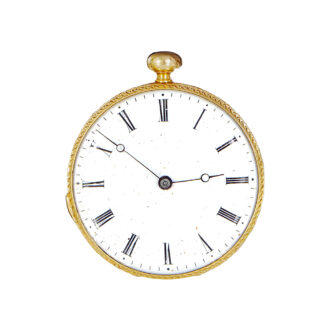
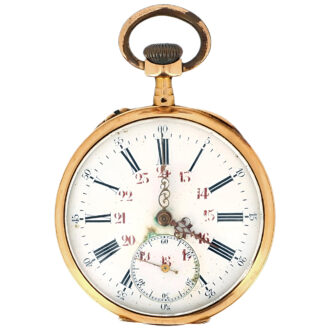
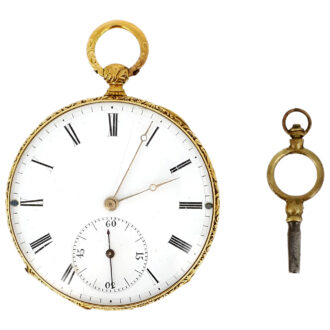
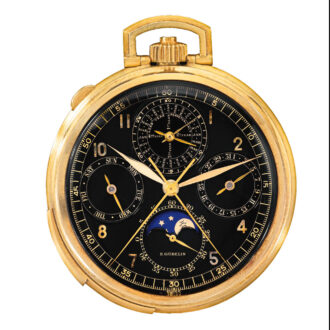
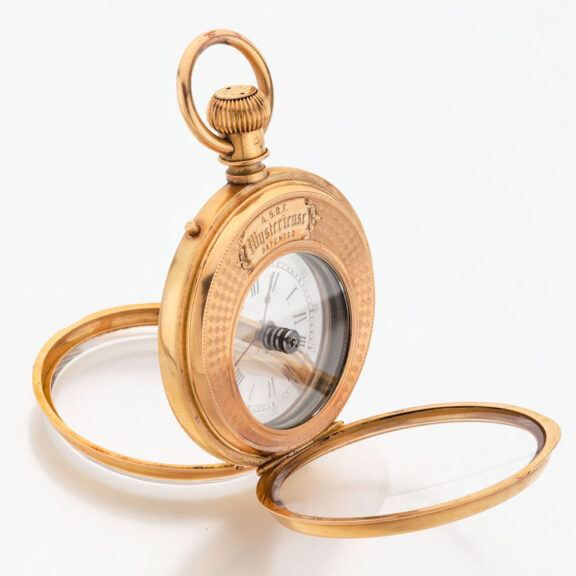
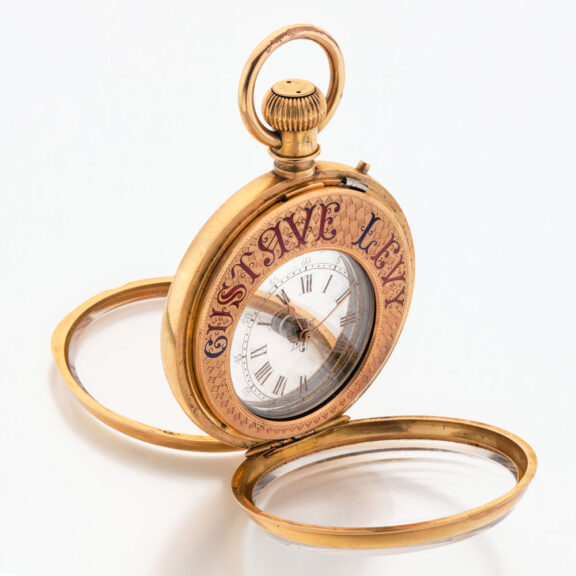
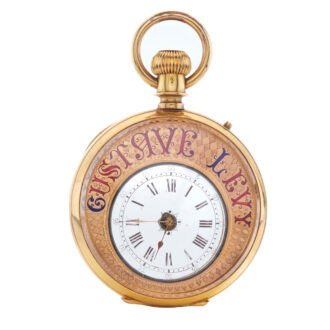
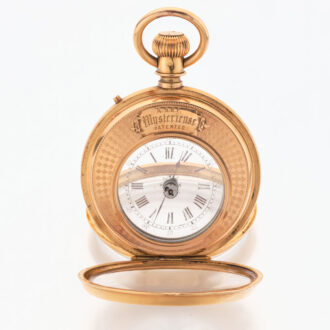
Very rare Swiss gold double sided mystery watch Circa 1890
- Kenmerk
- GF0208
- Diameter
- 53 mm
- Estimate
- € 10.000 - 17.500
- Price sold
- € 12.350
Mystery watch in gold and with owner’s name, very rare
–
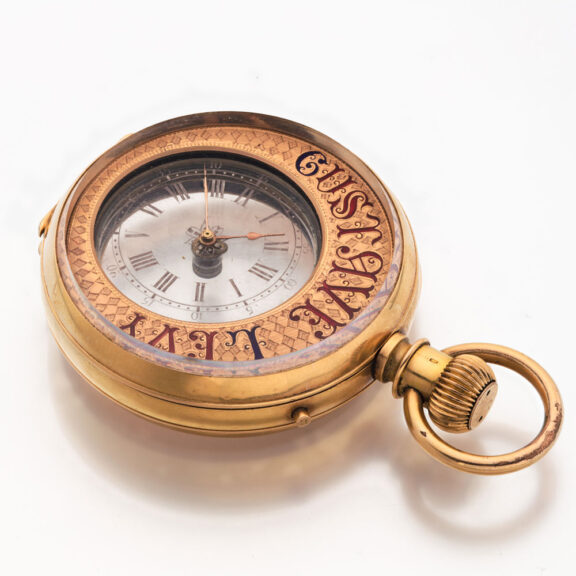
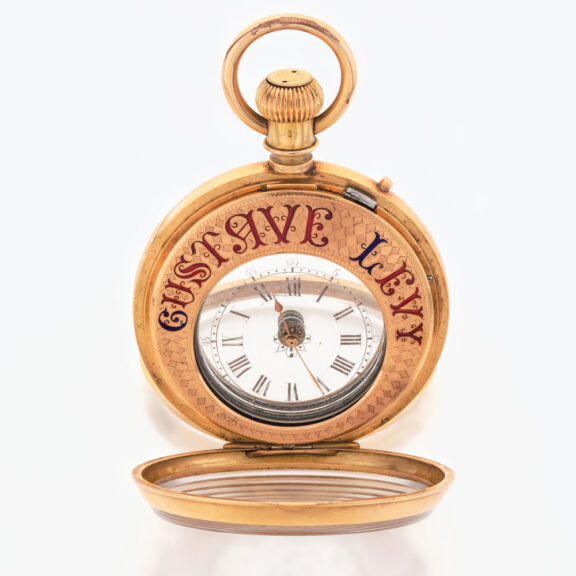
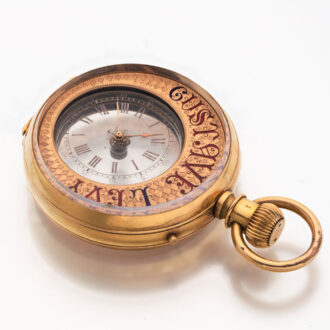
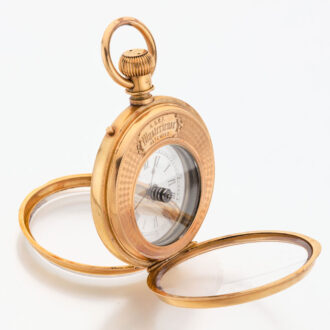
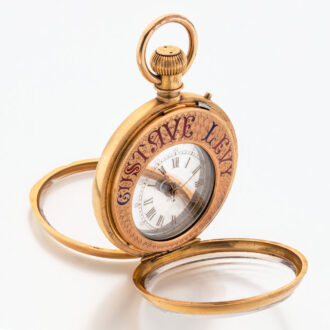
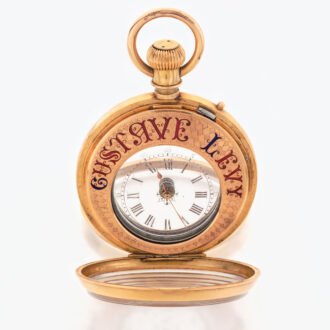
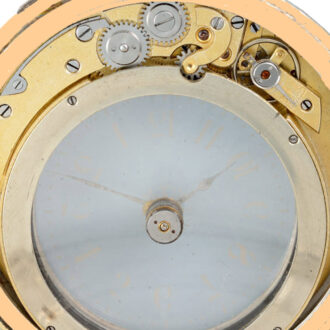
A unique example of an unusual gold pocket watch with hands moved by rotating glass discs and lavishly engraved bezel with blue and red signature “Gustave Levy”. Only a few watches of this type were produced in gold, circa 1890.
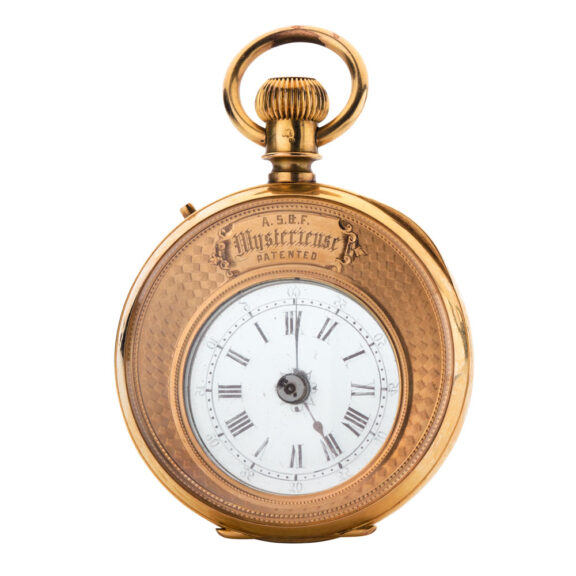
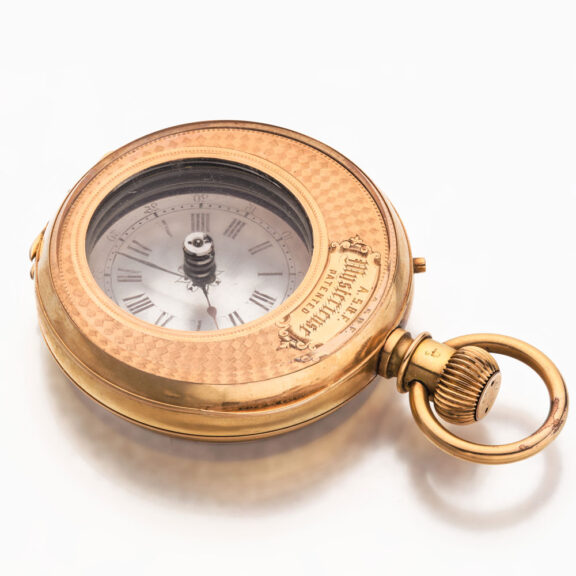
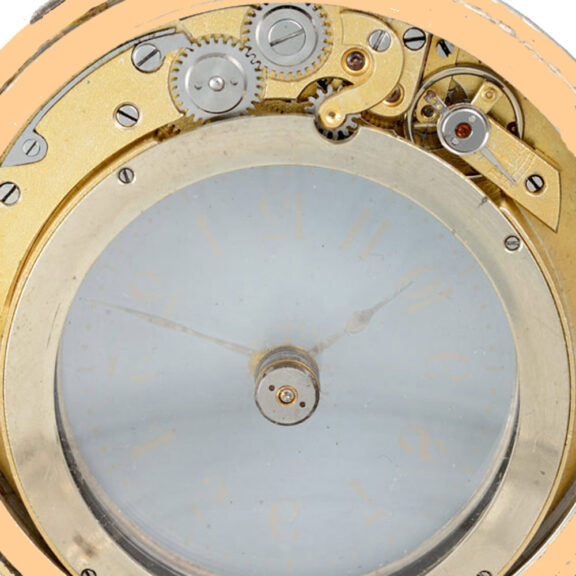
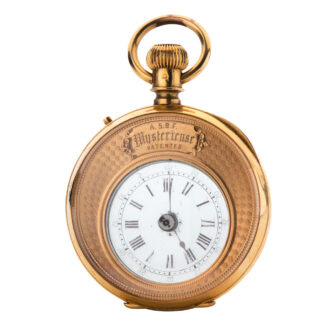
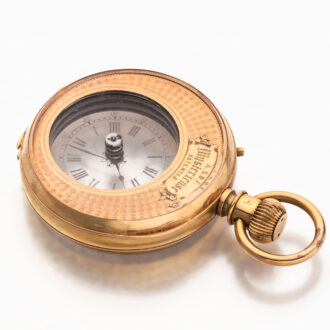
The gilt cylinder movement is relegated to the crescent shaped portion of the watch between the glass dial and the pendant. Keyless with going barrel, the crown turning in one direction only. Small plain three arm gilt balance with blue steel spiral hairspring, polished steel regulator. Polished steel cylinder and steel escape wheel. Glass dial with gilt Arabic numerals and minute ring, decorative engraved gold masks.
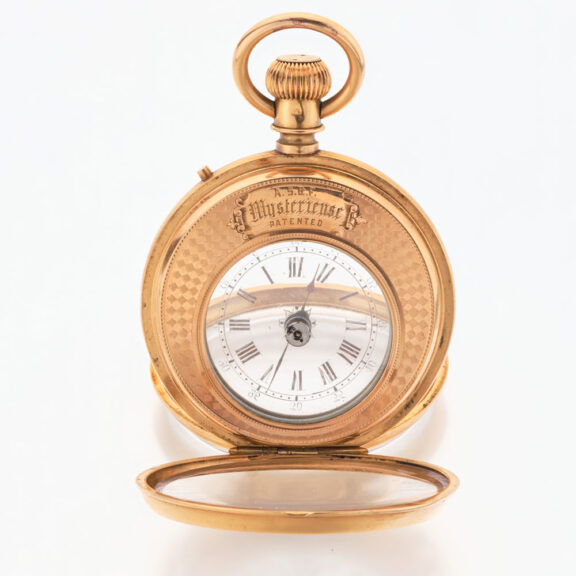
The blue steel hands are driven by a glass disc which has a toothed brass wheel attached to its outer edge engaging the train. The miniature motion work for the hands is set between another glass disc and the dial. There is no provision to set the hands apart from moving them manually, which is common in these watches. Plain gold case glazed back and front. Rectangular button in the band to release the sprung front cover, gold crown and bow.
–
Diameter: 53 mm
–
Weight: 98 g
–
Signed: A.S. et F. Mysterieuse Brevete
–
See the Camerer Cuss Book of Antique Watches page 258 for a similar watch. The mystery of hands moving without being attached to any clockwork mechanism is similar to clocks invented by Jean-Eugène Robert-Houdin. The patent for the watch was taken out by Armand Schwob et Frère in 1888.
–
Some words about Gustave Levy prove the popularity of the artist at the time: “Mr. G.J. Levy devotes much attention to the graceful utilities of the drawing and dining rooms. Many of his exhibits show the influence of good Art on objects of daily use, as well as on those of costlier and more elaborate character.”
Parisian bronze sculptor, manufacture and publisher, Gustave Levy was the successor of the famous founder Vittoz. The latter sold his workshop to E. de Labroue in 1852 who in turn gave it over to Gustave-J. Levy around 1855. The workshop, situated at 29 rue Sevigne, was specialised in the production of clocks, candle sticks, vases, lamps, statuettes and busts. Often the models were works of famous sculptors James Pradier, Charles Cumberworth, Francisque Duret, Alexandre Schoenewerk and Albert-Ernest Carrier-Belleuse.
–
Armand Schwob & Frère was based in La Chaux-de-Fonds at 14 avenue Leopold Robert. The company was founded on November 1, 1881, and registered on January 27, 1883, as a company to manufacture metal clocks of its own in La Chaux de Fonds. The company was owned by Armand Schwob & Abrabam Schwob, who came from Basel but lived in Paris. In Paris, the company was represented with a sales point for watches and jewellery on 19 Boulevard Bonne-Nouvelle.
–
In 1883 she was also represented at the exhibition in Amsterdam and offered brand watches AS & F., but also under the name Patek Cie. On July 9, 1885, an unfortunate discovery was made at the Antwerp World’s Fair. The jury, accompanied by Adrien Philippe, stepped forward to examine the shop window of Armand Schwob & Frère. A scandal was triggered by the presence of a pocket watch with the serial number 26291 and the signature “Patek & Cie” in Geneva. In 1886 a watch was offered for repair at Patek Philippe. But it was again a watch with the initials AS & F. A final proof surfaced in the year 1890 with the testimony of Georges Roulet. He said he had already engraved the name “Pateck & Cie, Geneva” at the formal written request of Armand Schwob & Frère.
–
The Schwob company was then sued for infringement of naming rights and convicted in 1890 and had to pay 15,000 francs in addition to a ban on the use of the name “Pateck” or “Patek”. In the trial, a witness reported that Schwob had been doing it for 50 years (i.e. 1833)? They would use the name Patek Cie for their watches (see also: Pateck ). This conviction was published in five newspapers voted for by “Patek Philippe & Cie” and added all legal costs. In Paris and La Chaux de Fonds, the firm was declared bankrupt in 1892.
–
A chip in the glass, about 5 mm.
Some very small dents in the band, overall in a very good condition.
–
Reference 0052000
Signed: A.S. et F. Mysterieuse Brevete
Share this page: