Mexican English gold and enamel astronomical watch Circa 1875
- Kenmerk
- SB0529
- Diameter
- 53 mm
- Estimate
- € 50.000 - 100.000
- Price sold
- € 52.050
Gold and enamel complicated double dialled watch
–
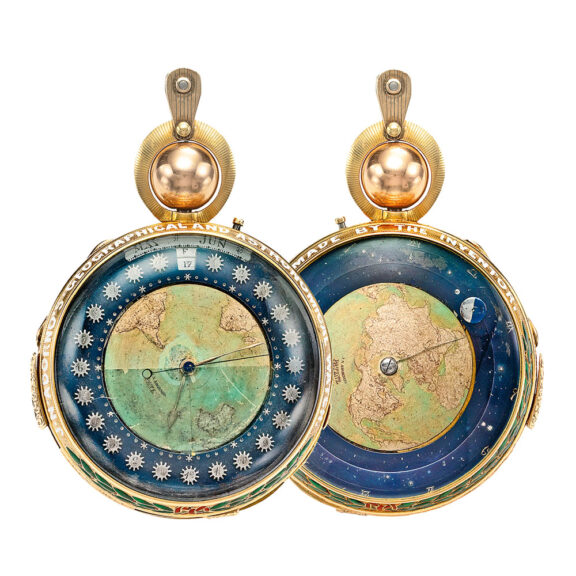
A unique Mexican/English gold and enamel double dialled minute repeating independent center seconds astronomical pocket watch with calendar and moon phases, circa 1875. Gilt two train movement, lever escapement, bi metallic compensation balance, movement signed J.N. Adorno Mexico & London, stem wind with pin setting for the time, slide repeat.
–
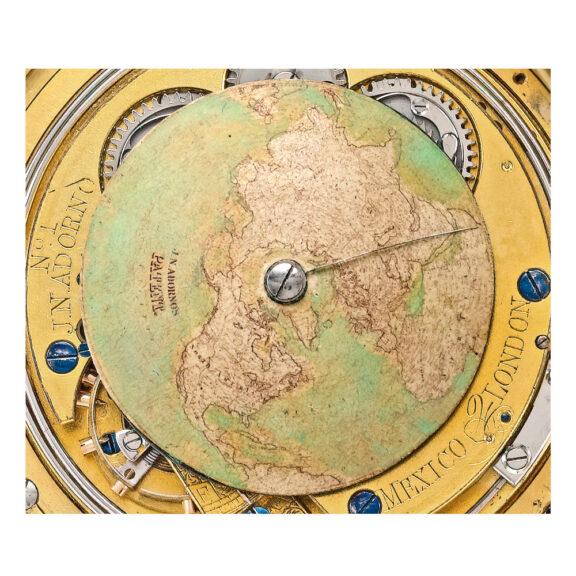
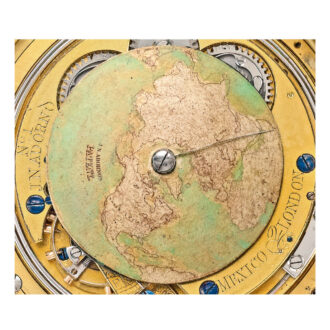
The dial on the front with a detailed revolving map of the southern hemisphere seen from the South Pole, painted in turquoise and tones of beige with a blued steel chapter ring, calibrated for 24 hours and divided 1-12 twice, numerals engraved on polished steel stars with a window at 12 o’clock to show the month, day and date on three concentric silver chapter rings, further with independent centre seconds hand beating one-second intervals, with a lock on the band and the crystal with a semi-circular shaded area to indicate night time hours. The one on the reverse with a similar revolving map of the northern hemisphere seen from the North Pole, both maps signed J.N. Adorno’s patent, surrounded by two blued steel revolving rings marked with principal stars and geared to a revolving moon half polished and half blued steel to indicate the phases of the moon, the calendar work and moon phases manually advanced by a single slide.
–
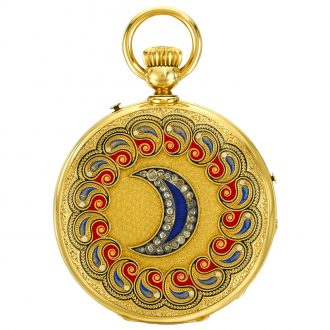
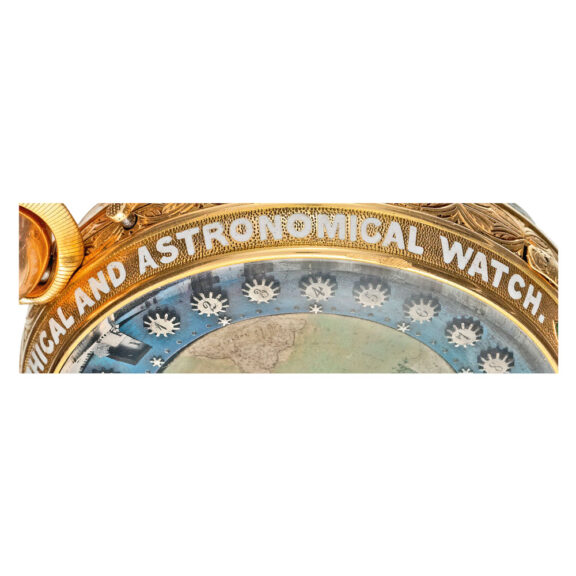
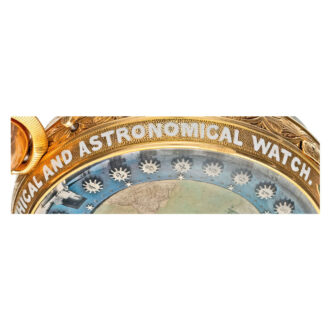
The case is chased with interlaced ribbon work enamelled with two laurel sprays with translucent green leaves tied by red enamel bows and also signed in champlevé white enamel J.N. Adorno’s Geographical and Astronomical Watch No. 1 Made by the Inventor, with an unusual crown set up composed of a sphere rotating within a fluted gold bow with hinged suspension loop, the band fitted with similarly chased slide for the repeat, start/stop button for the independent seconds and calendar setting slide.
–
Diameter: 53 mm
–
Signed: J.N. Adorno Mexico & London – J.N. Adorno‘s Geographical and Astronomical Watch No. 1 Made by the Inventor
–
The signature of J.N. Adorno on the present watch is most likely that of Juan Nepomuceno Adorno (1807-1880) born in Mexico City. An inventor, engineer, astronomer, cartographer, philosopher, author and musicologist that was considered by many as ahead of his time and by others as being quite eccentric. He was probably best known for his writings on Utopian societies described in his book, Introduction to the Harmony of the Universe, published in 1851. The book was first published in English when he was living in London. The book was later expanded and republished in Spanish in Mexico in 1862. Adorno was described as an indefatigable inventor. He was known to submit to the Mexican authorities a great variety of inventions between the 1860’s and 1870’s ranging from armaments, accounting devices, including a ‘kaleidoscopic machine’ which was meant to avoid falsification of official documents, a musical machine which simultaneously produced sound and transcribed musical notes. Some of his inventions were shown at the 1855 Imperial Exposition in Paris. Our research was unable to locate mention of his interests in horology, but his knowledge of science and of astronomy are well noted. Evidence of his pride can be judged by the number of times his name appears on this watch. This watch No. 1 is possibly the only watch made by Adorno, both dials are signed J.N. Adorno patent, the case rim and the movement are also prominently signed.
–
A unique Mexican/English gold and enamel double dialled minute repeating independent center seconds astronomical pocket watch with calendar and moon phases, circa 1875. Gilt two train movement, lever escapement, bi metallic compensation balance, movement signed J.N. Adorno Mexico & London, stem wind with pin setting for the time, slide repeat.
–
The dial on the front with a detailed revolving map of the southern hemisphere seen from the South Pole, painted in turquoise and tones of beige with a blued steel chapter ring, calibrated for 24 hours and divided 1-12 twice, numerals engraved on polished steel stars with a window at 12 o’clock to show the month, day and date on three concentric silver chapter rings, further with independent centre seconds hand beating one-second intervals, with a lock on the band and the crystal with a semi-circular shaded area to indicate night time hours. The one on the reverse with a similar revolving map of the northern hemisphere seen from the North Pole, both maps signed J.N. Adorno’s patent, surrounded by two blued steel revolving rings marked with principal stars and geared to a revolving moon half polished and half blued steel to indicate the phases of the moon, the calendar work and moon phases manually advanced by a single slide.
–
The case is chased with interlaced ribbon work enamelled with two laurel sprays with translucent green leaves tied by red enamel bows and also signed in champlevé white enamel J.N. Adorno’s Geographical and Astronomical Watch No. 1 Made by the Inventor, with an unusual crown set up composed of a sphere rotating within a fluted gold bow with hinged suspension loop, the band fitted with similarly chased slide for the repeat, start/stop button for the independent seconds and calendar setting slide.
–
Diameter: 53 mm
–
Signed: J.N. Adorno Mexico & London – J.N. Adorno‘s Geographical and Astronomical Watch No. 1 Made by the Inventor
–
The signature of J.N. Adorno on the present watch is most likely that of Juan Nepomuceno Adorno (1807-1880) born in Mexico City. An inventor, engineer, astronomer, cartographer, philosopher, author and musicologist that was considered by many as ahead of his time and by others as being quite eccentric. He was probably best known for his writings on Utopian societies described in his book, Introduction to the Harmony of the Universe, published in 1851. The book was first published in English when he was living in London. The book was later expanded and republished in Spanish in Mexico in 1862. Adorno was described as an indefatigable inventor. He was known to submit to the Mexican authorities a great variety of inventions between the 1860’s and 1870’s ranging from armaments, accounting devices, including a ‘kaleidoscopic machine’ which was meant to avoid falsification of official documents, a musical machine which simultaneously produced sound and transcribed musical notes. Some of his inventions were shown at the 1855 Imperial Exposition in Paris. Our research was unable to locate mention of his interests in horology, but his knowledge of science and of astronomy are well noted. Evidence of his pride can be judged by the number of times his name appears on this watch. This watch No. 1 is possibly the only watch made by Adorno, both dials are signed J.N. Adorno patent, the case rim and the movement are also prominently signed.
Signed: J.N. Adorno Mexico & London – J.N. Adorno’s Geographical and Astronomical Watch No. 1 Made by the Inventor
Share this page: