Swiss 18K gold and enamel lever pocket watch Circa 1903
- Kenmerk
- SB0225
- Diameter
- 48 mm
- Estimate
- € 4.000 - 8.000
- Price sold
- € 7.500
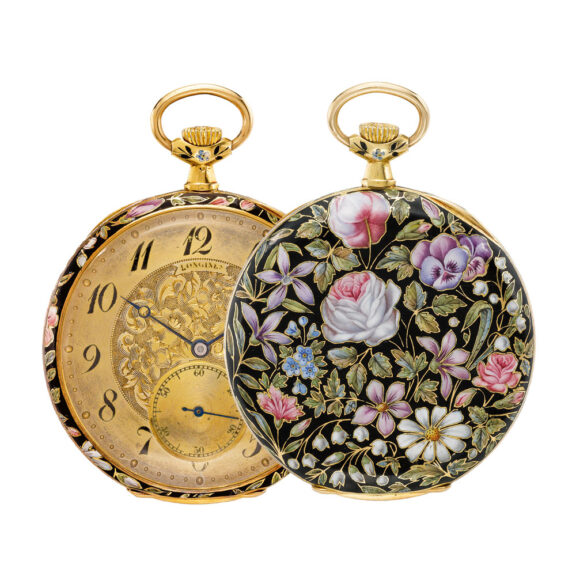
Gold and enamel open faced watch by Longines
–
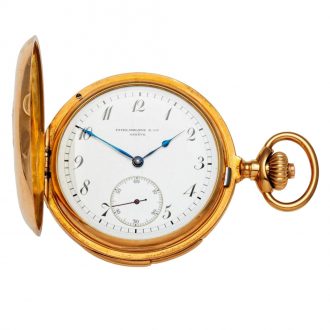
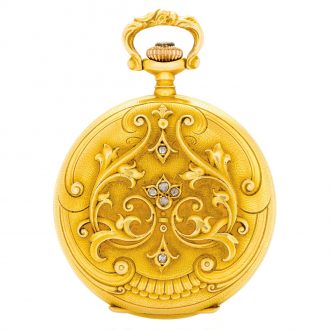
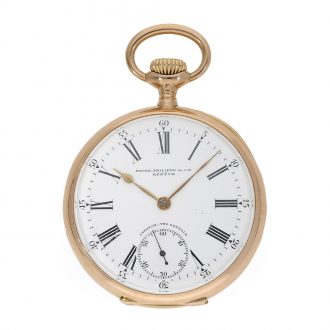
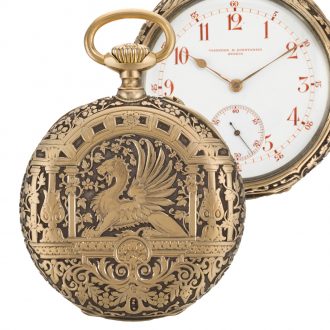
A Swiss 18 carat gold and enamel open faced lever pocket watch, circa 1903. Gilt lever movement, jewelled to the centre. Gold cuvette. Gilt engine turned dial with Arabic numerals, the centre engraved with a scrolling floral design, subsidiary seconds and blued steel moon hands. Case with floral polychrome cloisonné enamel design.
Case numbered, cuvette, movement and dial signed.
–
–
A Swiss 18 carat gold and enamel open faced lever pocket watch, circa 1903. Gilt lever movement, jewelled to the centre. Gold cuvette. Gilt engine turned dial with Arabic numerals, the centre engraved with a scrolling floral design, subsidiary seconds and blued steel moon hands. Case with floral polychrome cloisonné enamel design.
Case numbered, cuvette, movement and dial signed.
–
Diameter: 48 mm
–
Signed: Longines
–
Longines confirms the production of this watch in November 1903 and subsequent sale to the firm’s Berlin agent.
–
Cloisonné is an ancient technique for decorating metalwork objects with coloured material held in place or separated by metal strips or wire, normally of gold. In recent centuries, vitreous enamel has been used, but inlays of cut gemstones, glass and other materials were also used during older periods, indeed, cloisonné enamel very probably began as an easier imitation of cloisonné work using gems. The resulting objects can also be called cloisonné.
–
Signed: Longines
–
Longines confirms the production of this watch in November 1903 and subsequent sale to the firm’s Berlin agent.
–
Cloisonné is an ancient technique for decorating metalwork objects with coloured material held in place or separated by metal strips or wire, normally of gold. In recent centuries, vitreous enamel has been used, but inlays of cut gemstones, glass and other materials were also used during older periods, indeed, cloisonné enamel very probably began as an easier imitation of cloisonné work using gems. The resulting objects can also be called cloisonné.
Signed: Longines
Share this page: