Swiss chronograph watch for the Indian market Circa 1895
- Kenmerk
- SB0191
- Diameter
- 53 mm
- Estimate
- € 30.000 - 50.000
- Price sold
- € 54.700
–
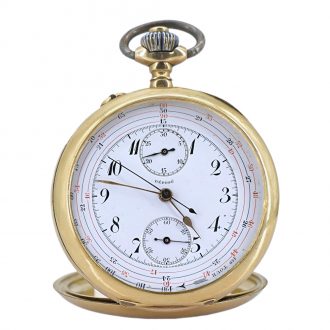
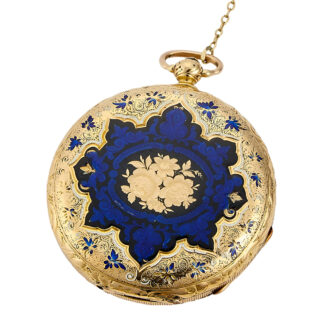
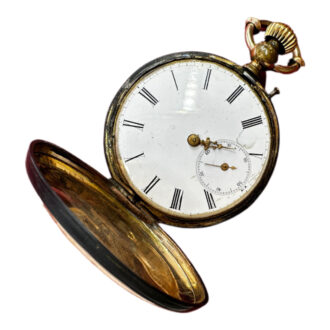
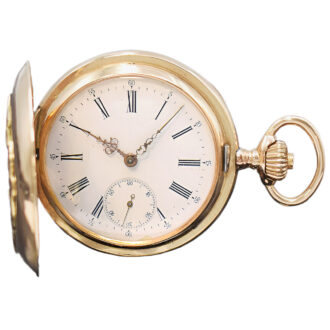
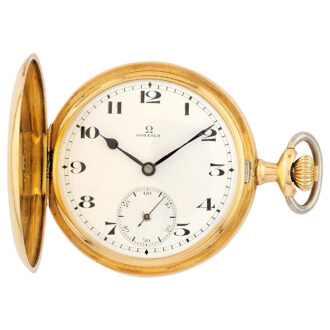
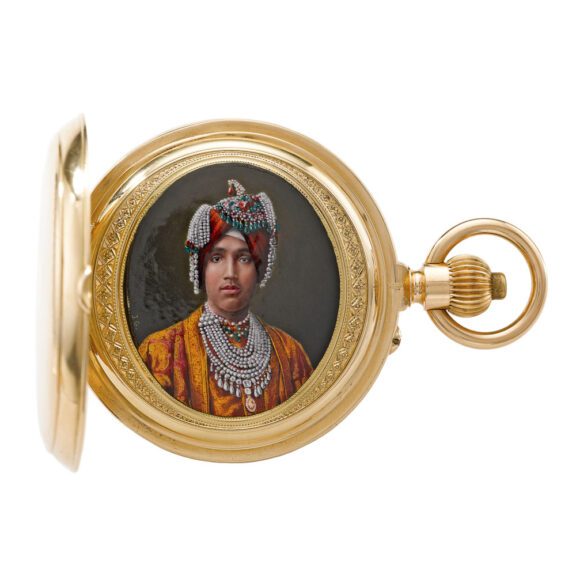
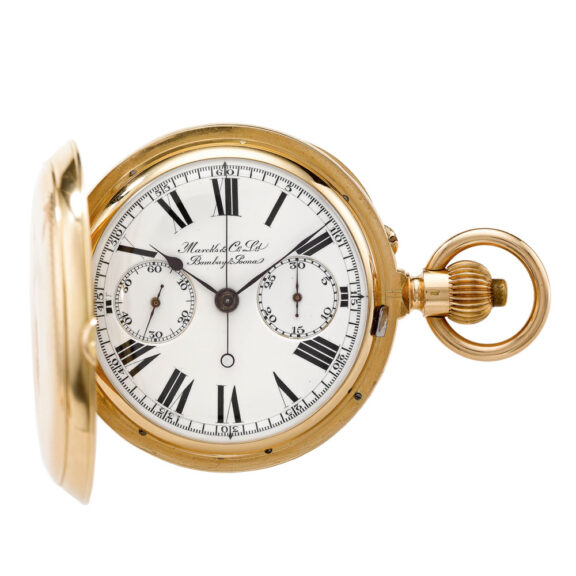
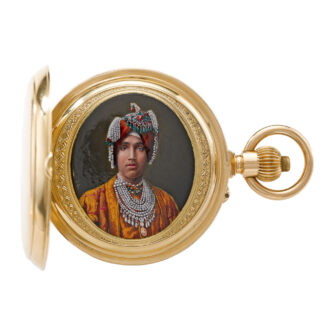
A fine and rare Swiss gold hunting cased chronograph pocket watch with enamel portrait of Sir Rajinder Singh of Patiala by John Graff, circa 1895. Retailed by Marcks & Co Ltd Bombay & Poona. Made for the Indian market. Gilt three quarter plate lever movement, gold cuvette with finely painted polychrome enamel portrait of Sir Rajinder Singh of Patiala (1872-1900), signed JG (John Graff), the painted pearls to the necklace and turban in relief. White enamel dial, Roman numerals, subsidiary dial for constant seconds and 30 minute register, outer track calibrated for chronograph. 18 Carat engine turned case, chronograph pusher to the winder. Case, dial and movement signed by the retailer.
Diameter: 53 mm
–
Signed: Marcks & Co Ld Bombay & Poona
–
The subject of the present lot is Sir Rajinder Singh, Maharaja of Patiala. During his reign, he created orphanages, women’s hospitals and personally trained soldiers. An accomplished sportsman, he excelled in polo and cricket. In 1897, he was awarded the Grand Cross of the Star of India. Patiala was one of the most important of the princely states of India. As such, it became a destination market for purveyors of luxury goods. Maharaja Bhupinder Singh, the son of Sir Rajinder Singh, became known as the greatest patron of Cartier of all time. The present lot attests to this discerning market, and it later was acquired as part of the celebrated Sandberg Collection of Watches, sold in at Antiquorum, Geneva, in May 2001. Its provenance, subject matter and high quality signed enamel portrait are highly sought after by collectors today.
–
Watches made for the Indian market, known as ‘Maharaja watches’ frequently made use of photographs sent from Indian dignitaries so that artists in Geneva could render the portraits in enamel. Of the half dozen most esteemed artists specializing in this work, John Graff (1836-1902) rose to the top of his field. These subjects presented a particular challenge to enamelers, as the color schemes favored by the subjects’ dress were so vivid that work by less talented Western artists appeared gaudy. Graff’s portraits, however, are a testament to his understanding of color and portray the dignitaries in their intended grandeur. Furthermore, the portraits were done using often blurry photographs sent from India as the basis, rather than seeing the subject first-hand or working from a clear likeness. Because of his mastery in the field, John Graff’s signature on watches and snuff boxes became highly sought-after throughout India. The present lot is testament to his popularity as an artist, with both portraits signed J. Graff in full, rather than simply J. G.
–
For further discussion of the ‘Maharaja watches’ and Swiss watch trade in India, see Jaquet, E. & Chapuis, A., Technique and History of the Swiss Watch, pp. 100 and 128-129. For images of similar watches with J. Graff’s enamel portraits made for the Indian market, see the same text, pl. 133.
Signed: Marcks & Co Ld Bombay & Poona No. 973
Share this page: