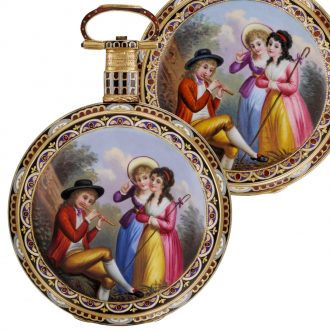
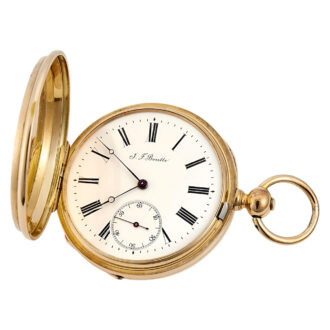
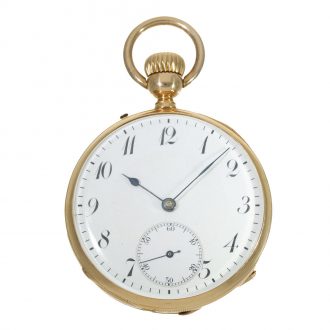
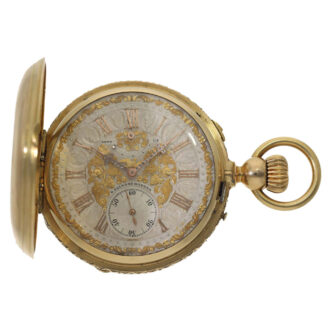
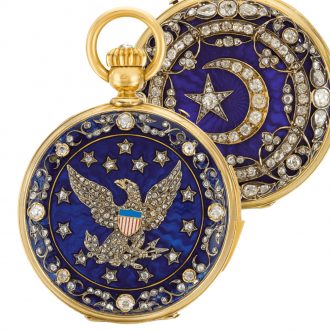
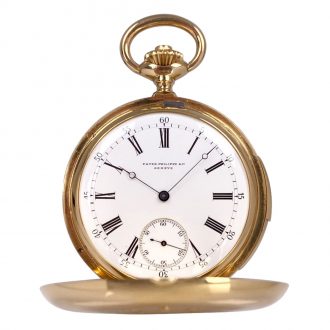
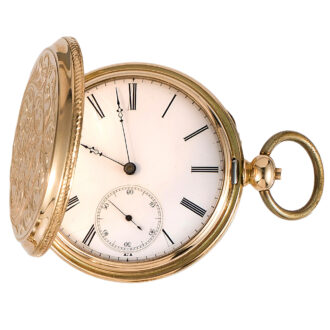
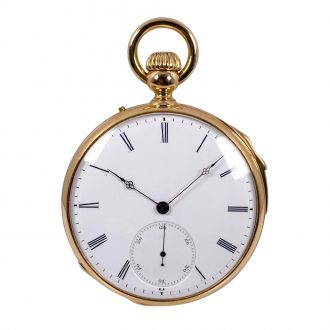
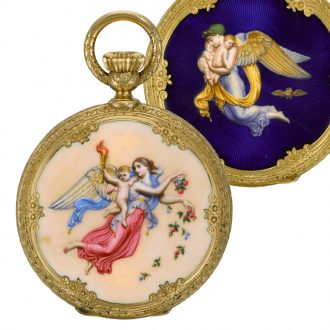
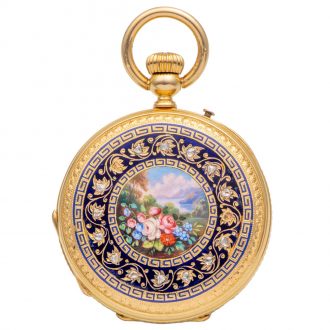
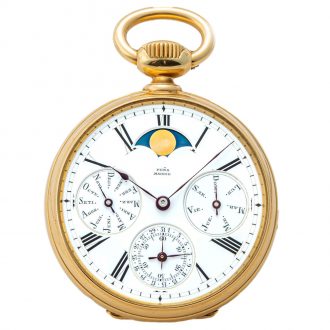
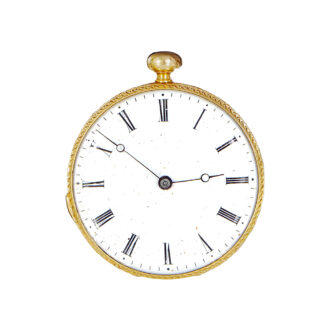
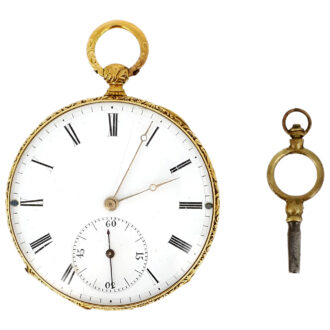
Swiss 18k gold half hunting keyless pocket watch Circa 1865
- Kenmerk
- TA1671
- Diameter
- 49 mm
- Estimate
- € 9.000 - 18.000
- Price sold
- € 16.350
Gold Royal presentation watch
–
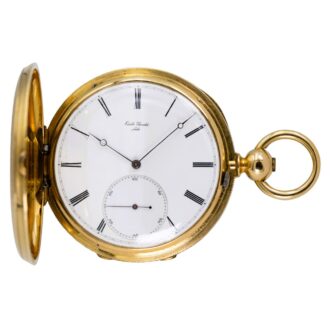
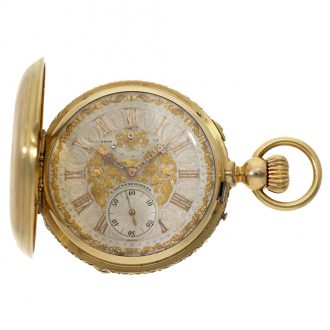
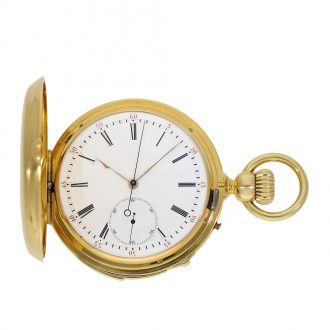
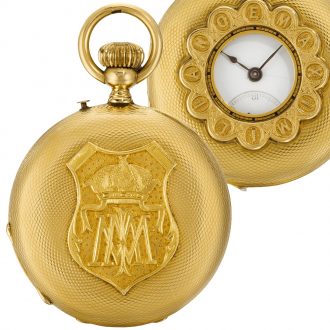
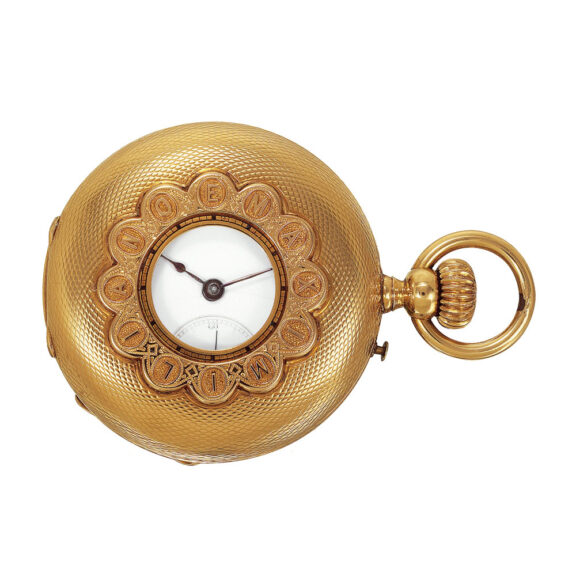
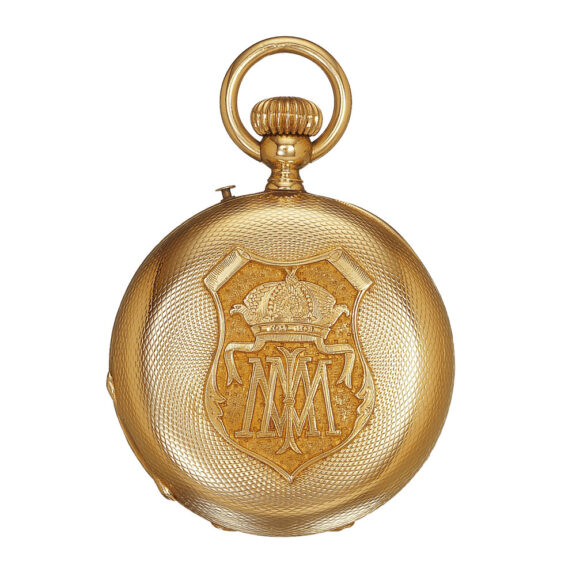
A fine Swiss, 18K gold half hunting keyless Royal Emperor Maximilian I Swiss presentation watch, circa 1865. An engine-turned case, back with applied gold initials MMI (Maximilian, Imperator) surmounted by a crown, frontal dial aperture surrounded by an applied gold ring with engraved letters MAXIMILIANOE, gold hinged cuvette with applied gold Imperial crown. White enamel dial, radial Roman numerals, outer minute track, subsidiary sunk seconds. Blued steel double spade hands. A nickel movement, bar calibre, 15 jewels, straight-line calibrated lever escapement, uncut bimetallic balance with flat balance spring. Signed on the cuvette under the applied coat-of-arms.
–
Diameter: 49 mm
–
Signed: No Name
–
Ferdinand Maximilian Joseph of Habsburg (1832-1867), Maximilian I of Mexico Born on July 6, 1832, he was the son of Sophie, Archduchess of Austria and Franz Karl, Habsburg Archduke and son of the reigning Emperor. Maximilian’s older brother Franz Joseph became Emperor, while he himself chose a career in the imperial navy. In 1857 Franz Joseph appointed his brother governor-general of the Austrian-held provinces of northern Italy, the Kingdom of Lombardy-Venetia. Maximilian took up residence at Monza outside Milan with his bride, Princess Charlotte of Belgium, the daughter of King Leopold of Belgium and Louise d?Orléans. Although he had begun to win the sympathies of the Italians, his liberal ideas were frowned on in Vienna. In 1859, Franz Joseph removed his brother from office and gave power to the military. Maximilian and Charlotte both resented the dismissal and found it difficult to return to civilian life, however an unexpected offer was soon to change this.
–
An army of Spanish, English and French troops had landed in Mexico to enforce payment of the Mexican Republic’s huge foreign debts. The Spanish and English soon withdrew, but Napoleon III decided to remain and establish a conservative, pro-French regime. In 1864, he offered Maximilian the Mexican throne. In April 1864 the couple set sail for their new homeland. They soon discovered that the Mexicans were largely unwilling to accept a foreign Emperor, no matter how liberal and that support for Benito Juárez was strong. To further complicate matters, in the face of strong international pressure, France became less willing to support the new regime. Despite a journey Charlotte made in 1866 to try and shame the French Emperor into honouring his promises, Napoleon III withdrew his troops. The distraught Charlotte, seeing that her pleas fell on deaf ears, went to see the Pope. It was during this visit that she showed the first signs of the madness that would persist until her death in 1927. Abandoned by the French, Maximilian’s reign was condemned, yet he refused to leave the country.
–
In Querétaro, a town some 100 miles to the north of Mexico City, he fell into the hands of Juárez and was sentenced to die along with two of his companions. After making his final confession, Maximilian took out his gold watch and asked that it be given to his wife. Before the firing squad, he refused to be blindfolded or to have his hands tied behind his back. His last words were: “I forgive everyone, and I ask everyone to forgive me. May my blood which is about to be shed, be for the good of the country. Viva Mexico, viva la independencia!” The present watch is a token of Maximilian’s love of horology, but he must also have had fond memories of a musical clock in his family home. Shortly after the New Year in 1867, just a few months before he was killed, Archduchess Sophie wrote her son: During lunch, and afterwards, the music of your Olmütz clock began to sound, and I had the impression that it was you sending a greeting to the family circle from where you are, far away.
Share this page: