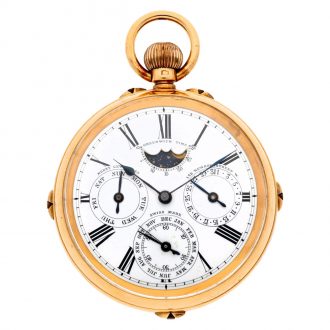
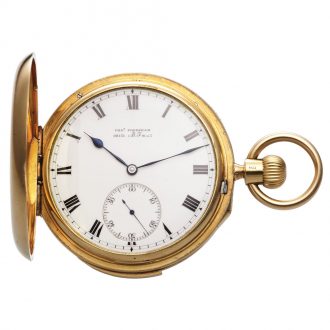
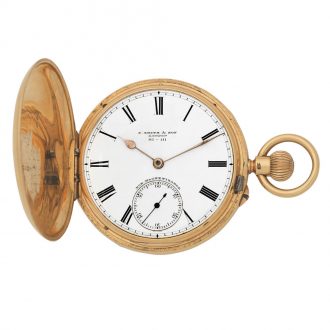
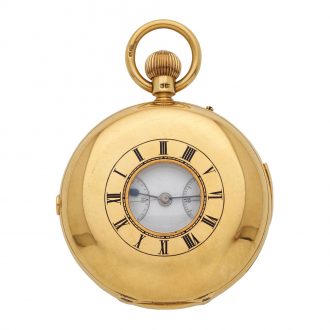
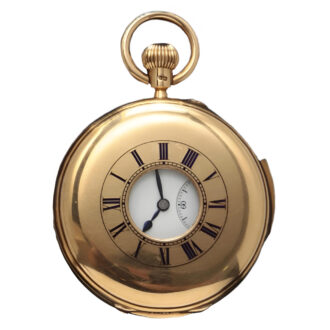
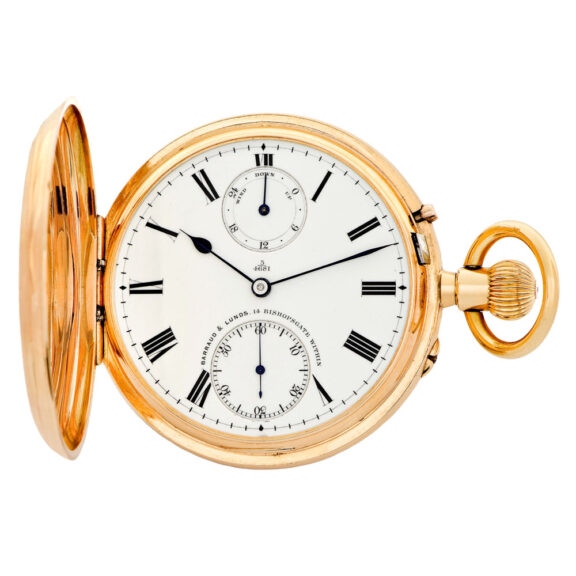
English 18 Carat pink gold hunter with power reserve Circa 1900
- Kenmerk
- TA3599
- Diameter
- 55 mm
- Estimate
- € 4.000 - 7.500
- Price sold
- € 8.500
Gold lever with free sprung balance and special winding
–
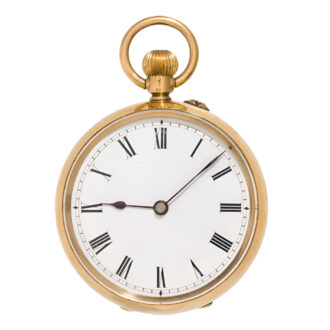
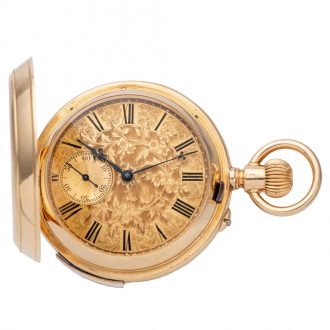
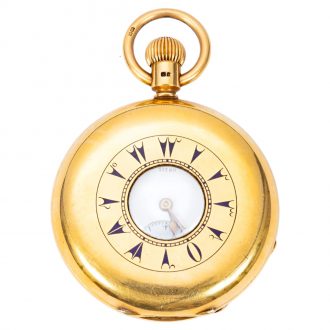
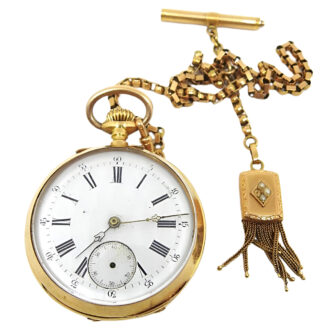
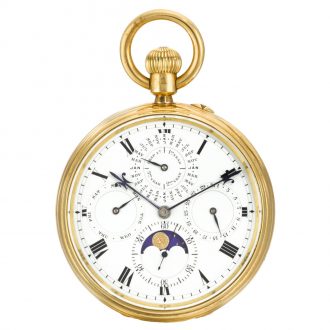
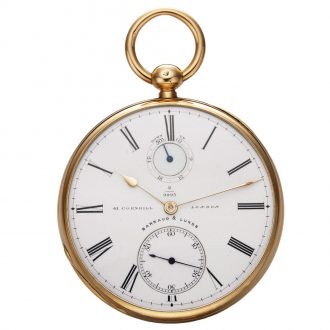
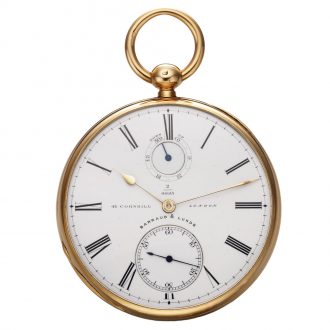
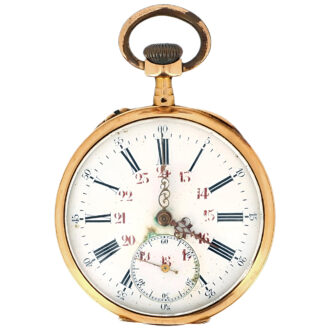
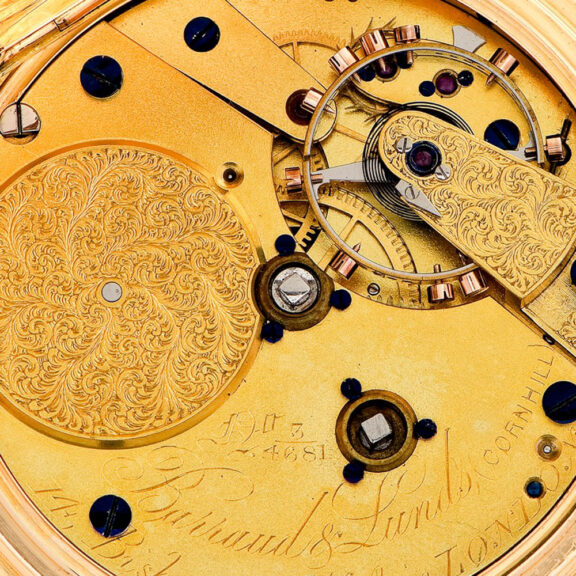
A large English 18 Carat pink gold hunting cased keyless pocket watch, circa 1900. With power reserve, free sprung balance and special winding. The case with London hallmarks for 1900 – 1901. The case is stamped with master mark JW, a thief proof swivel bow, a button for engaging the winding at 2 0’clock, the hand setting at 4 o’clock and a hinged gold cuvette. White enamel dial by Willis, radial Roman numerals, outer minute divisions, subsidiary seconds, power reserve indication at 12 o’clock and blued steel pear hands. A matte gilt, half plate movement, engraved barrel cap, 15 jewels, fusee and chain with Harrison’s maintaining power, lateral lever escapement, free sprung bimetallic compensation balance with gold temperature and meantime adjustment screws, blued steel balance spring with double overcoil, foliate engraved cock. Dial and movement signed.
–
Diameter: 55 mm
–
Signed: Barraud & Lunds London
–
The dial is slightly chipped.
–
The Barrauds, a family of watchmakers. Paul Philip Barraud was a prominent English watchmaker. He became well-known for the construction of chronometers. He was admitted to the freedom of the City of London and the Clockmakers’ Company on January 11th, 1796 by redemption. Paul Philippe became a Liveryman in 1796, entered the Court of Assistants in 1806, was Junior Warden in 1807, Renter Warden in 1808 and Senior Warden in 1809. He became a master in 1810 and repeated as a master in 1811. Paul Philip had three sons: Frederick Joseph, John and James. After a long and prolific life, Paul Philip died in 1820 and Frederick Joseph assumed management of the firm. Frederick Joseph was free of the Clockmakers’ Company in 1806. He took his son Frederick Philip and the son of his brother John, Hilton Paul, as his apprentices. John himself had only a minor role in the business and the youngest brother James did not follow the trade at all. In 1838, Frederick Philip joined in partnership with John Richard Lund, a horological inventor, the firm name became Barrauds & Lund. In 1846 Hilton Paul replaces his uncle, Frederick Joseph in the firm. Frederick Paul died on August 12th, 1849 and the business was renamed Barraud & Lund. Frederick Joseph died on September 4th, 1859.
Signed: Barraud & Lunds London
Share this page: