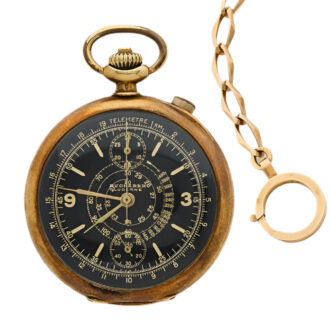
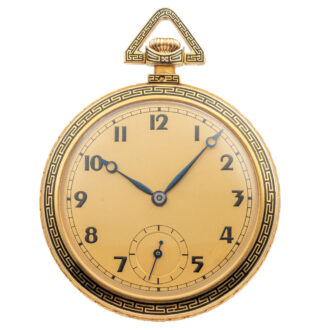
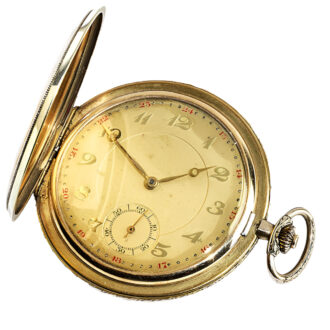
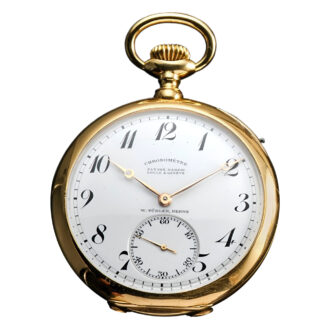
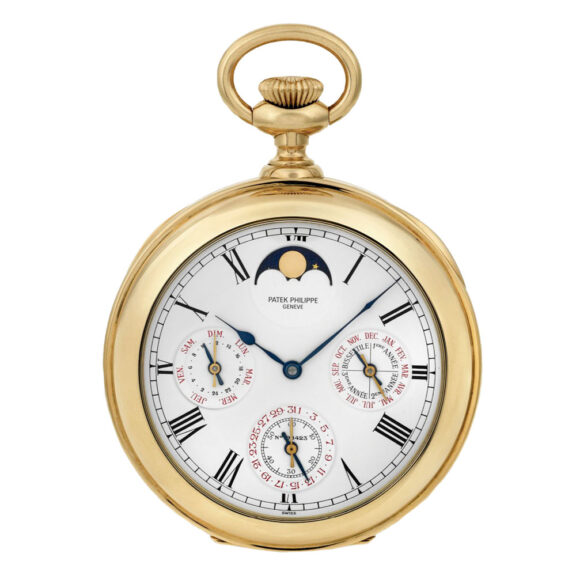
Historical and unique Swiss gold tourbillon watch Circa 1930
- Kenmerk
- TA3411
- Diameter
- 63 mm
- Estimate
- € 275.000 - 600.000
- Price sold
- € 300.900
Ultra high precision lever chronometer watch
–
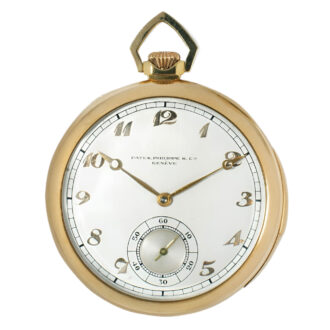
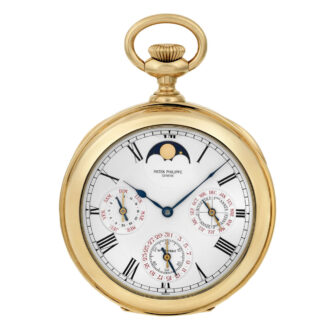
An exceptional, magnificent and historically important, large Swiss 18 carat yellow gold open faced keyless ultra high precision lever chronometer deck watch, circa 1930. A unique tourbillon watch with calendar and moon phases. Gold rimmed cuvette glazed with a sapphire crystal for viewing the movement. A 14 carat gold dial overlaid with simili enamel, radial Roman hour numerals, an outer minute track, subsidiary dials for the date concentric with seconds, days of the week concentric with 24 hour indication, the months concentric with a 4 year cycle, an aperture for the moon phases and blued steel hour, minute, 24 hour, leap year and date hands, and yellow gold seconds, days of the week and months hands.
–
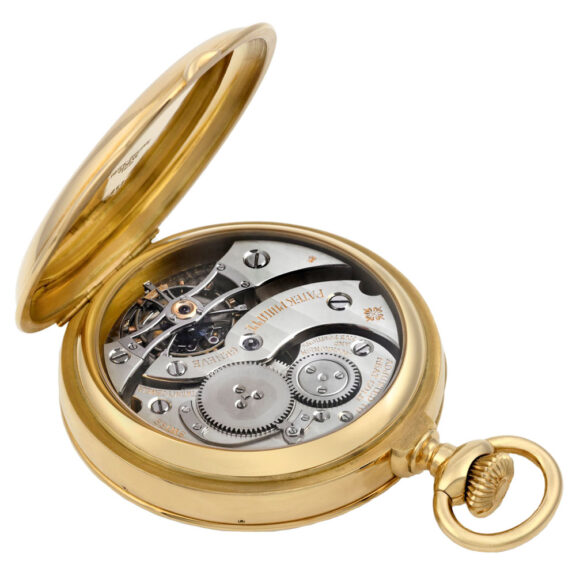
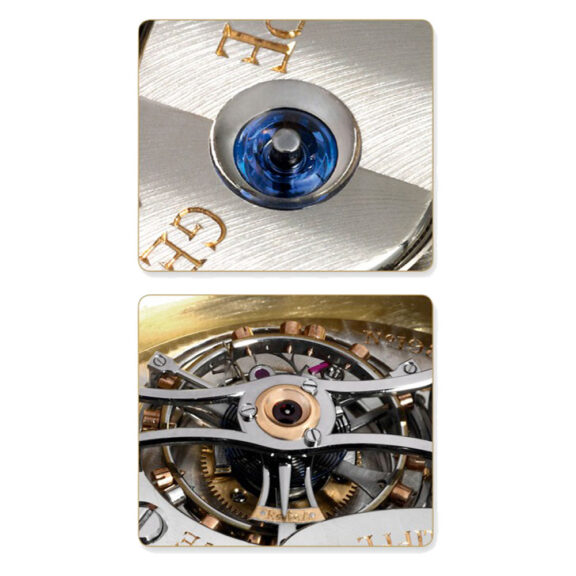
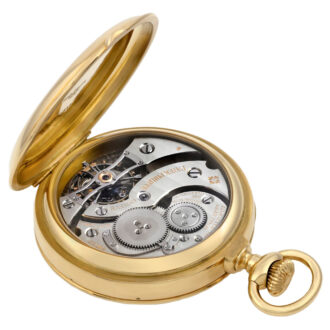
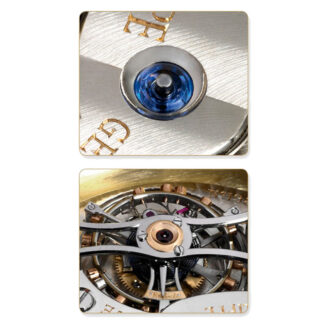
A rhodium plated movement, stamped twice with the seal of the Geneva quality mark, Geneva striping decoration, 20 jewels, the centre wheel jewel of blue sapphire, steel one minute tourbillon carriage by Hector Golay with three polished equidistant arms, lateral lever escapement, Guillaume balance with temperature and meantime adjustment screws, adjusted to heat, cold, isochronisms and five positions, blued steel Balance spring with Philips terminal curve, index regulator on the carriage, special polished steel double ended balance bridge secured by three screws, the upper balance pivot jewel in a gold chaton held by three screws. Dial, case and movement signed.
–
Thickness: 20 mm
–
Diameter: 63 mm
–
Signed: Patek Philippe Genéve
–
One of the world’s most accurate mechanical precision watches from the 20th century & multiple observatory prize winner, the national physical laboratory craftsmanship test record holder of 1954 with remarkable complete daily testing records between 1934 and 1954. The movement was constructed between 1930 and 1934, the tourbillon made by celebrated master watchmaker Hector Golay, and the perpetual calendar mechanism and case constructed between 1989 and 1990, sold on September 12th, 1991.
–
This Patek Philippe tourbillon is a highly important part of the history of mechanical precision timekeeping. It has a remarkable and distinguished list of successes at the Observatory trials in both Kew and Teddington in the UK and in Geneva. The movement was comprehensively and continuously tested almost daily for more than 20 years between 1934 and 1956, during this period it was regulated for trial by three of the most famous Patek Philippe regulars or precision timers: André Zibach, François Modoux and Henri Wehrli, the latter two being responsible for the regulation of most of the watches made by Patek Philippe for the legendary and exacting watch enthusiast Henry Graves Jr. The regulars were the highest-paid workers in the watch industry because success in Observatory trials conferred reputation and prestige on the brand and therefore greater commercial success.
–
The movement was made by Patek Philippe between the years 1930 and 1934 using a steel tourbillon cage made by Hector Golay and fitted with a Guillaume balance to reduce timekeeping errors caused by temperature fluctuation (middle-temperature error). The construction of the movement incorporates an unusual straight-line balance bridge not so far seen in any other known Patek Philippe tourbillon. Most other Patek Philippe tourbillons have an asymmetrical bridge with two arms on one side and a single arm on the other, the purpose of this more substantial bridge is likely to be to provide greater stability for the carriage in a watch that was from its conception always intended to be rigorously tested. Another rare feature is the blue sapphire jewel of the centre wheel used instead of the usual ruby red jewels, whilst this blue jewel has no technical advantage it is a feature known in less than five Patek Philippe watches to date and adds to the special nature of the watch.
–
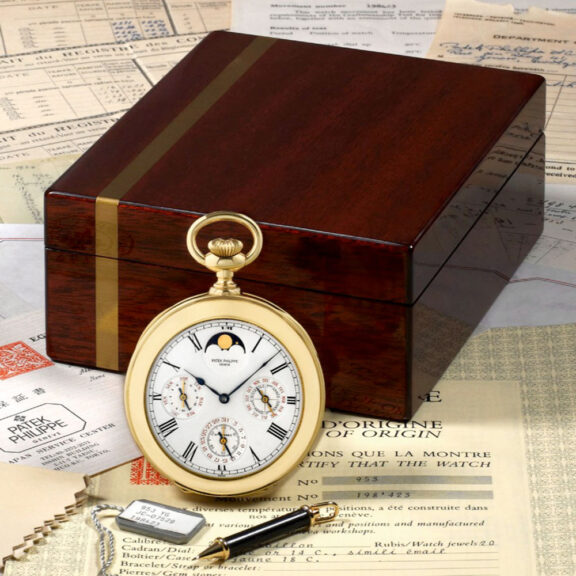
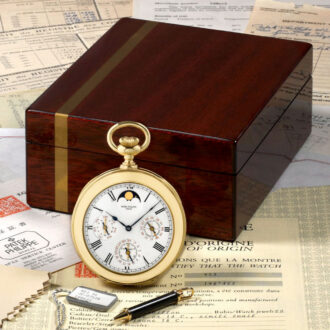
A remarkably detailed archive of original documentation recording the rating of movement has survived with the watch and the hand-written daily rating records show the timekeeping variations for almost every day over a twenty-two-year period from the 16th June 1934 until 28th August 1956. Upon its completion in 1934, the watch movement was sent to the Geneva Observatory for initial trial and then in November 1934 to the National Physical Laboratory in Teddington, England, where it appears to have remained under constant observation throughout the 1930s. It was during this period, in March 1938 that it was sent to Kew Observatory and achieved the first of four Kew class A ratings, the second was in October of that same year and a third was gained in April 1939. In July 1940 (perhaps due to the uncertainties of World War II) the watch was returned to Geneva Observatory where testing was resumed and continued for the remainder of the 1940s. By early 1950 watch No. 198423 was back at the National Physical Laboratory in Teddington and shortly after, in February 1950, it gained its fourth Kew class A rating. The four Kew A ratings were achieved with 94.3, 94.5, 95.9 and 96.5 out of a possible 100 points respectively.
–
Above all, perhaps what sets the watch apart from other highly-rated watches is its unprecedented success during the National Physical Laboratories. Craftsmanship Test which ran from 1951 to 1978 and was the most demanding of all watchmaking trials. Only eleven other watches ever passed this test and Patek Philippe movement No. 198423 was the only watch ever to achieve grade 1 for 5 of the 6 categories: Consistency of rate 1a. Mean rate per period at 20 degrees C 1b. Positional adjustment 1a. Temperature compensation 1a. A drift of rate 1a. Uniformity of rate during day 1a. At the end of this test, on 10th August 1954, this watch set the Craftsmanship Test precision record with a variety of overall rates during a selected 24-hour interval of 0.07 seconds. Later in the 1950s, the watch was sent back to Geneva and submitted for trial. Circa 1955 it was submitted on at least three occasions and achieved 807 points (regulated by Modoux), 822 points (Modoux) and 834 points (Zibach). It was again submitted in 1957 when it gained 52.25 points out of a possible 60 in category A.
Signed: Patek Philippe Genéve
Share this page: