Swiss gold chronometer made for the Hispanic market Circa 1875
- Kenmerk
- TA2220
- Diameter
- 53 mm
- Estimate
- € 45.000 - 80.000
- Price sold
- € 56.050
Gold watch with one-minute tourbillon
–
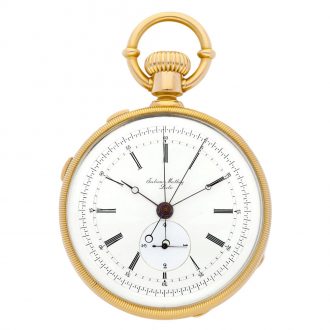
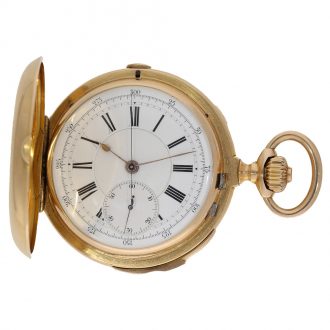
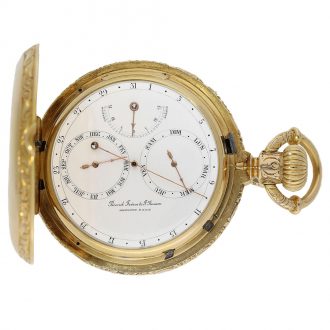
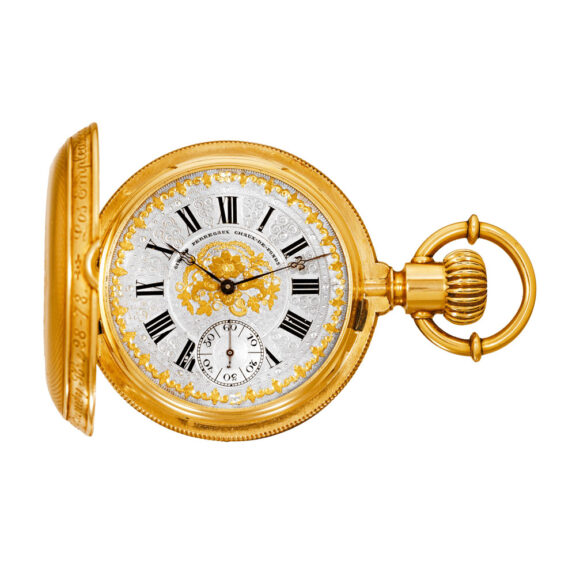
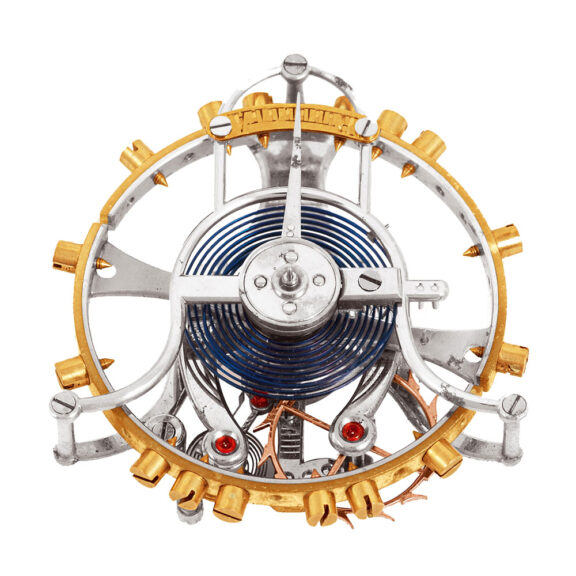
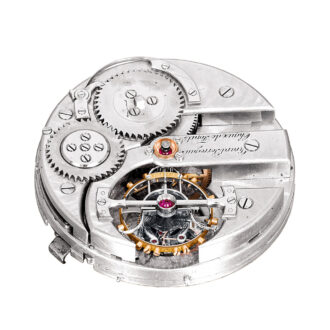
A very fine Swiss, 18K gold, hunting cased, keyless pocket chronometer, circa 1875. With one-minute Guinand type II tourbillon regulator. Made for the Hispanic market.
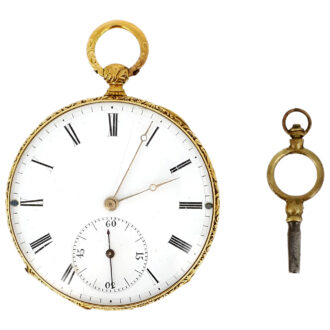
A massive case, engine-turned with a ribbed band, the cover centred with a monogram, the band of the front cover inscribed Los Empleados del Ferro-Carril de Pisagua a su Jefe Sr. Dn. Gmo. Grundy. Sbre.28-78. Hinged gold cuvette with engine-turned and chased foliate border, glazed gold-rimmed cover to view the movement.
–
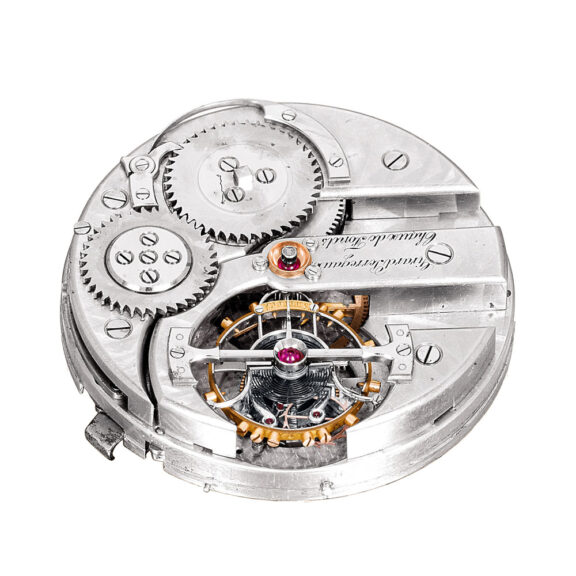
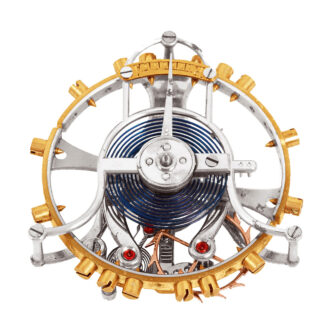
Silver dial with painted radial Roman numerals, outer dot minute markers and subsidiary seconds, the centre and outer border decorated with cast and engraved gold foliage. Blued steel pierced tulip hands. A nickel-plated movement, geometric decoration, gold wheel train, 15 jewels in gold chatons, wolf’s tooth winding, Swiss pivoted detent escapement, cut bimetallic compensation balance with gold screws, blued steel Breguet balance spring with perpendicular stud for preventing excessive amplitude, Guinand type II polished steel tourbillon carriage with gold index scale. Dial cuvette and movement signed.
–
Diameter: 53,5 mm
–
Signed: Girard-Perregaux Chaux-de-Fonds
–
Ernest Guinand (c. 1810-1879). Guinand was an important Master Horologist from Le Locle, who, along with Auguste Grether from Ponts-de-Martel (1817-1879), specialized in the production of tourbillon carriages. According to the records of the Neuchâtel Observatory, Guinand’s production of tourbillons began between 1865 and 1867. He designed three models of Tourbillon carriages, always based on an A-shaped frame. He worked for several important makers, including Girard-Perregaux and Montandon. Most of Guinand’s carriages were equipped with a pivoted detent escapement, one with spring detent and some with lever escapement. Most of his carriages were not signed and can only be identified by their characteristic A-shape. In 1864 Patek Philippe chose him to build their first tourbillon regulator.
Signed: Girard-Perregaux Chaux-de-Fonds
Share this page: