Swiss gold repeating automaton The Barking Dog Circa 1810
- Kenmerk
- AS1906
- Diameter
- 39 mm
- Estimate
- € 50.000 - 100.000
- Price sold
- € 79.750
Small gold, enamel, and pearl set open faced pocket watch
–
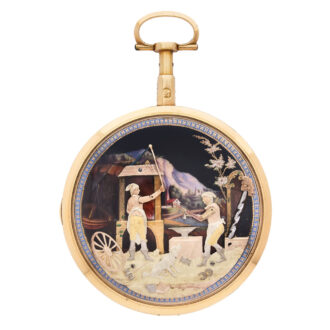
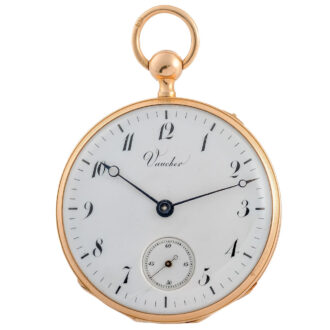
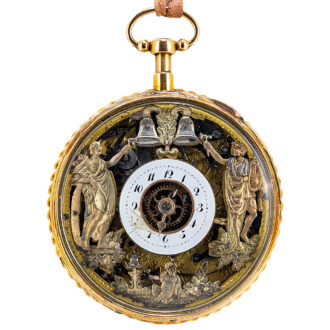
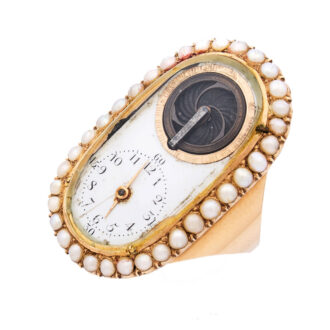
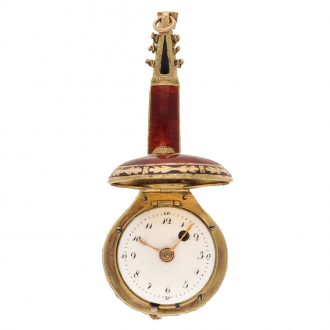
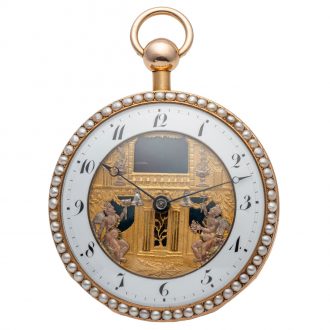
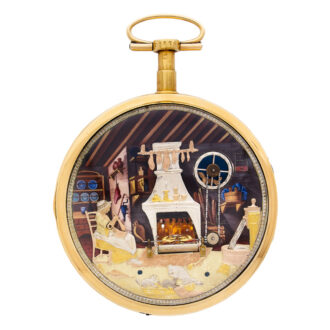
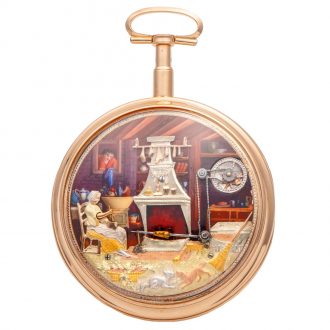
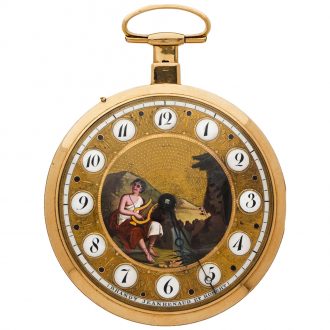
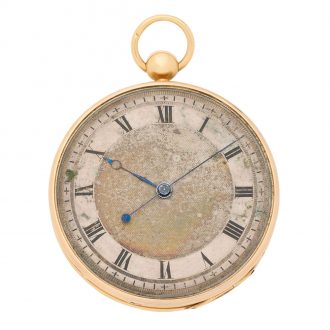
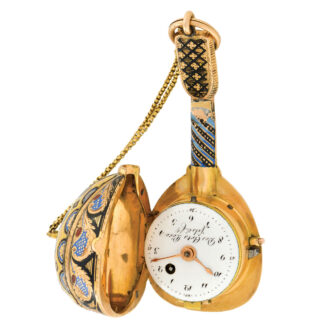
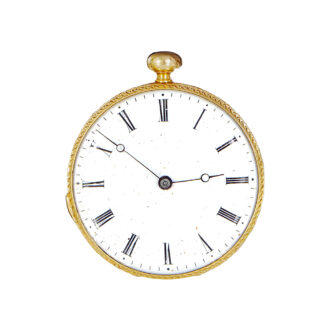
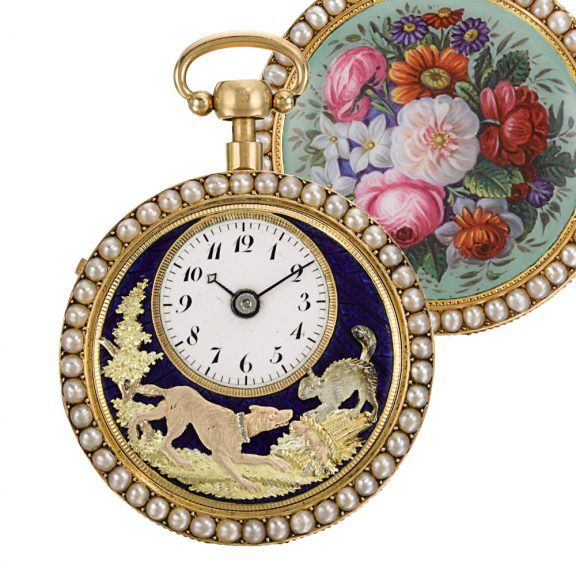
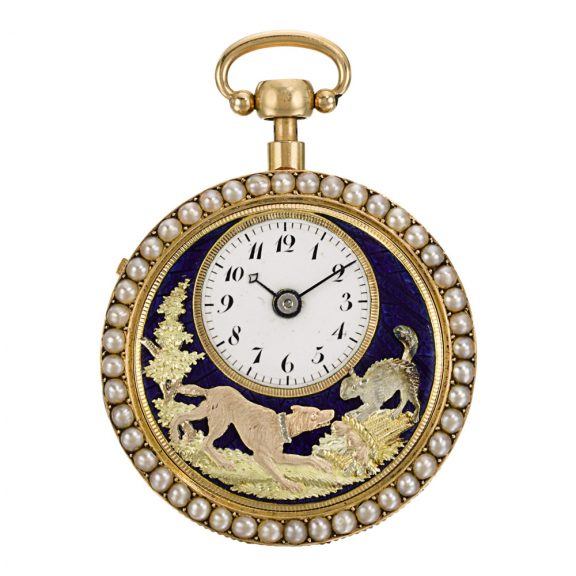
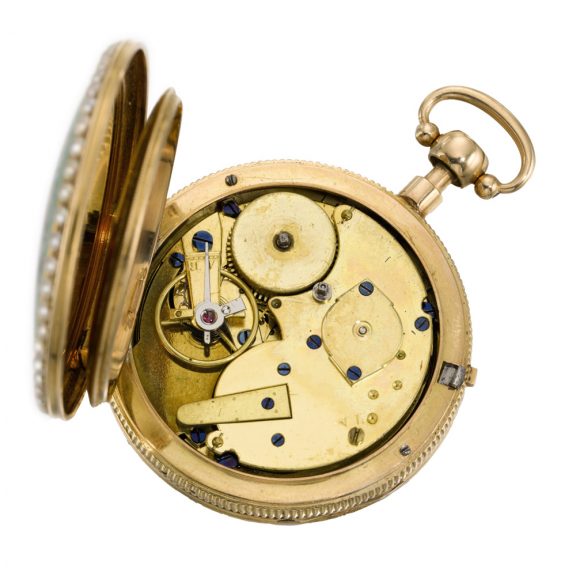
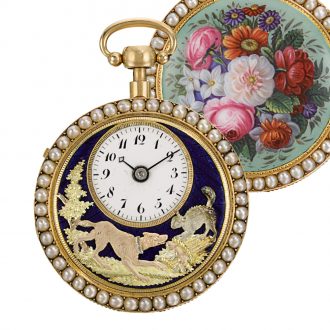
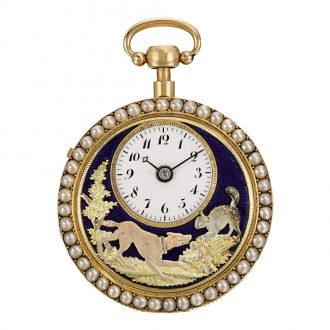
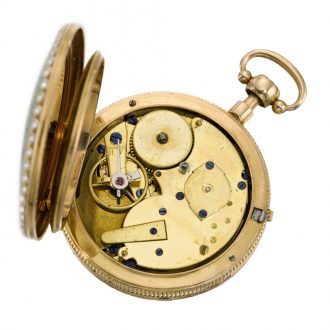
A very fine, rare, and small Swiss gold, enamel, and pearlset open faced quarter repeating automaton watch made for the Chinese market by Piguet & Meylan, circa 1810. This watch features a gilded half plate movement with a cylinder escapement and a plunge repeat that activates the quarter repeating and the bellows for the Barking Dog feature. The eccentric white enamel dial has Arabic numerals and a translucent blue enamel background, with a varicoloured gold scene depicting a dog barking at a cat. The dog’s head raises and lowers while barking to indicate the hours and quarters, and the cat moves its tail from side to side.
–
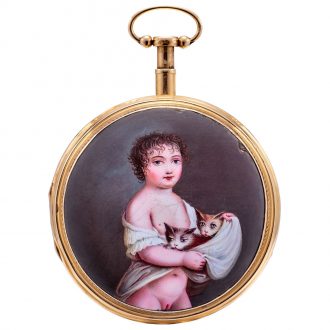
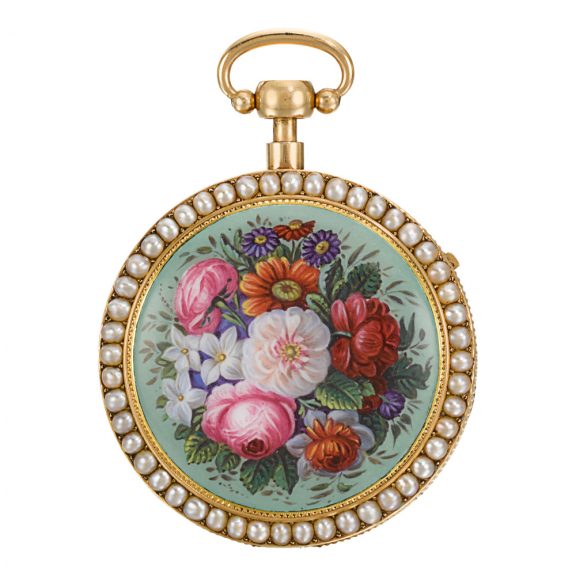
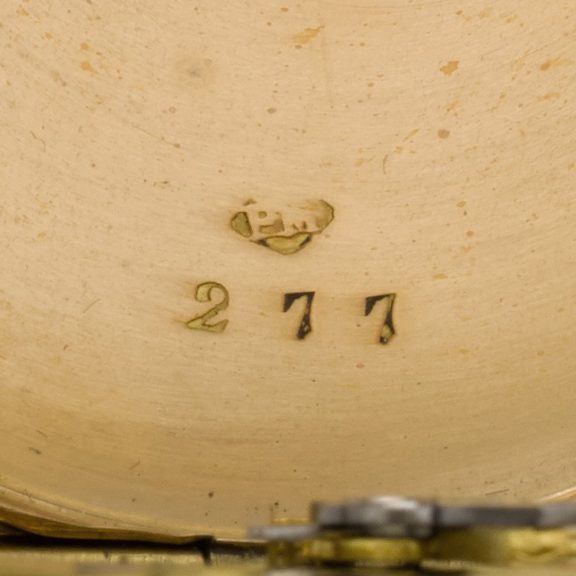
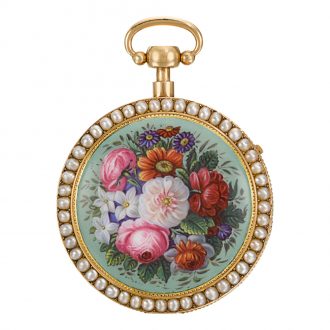
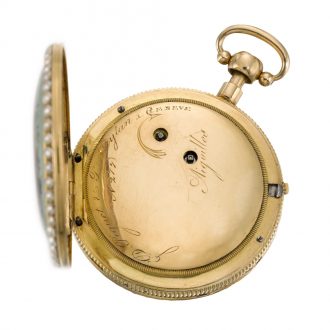
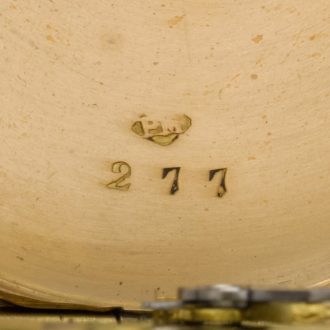
The gold case has a reverse with polychrome enamel painted summer flowers against a light green enamel ground, both bezels set with pearls, a reeded band with an opening panel at the base for the bark, a gold cuvette stamped PM within a lozenge shaped cartouche for Piguet & Meylan, and cover, cuvette, and bezel numbered 277. Additionally, it comes with a later associated gold and enamel key.
–
Diameter: 39 mm
–
Signed: Piguet & Meylan
–
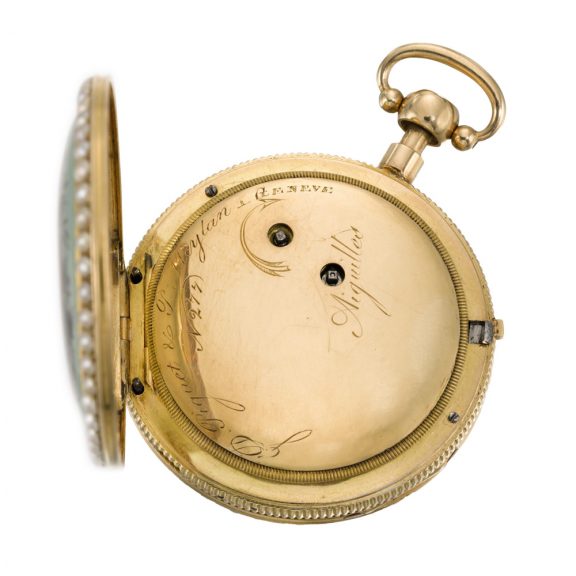
The movement is running. The dog automaton barks the hours and quarters, although it may benefit from servicing. The blue enamel dial has been restored, but it now has small scratches to the enamel. There is tarnishing to the automaton cat. The case has a couple of small scratches to the floral enamel panel. There are light scratches to the cuvette. In addition to the original maker’s stamp PM for Piguet Meylan and the original stamped number, which are both on the inside of the cuvette, the front of the cuvette appears to have had a further script form signature added later, which reads: “J. [sic] D. Piguet & P. Meylan, Geneve, N 277.” The associated key is worn and only adjusts the hands; it does not wind the mechanism.
–
A rare type of repeating watch, the ‘Barking Dog’ sound is cleverly produced by a set of bellows activated by pressing the pendant, marking the hours and quarters. The mechanism applies sharp pressure on miniature bellows connected to a whistle, vented through an aperture that opens to the lower edge of the case.
–
Only about 20 ‘Barking Dog’ automata watches are known, most large (approximately 59 mm in diameter). The present watch measures just 39 mm in diameter and is one of only four known examples of this small size. These watches typically feature a dog attacking a swan or other bird, a theme believed to be inspired by 1740s paintings by Jean Baptiste Oudry. In contrast, all four small ‘Barking Dog’ watches depict a dog barking at a cat, likely based on a design by painter Johann Wenzel Peter (1745–1829). These small watches, all by Piguet & Meylan, are numbered between 275 and 282. Two of these show the cat on the left side of the scene, while the other two show the cat on the right. Below is a summary of the four:
1 – Piguet & Meylan, no. 275 (cat on the left), Sotheby’s New York, 11 June 2015, lot 113
2 – Piguet & Meylan, no. 277 (cat on the right), Present Watch
3 – Piguet & Meylan, no. 280 (cat on the right), Sotheby’s New York, December 7, 2016, lot 229
4 – Piguet & Meylan, no. 282 (cat on the left), Antiquorum Geneva, 2 June 2007, lot 311
–
The renowned Bohemian painter Johann Wenzel Peter (1745–1829), who lived and worked in -Rome from 1774, specialised in depicting animals in conflict. His design of a dog barking at a cat (though not identical to this) was frequently copied by Roman mosaicists after it was first recorded in the studio of mosaicist Puglieschi in 1805/6. An example signed by Gioacchino Barberi (1783–1857) is set into the lid of a contemporary gold box by A.J. Strachan, London, 1807/8, now in the Gilbert Collection, London (Charles Truman, The Gilbert Collection of Gold Boxes, vol. I, Los Angeles, 1991, p. 328, no. 113). Another example in a private collection, signed by mosaicist Domenico Moglia (1780–1862), is also set into the lid of a snuff box by Strachan, again of 1807/8; the base features a micro mosaic of a dog barking at a swan. It is plausible that Piguet & Meylan were aware of these fashionable mosaics, as many were bought as plaques by travellers on the Grand Tour and mounted by Geneva gold box makers.
Signed: Piguet & Meylan
Share this page: