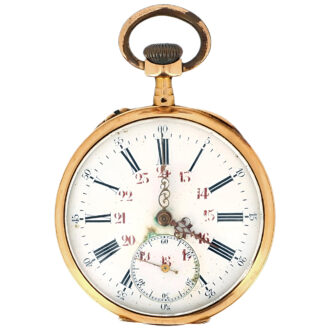
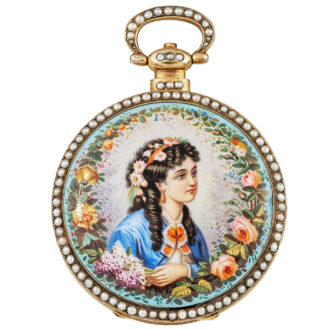
Swiss centre seconds duplex for Chinese market Circa 1860-1880
- Kenmerk
- AA0257
- Diameter
- 63 mm
- Estimate
- € 17.500 - 35.000
- Price sold
- € 33.400
Gilt silver and enamel pocket watch by Frédéric Bovet
–
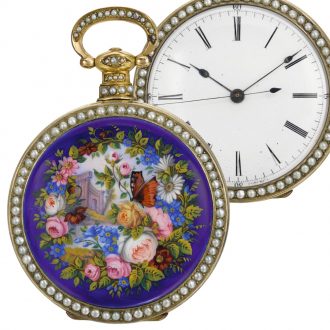
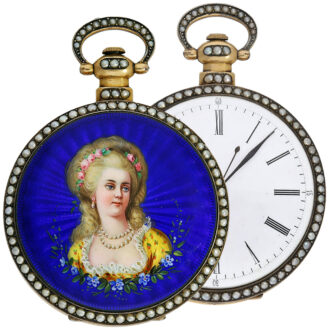
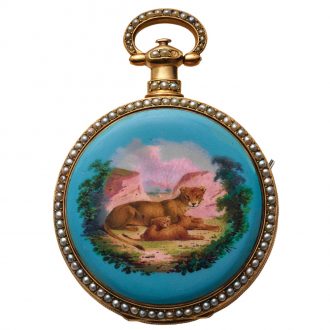
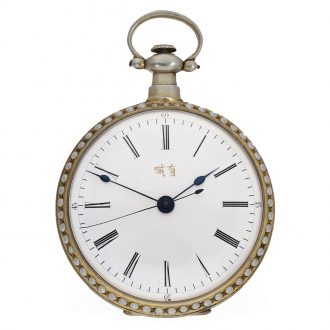
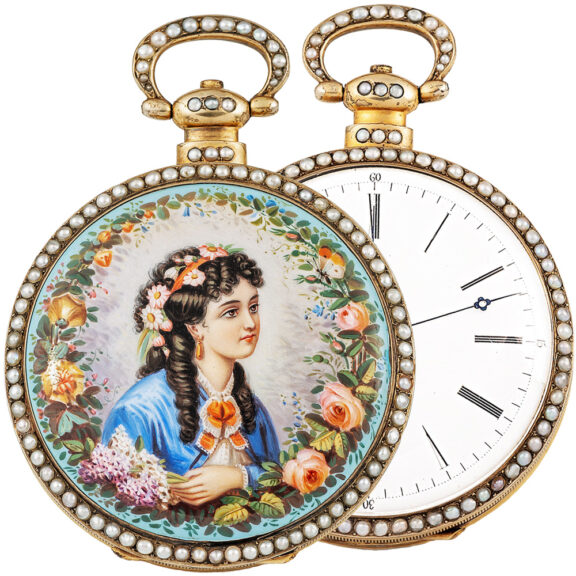
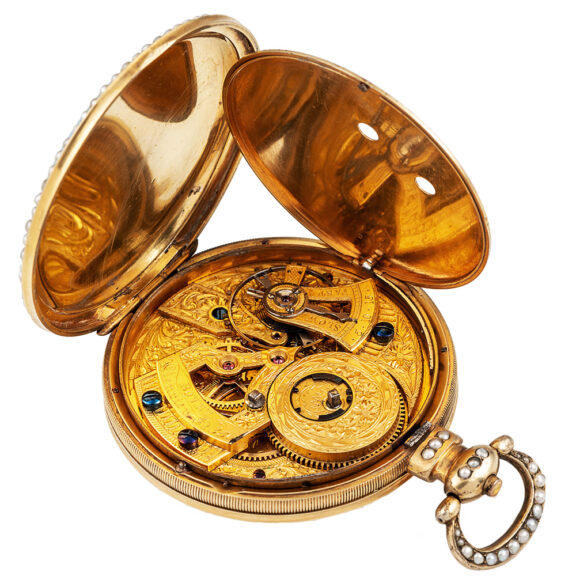
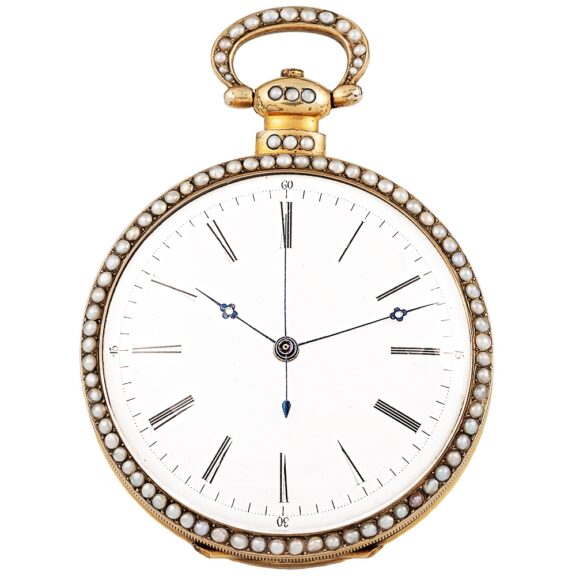
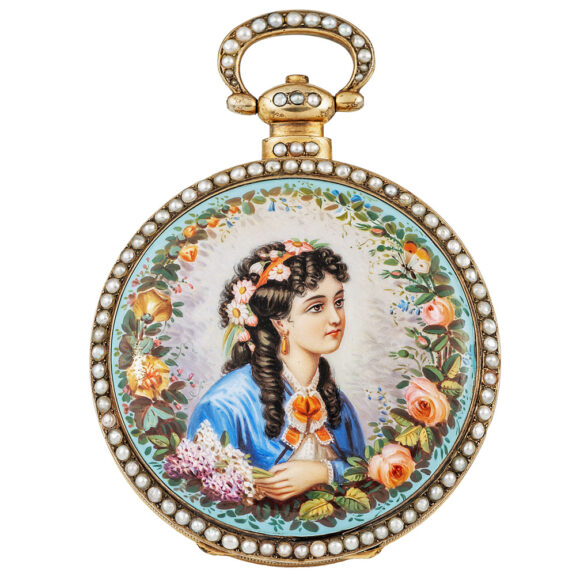
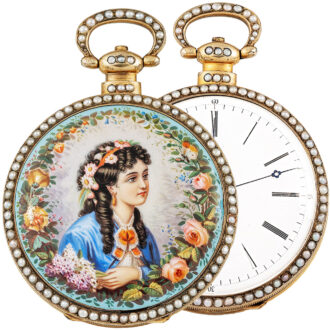
An extremely fine Swiss rare, unusual and oversized gilded silver and enamel open faced centre seconds key wind duplex pocket watch made for the Chinese market with a special calibre and balance, circa 1860-1880.
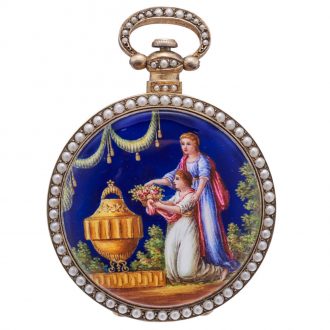
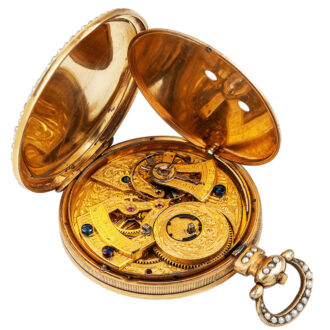
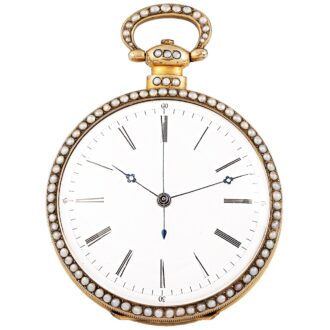
The case back with a polychrome enamel portrait, probably Geneva, of a young Western woman with a melancholy air in the bust looking to the right on a vegetal ground in an entourage of flowers from which a butterfly (the symbol of fragility) emerges, a fluted band, the bezels, pendant and bow set with half-pearls. White enamel dial with Roman hours, outer minutes/seconds track with Arabic fifteen-minute numerals, centre seconds and decorative hands. Signed gilded brass movement, engraved in Chinese style, going barrel, duplex escapement, compensated balance with gold poising screws, blued steel flat hairspring.
–
Diameter: 62.5 mm
–
Signed: Bovet
–
This watch is a rare example of an oversized Chinese movement in which the balance wheel is bimetallic. It’s extremely rare to find a watch typically made for the Chinese market with such a subject.
–
Bovet is one of the most important Swiss watchmaking dynasties having worked for the Chinese market. Founded by siblings, the children of Jean-Frédéric Bovet (1758-1818), a watchmaker from Fleurier, Val-de-Travers and Julie Yersin (1763-1837) from Môtiers, married in Fleurier on July 28, 1781. These children were Charles-Frédéric (1786-1846), Charles-Alphonse (1788-1850), Gustave (1790-1835), Edouard (1797-1849), Charles-Henri (1802-?) and Julie-Caroline Bovet (1807-?). The three brothers, Frédéric, Alphonse and Edouard, first set up a business in London in 1814-1815, making watches for the local market.
In 1818, Edouard was hired by the Maison Magniac to be a watchmaker for them in China, in Canton. Thus, at the age of 21, on April 20, 1818, he embarked aboard the ‘Orwell’, of the East India Company, the fastest ship of the moment. On August 16, 1818, the ‘Orwell’ anchored at the Tiger Gate after “un voyage assez pénible et le plus court qui ait jamais été fait” (a rather painful and short trip that has ever been made), a journey of 119 days. Edward notes in his logbook: “On ne peut pas se faire une idée de la quantité de bateaux qui se trouve dessus cette rivière, tout ce peuple vit dessus l’eau, car il n’y a pas assez de place dessus terre ; la rivière est plus large que la Tamise par place. Canton est une vilaine ville […], tout est vilain et puant…” (One can’t get an idea of the quantity of boats on this river, all these people live on the water, because there is not enough space on the ground, the river is wider than the Thames by place. Canton is a nasty city […] everything is ugly and stinky…). In a few years, after having realised the great possibilities of the Chinese market, the Bovets established their own company.
–
On May 1st, 1822, Edouard, remaining in Canton, signed a partnership contract with his brothers Frédéric and Alphonse, working out of London, and Gustave, out of their hometown, Fleurier, for the export of watches from London. The youngest Bovet brother, Charles, later joined the company as well. Edouard Bovet notes that not only Mandarins but all of the Chinese are fond of watches. He wanted to sell quality watches at affordable prices to the rest of the population, who were often neglected by the luxury market. Fleurier became the manufacturing centre of the Chinese watch.
–
The Bovets boosted the economy of Val-de-Travers, in 1840, no less than 175 watchmaker workshops worked for the Bovets in Fleurier, Saint-Sulpice and Bayards. The Bovets were the first to write their name in Chinese on watch dials. The brand became so famous that the word “Poway”, rather than “Bovet”, according to the Chinese pronunciation, became the synonymous of “watch” for the Chinese. Among the signatures on these watches, one often finds the name Bovet translated into Chinese, as well as the name “Tevob” (“Bovet” spelt backwards). In 1830, Edouard left China, returning to Fleurier with his Chinese son Edouard-Georges (1826-1894), born of a Chinese mother, after becoming a very rich man in the Orient. Edouard, who is nicknamed Bovet-de-Chine, following his participation in the liberal insurrections of 1831, must go into exile in Besançon, Doubs, France and relocate part of his industry. On September 25, 1847, he married in England, in Middlesex (London), Constance Ellen Meunier (1815-?), originally from Pontarlier, Doubs, France. He would return to Fleurier only in 1848 after the establishment of the Republic following the Revolution of March 1st, 1848, in Neuchâtel, which ended the reign of the King of Prussia on the Principality of Neuchâtel. He died one year later. In 1840, Bovet Frères et Cie was established in Fleurier, later including Frédéric Fritz Bovet (1824-1913), son of Alphonse Bovet. In 1864, the Bovet watch production was sold to Bovet’s manufacturing inspectors in Fleurier, Jules Jéquier and Ernest Bobillier, soon joined by Ami Leuba. In 1888, Bovet Frères was founded under the direction of Alexis Landry, who served his apprenticeship in Fritz Bovet’s workshop in Fleurier, still producing ebauches for Chinese watches and silver cases. Alexis Landry partnered with Albert and Jean Bovet, specialising in complicated watches and chronographs.
–
In 1901, the Bovet trademark was acquired by César and Charles Leuba, sons of Ami Leuba. In 1918, Jacques Ullmann & Cie of La Chaux-de-Fonds bought the Bovet brand from the Leuba brothers, and in 1948, Favre-Leuba took over the company and acquired the first production plant. In 1966, Favre-Leuba sold the Fleurier plant, and in 1989 Michel Parmigiani acquired the Bovet name. A limited company registered as Bovet Fleurier S.A. was formed in 1990, using the Bovet trademark. In 1994, Roger Guye and Thierry Oulevay (1956-2013) bought Bovet Fleurier S.A. and opened a branch in Geneva. Pascal Raffy became the majority shareholder and President in 2001. Today, Bovet 1822 timepieces are widely available in the world’s major destinations. Eager to maintain its historical roots in the Far East, the company has subsidiaries in Hong Kong and Japan and delivers its collection to select distributors in Singapore, Taiwan, the Middle East, Turkey, Russia, the United States, London, and Geneva.
Signed: Bovet
Share this page: