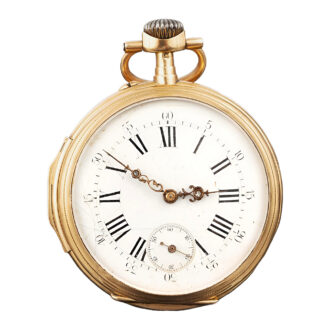
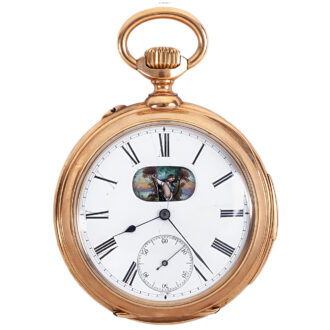
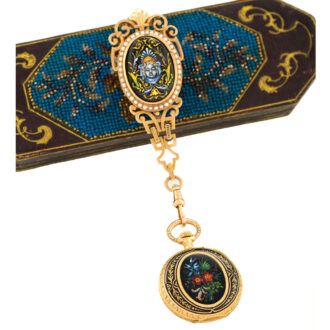
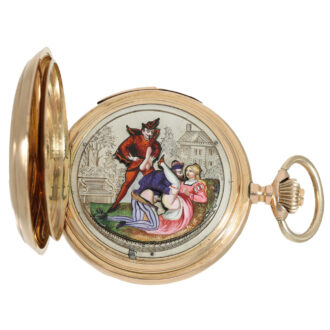
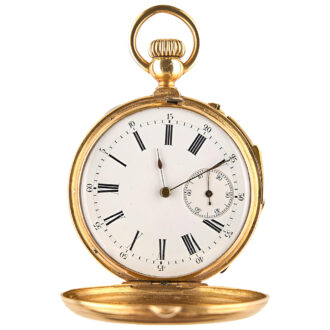
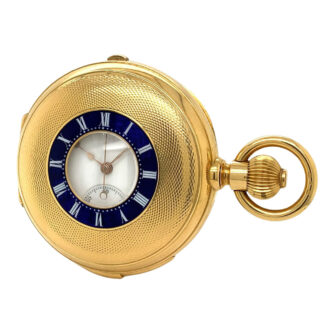
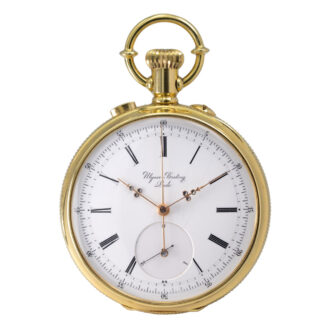
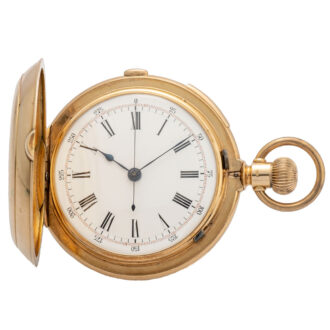
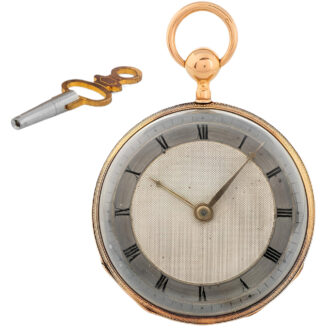
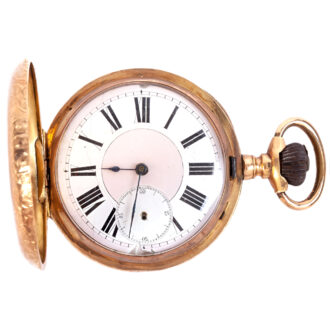
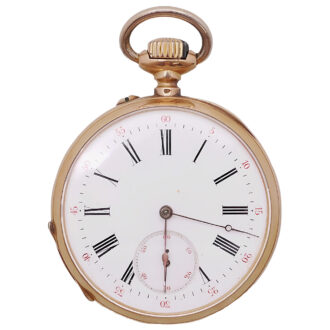
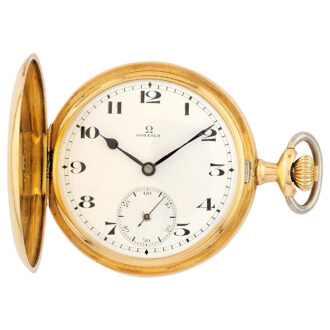
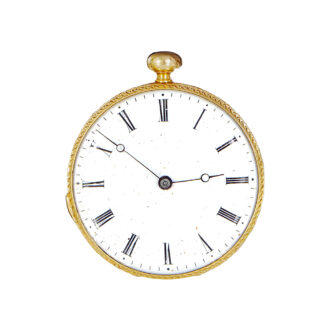
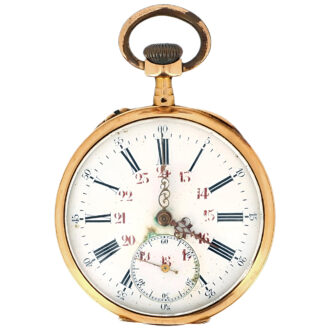
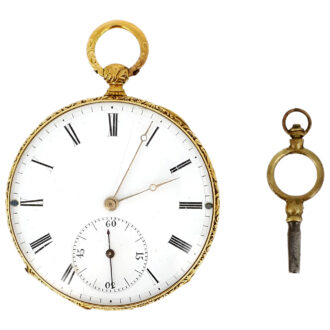
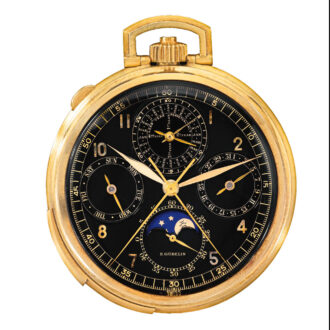
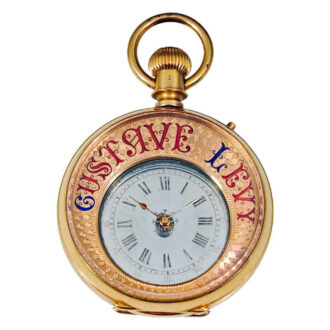
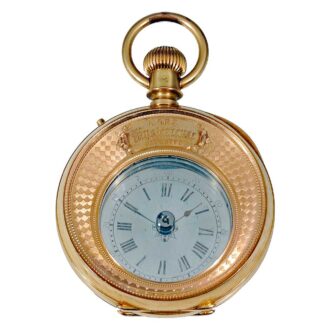
Very rare Swiss gold double sided mystery watch Circa 1890
- Kenmerk
- AD0566
- Diameter
- 53 mm
- Estimate
- € 10.000 - 17.500
- Price sold
- -
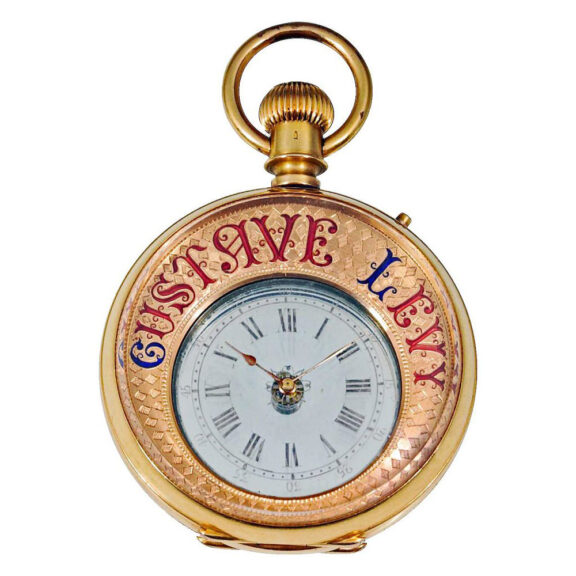
Mystery watch in gold and with owners name, very rare
–
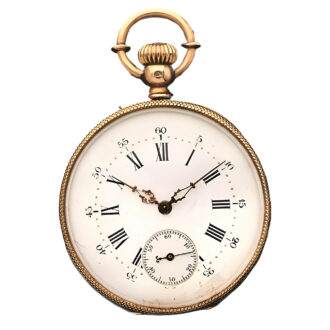
A unique example of an unusual gold pocket watch with hands moved by rotating glass discs and lavishly engraved bezel with blue and red signature “Gustave Levy”. Only a few watches of this type were produced in gold, circa 1890.
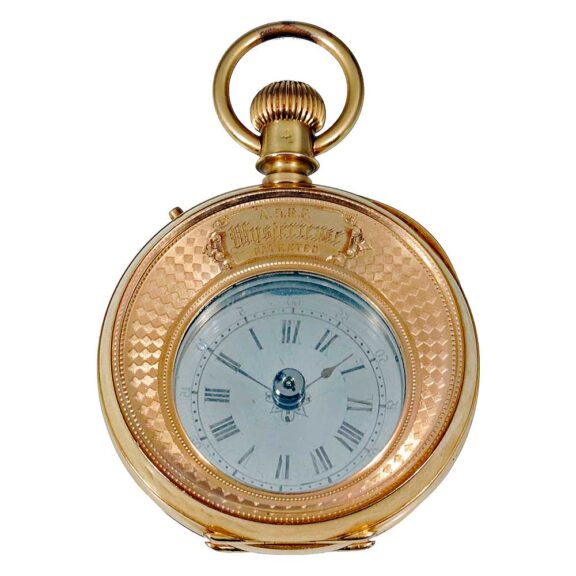
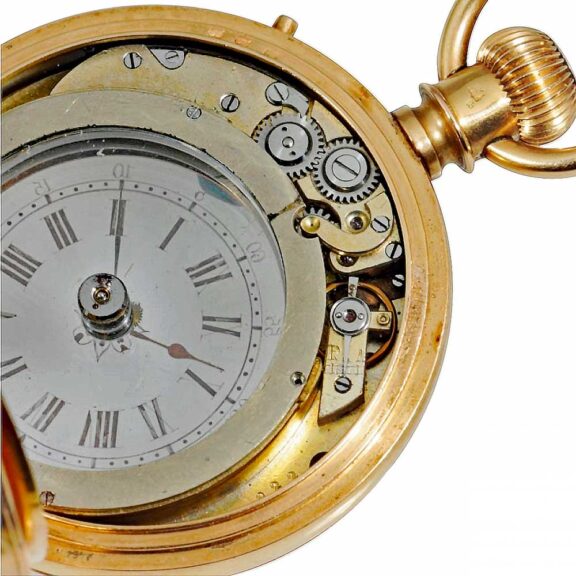
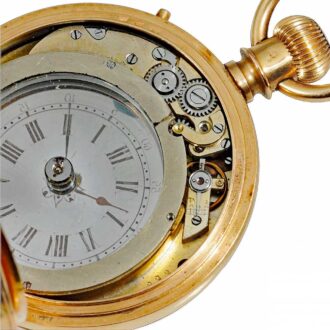
The gilt cylinder movement relegated to the crescent shaped portion of the watch between the glass dial and the pendant. Keyless with going barrel, the crown turning in one direction only. Small plain three arm gilt balance with blue steel spiral hairspring, polished steel regulator. Polished steel cylinder and steel escape wheel. Glass dial with gilt Arabic numerals and minute ring, decorative engraved gold masks.
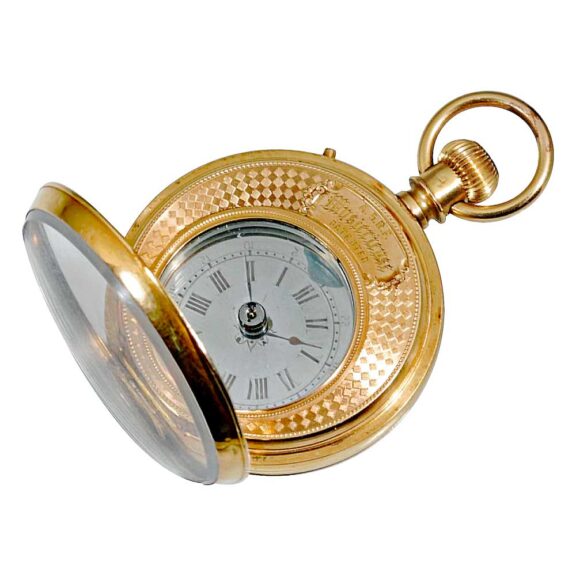
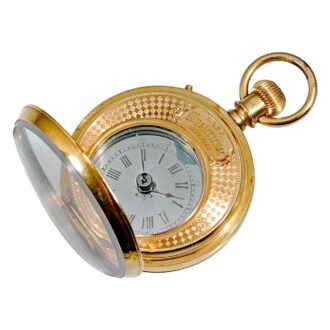
The blue steel hands are driven by a glass disc which has a toothed brass wheel attached to its outer edge engaging the train. The miniature motion work for the hands is set between another glass disc and the dial. There is no provision to set the hands apart from moving them manually, which is common in these watches. Plain gold case glazed back and front. Rectangular button in the band to release the sprung front cover, gold crown and bow.
–
Diameter: 53 mm
–
Weight: 98 g
–
Signed: A.S. et F. Mysterieuse Brevete
–
See the Camerer Cuss Book of Antique Watches page 258 for a similar watch. The mystery of hands moving without being attached to any clockwork mechanism is similar to clocks invented by Jean-Eugène Robert-Houdin. The patent for the watch was taken out by Armand Schwob et Frères in 1888.
–
Some words about Gustave Levy prove the popularity of the artist at the time: “Mr. G.J. Levy devotes much attention to the graceful utilities of the drawing and dining rooms. Many of his exhibits show the influence of good Art on objects of daily use, as well as on those of costlier and more elaborate character.”
Parisian bronze sculptor, manufacture and publisher, Gustave Levy was the successor of the famous founder Vittoz. The latter sold his workshop to E. de Labroue in 1852 who in turn gave it over to Gustave-J. Levy around 1855. The workshop, situated at 29 rue Sevigne, was specialised in the production of clocks, candle sticks, vases, lamps, statuettes and busts. Often the models were of works of famous sculptors James Pradier, Charles Cumberworth, Francisque Duret, Alexandre Schoenewerk and Albert-Ernest Carrier-Belleuse.
–
For the World Exhibition in London in 1862 and the one in Paris in 1867, the Levy house won a bronze medal. It also presented at the World Exhibition in Vienna in 1873, where it won a medal of merit. Its biggest award was a gold medal during the 1878 World Exhibition where it exhibited a large Renaissance candlestick stand with seventeen lights. The reputation of the company was so great that one finds a fireplace decoration with clocks and candle sticks, signed by G.J. Levy and having belonged to the president of the United States of America Grover Cleveland. Today it is conserved at the Hoffman Clock Museum in Newark.
In 1881, the Levy company came under the direction of Emile Vie before being taken back by Emile Colin in 1882.
–
A chip in the glass, about 5 mm.
Some very small dents in the band, overall in a very good condition.
Signed: A.S. et F. Mysterieuse Brevete
Share this page: