1,151 watches in this selection. The chronometer escapement is one of the most precise escapements.
Marine chronometer in mahogany box – A very high quality marine chronometer made by Kelvin, White & Hutton in London, England, circa 1920. The numbered brass case, fitted into a three part mahogany box with recessed brass carrying handles and the original ivory company plate, with a gimbal…
Marine chronometer with power reserve – A marine chronometer with 56 hour power reserve indicator made by Alexander Dobbie & Son in Glasgow, Scotland, circa 1870. The case of the watch was crafted from brass and mounted in a gimbal suspension. The numbered silvered dial has Roman hour…
Marine chronometer with power reserve indicator – A fine, 1st quality, early version marine chronometer with original key made by the Glashütter Uhrenbetriebe Sa in Glashütte, circa 1953. The watch’s brass case is mounted on a gimbal suspension in a mahogany wooden box. The numbered, silvered dial, marked GUB…
Deck chronometer made for the German navy – An extremely fine chronometer made for the German Navy by Franz Lidecke in Geestemünde, Germany, circa 1925. The original numbered mahogany box consists of three sections, one of which is glazed and holds the watch mounted in a gimbal suspension.
Bakelite deck chronometer – A rare marine chronometer with navy deployment number made by A. Lange & Söhne in Glashütte, Germany, circa 1943. This chronometer has a bakelite case and is fitted in a numbered wooden box with gimbal suspension. The numbered white enamel dial has Arabic…
Bakelite deck chronometer – A marine chronometer with the original winding key made by A. Lange & Söhne in Glashütte, Germany, circa 1940. This chronometer is housed in a durable, black bakelite case set within its original glazed wooden box, which features carrying handles on both sides…
Gold chronometer in the manner of Earnshaw – A historically interesting pocket chronometer in the manner of Earnshaw made by John Gibson in London, England, circa 1810. The heavy case, which was crafted from 18 carat gold, opens on both sides, is punched LC and bears London Hallmarks…
Gold and enamel pocket watch – A highly interesting hunting cased pocket chronometer made for the Cuban market by Benoit Guinand in Switzerland, circa 1865. The extremely heavy, solid 18 carat gold case has a floral relief band and both sides have a monogram on a blue enamel…
Gold John Arnold type chronometer – A rare and excellently preserved John Arnold type chronometer made by David Morice in London, England, circa 1813. The case of this watch, which was crafted from 18 carat gold, can be opened on both sides, has London Hallmarks for 1813 and…
Gold hunter with pivoted detent escapement – A Swiss 18 carat gold keyless pocket watch made for the South American market by Paul Jeannot in Geneva, Switzerland, circa 1890. A fine gold hunting cased keyless pocket watch, cover and caseback engine turned. On the inside, and has an…
Gold open faced chronometer – An English 18 carat gold open faced keyless wind chronometer pocket watch made by Frodsham in Liverpool, circa 1856. The gilt ¾ plate movement with an Earnshaw style spring detent escapement, free sprung cut and compensated bimetallic balance, gold compensation screws, helical balance…
Gold pivot detent chronometer – A Swiss 18 carat gold open faced chronometer pocket watch with day and date indication made by Henry Capt in Geneva, circa 1860. Gilded bar movement with a pivoted detent chronometer escapement and bimetallic compensation balance. The cuvette engraved with technical details.
Gold heavy watch with spherical hairspring – A very fine chronometer pocket watch in its original presentation box made by Girard-Perregaux in La Chaux-de-Fonds, Switzerland, circa 1885. The numbered case of this watch was crafted from 18 carat gold, has a coined band, a monogram in a…
Unusual pair of deck watches – An extremely unusual pair of chronometer deck watches, made for the navy, by Julius Assmann, Glashütte I/Sa, Germany, circa 1915. The numbered plain cases of these watches were crafted from silver and their white enamel dials feature Arabic hour numerals,…
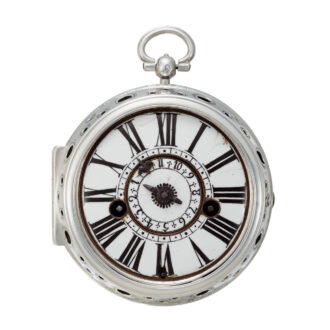
Important chronometer in a case hinged on both sides. – An important early 2nd quality chronometer, assembled by John Arnold in London, England, circa 1783. The case of this watch was crafted from silver by William West, has London Hallmarks 1783 and is hinged on both sides.
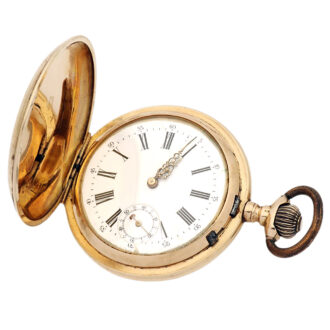
Pocket case watch with chronometer escapement – A Swiss gold full hunter cased watch with a chronometer escapement, made in Switzerland, circa 1900. The, on both sides, engine turned full hunter case of this watch has three gold lids all crafted from 14 carat gold and its numbered…