Highly important Swiss gold pocket chronometer Circa 1860
- Kenmerk
- BA0798
- Diameter
- 53 mm
- Estimate
- € 90.000 - 150.000
- Price sold
- -
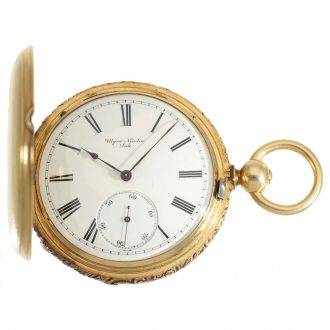
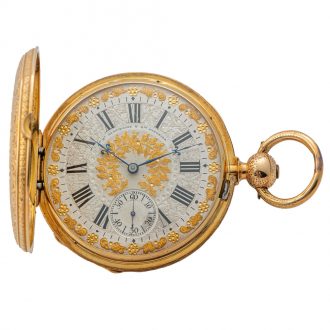
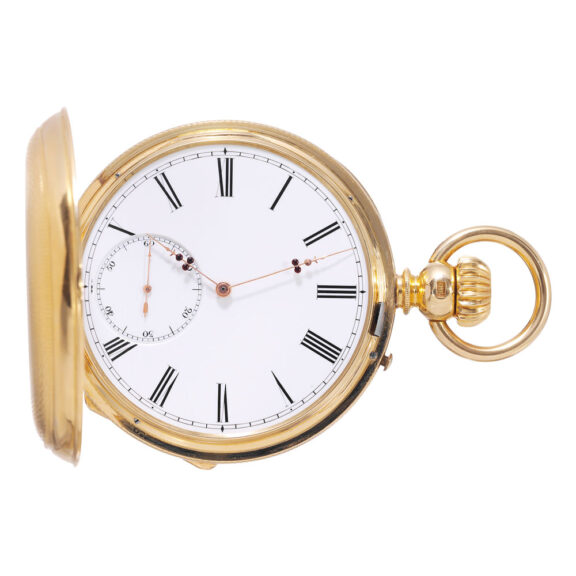
Gold hunting case chronometer with one minute tourbillon by Patek Philippe
–
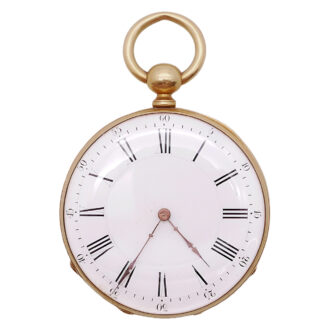
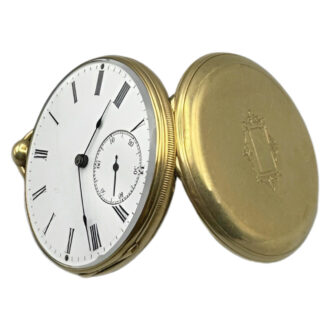
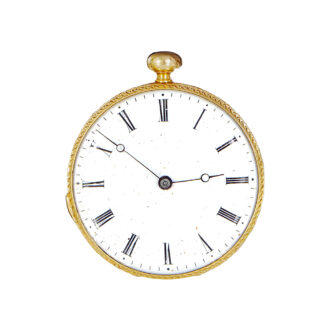
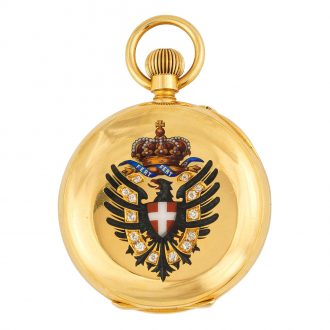
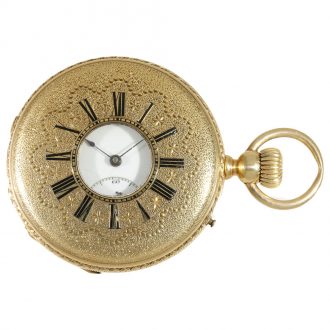
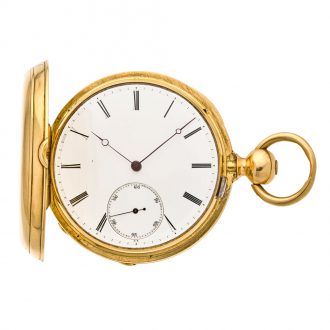
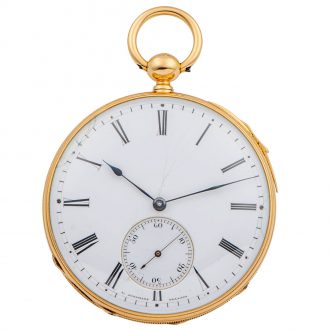
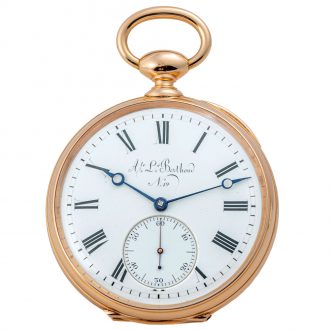
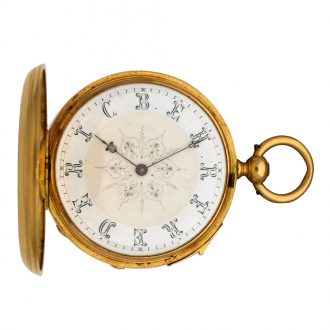
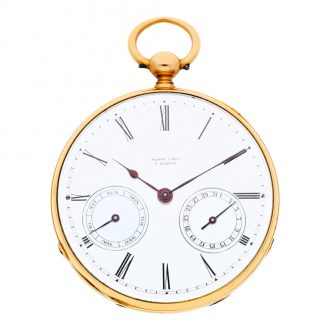
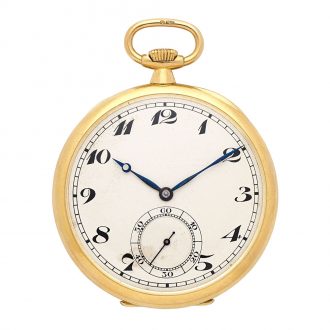
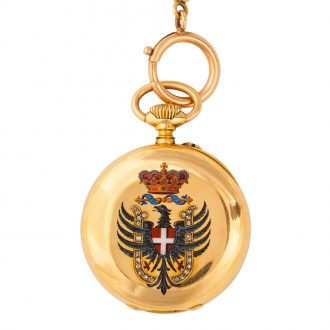
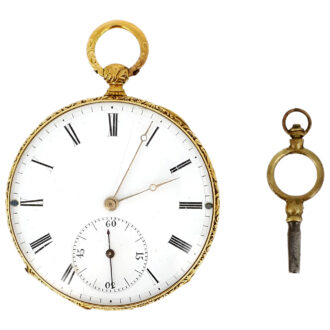
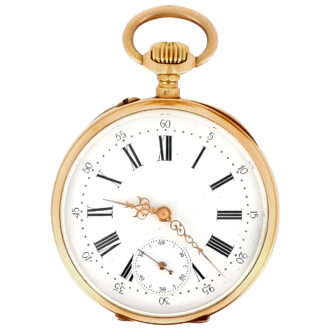
A very fine and highly important Swiss 18 carat gold hunting cased keyless pocket chronometer with one minute tourbillon regulator, circa 1860. Maillchort movement, spotted back plate, bridge caliber decorated with zig-zag decoration, 19 jewels, wolf’s tooth winding, 3 armed steel tourbillon carriage with two straight arms and one lyre shaped, pivoted detent escapement, detent held in locking position by a long thin spring, gold escape wheel, cut bimetallic compensation balance with gold temperature and meantime adjustment screws, blued steel balance spring with terminal curve and amplitude controlling device. Gold hinged cuvette with engine turned border. White enamel dial with Roman numerals, outer minute track, subsidiary seconds at 9 o’clock and original gold paste set hands. Engine turned case with polished borders, engine turned band. Cuvette signed by watchmaker, case numbered and punched with Neuchâtel mark, movement numbered and punched W. Hoff Chaux-de-Fonds on the dial plate.
–
Diameter: 53 mm
–
Signed: Patek, Philippe & Cie Genève
–
This watch bears only the casemaker’s and watchmaker’s numbers and not the Patek Philippe serial number. Patek Philippe watches without company serial numbers are very rare, but they do exist. In the Patek Philippe Museum there is a carriage clock which the company probably made for the 1851 London Exhibition, a beautiful clock which is not numbered. Two other unnumbered pieces were sold by the company, fortunately they are accompanied by the original Patek invoice, dated February 4, 1853. So we know that there are other Patek Philppe watches without Patek Philippe serial numbers.
–
The 1860’s were a period of great expansion in the history of Patek Philippe. After their remarkable success at the 1851 Exhibition, where Queen Victoria and Prince Albert bought Patek Philippe watches, the company’s reputation was firmly established and orders, more and more challenging, were flowing in. The company had to find a reliable source for tourbillon watches, which industry, at the time, was centered in La Chaux-de-Fonds and Le Locle. It is only natural to assume that the company therefore contacted the few watchmakers capable of making tourbillons, to determine the quality of their work and their reliability, etc. In the end, their choice fell on Ernest Guinand, who in 1864 made the first recorded Patek Philippe with tourbillon regulator, serial No. 25298. But what about the other watchmakers who must have been contacted before Guinand. It seems likely that Patek Philippe ordered a tourbillon watch from Hoff as a preliminary before placing a firm order for a series of watches. One imagines that under the circumstances, the watchmaker would engrave the case with his client’s name, and leave an empty space for the serial number. Although a few Patek Philippe watches are known with the ebauche maker’s punch mark on the movement, this is a rare occurrence. It may be that the company did not appreciate Hoff’s signing the watch without their permission, even though it was under the dial, despite his excellent capacities as a watchmaker. This analysis would not be complete without addressing the question of illicit imitation. We know, without a shadow of a doubt that this watch is legitimate, for forgery carried very stiff penalties. This is best demonstrated by the Patek Philippe lawsuit against A. Schwob & Frère for forging Patek Philippe’s signatures. Patek won and was awarded 15,000 francs for damages. Every watchmaker was aware of the penalties incurred by anyone who was foolhardy enough to make a watch under false pretences. Certainly no watchmaker as talented and reputable as Hoff would risk his reputation and livelihood in a contest he was bound to lose. In conclusion, we suggest that the present watch was made for Patek Philippe and that, for some unknown reason, the watch was not recorded in the registers.
–
Wilhelm (Guillaume) Hoff. A very capable maker. Although not many signed pieces of his are extant, the ones that are known clearly show great talent. In ‘Le Tourbillon’, page 348, R. Meis lists Hoff’s tourbillon regulator with spring detent escapement. This piece, with its superbly finished tourbillon carriage, pivoted detent escapement and amplitude controlling device, is extremely convincing proof of Hoff’s talent.
Signed: Patek, Philippe & Cie Genève
Share this page: