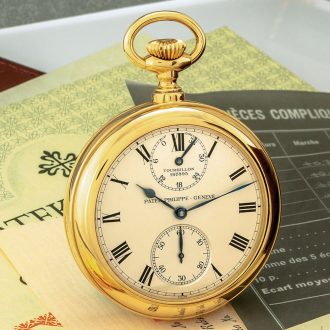
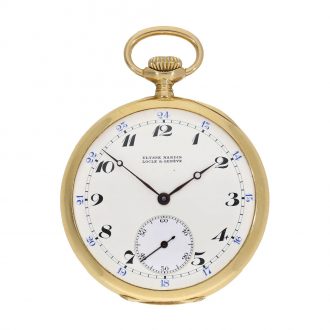
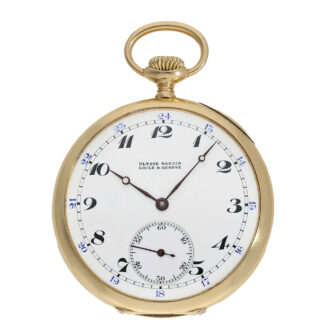
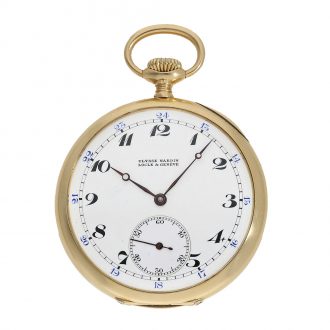
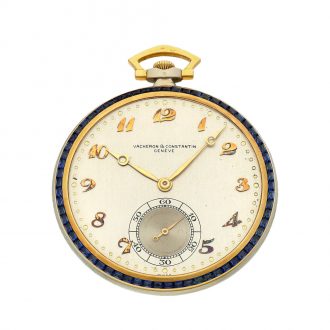
Fine Swiss 18K gold ultra complicated thin watch Circa 1924
- Kenmerk
- FA9305
- Diameter
- 51 mm
- Estimate
- € 250.000 - 750.000
- Price sold
- € 862.000
Gold unique complicated lever watch
–
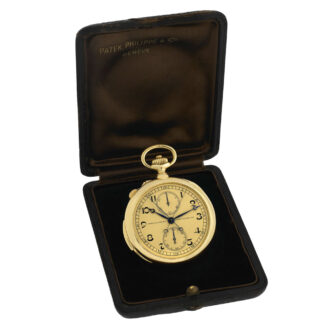
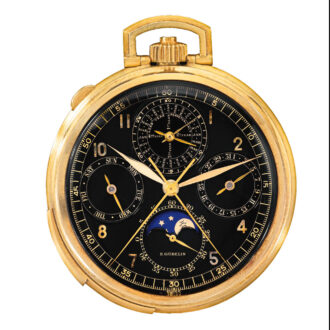
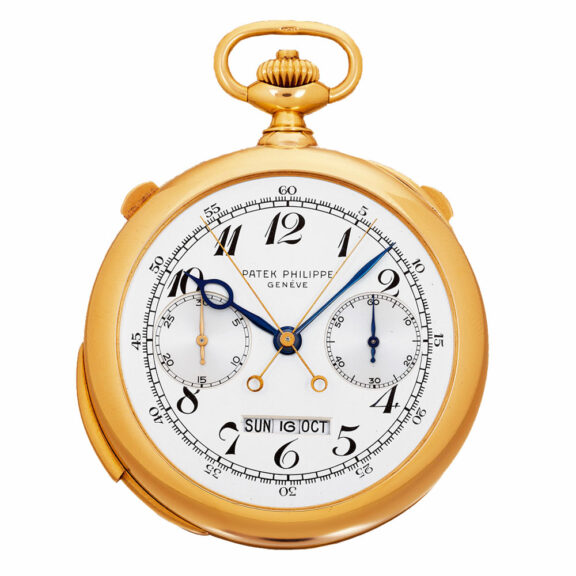
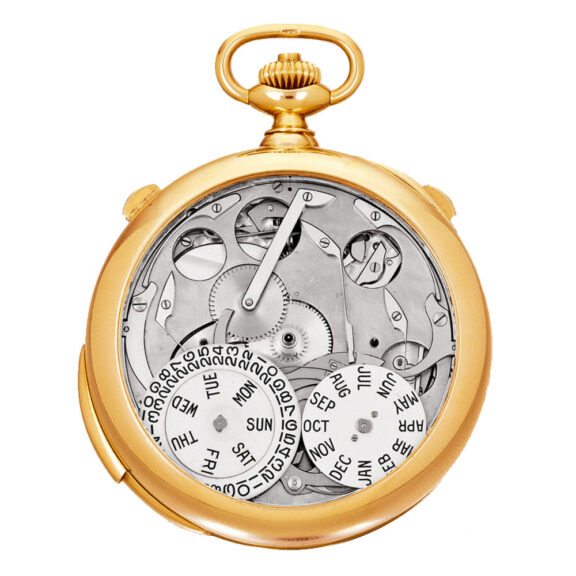
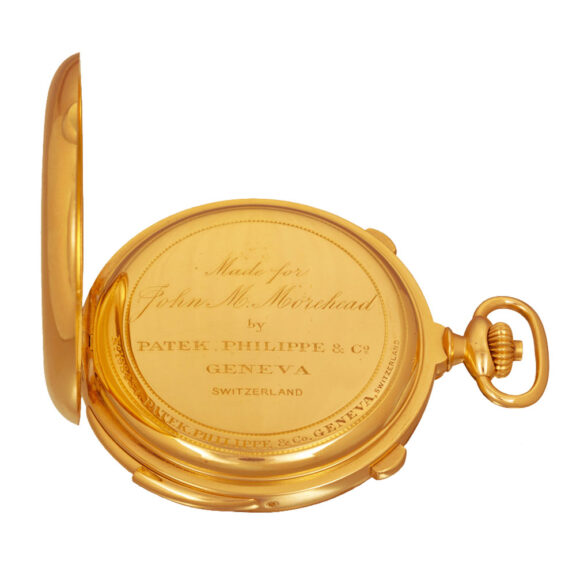
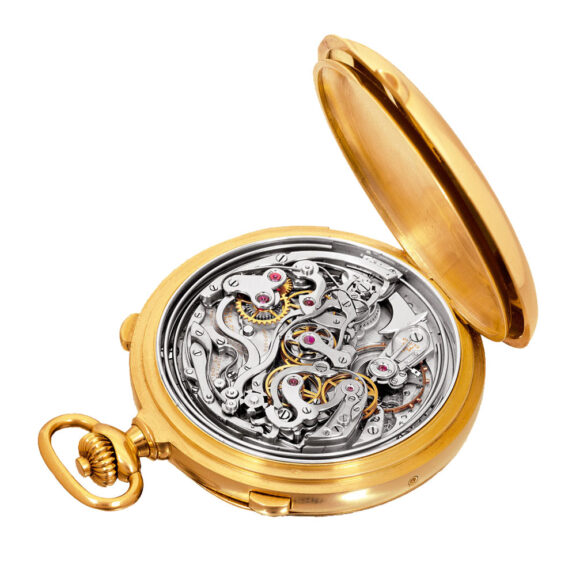
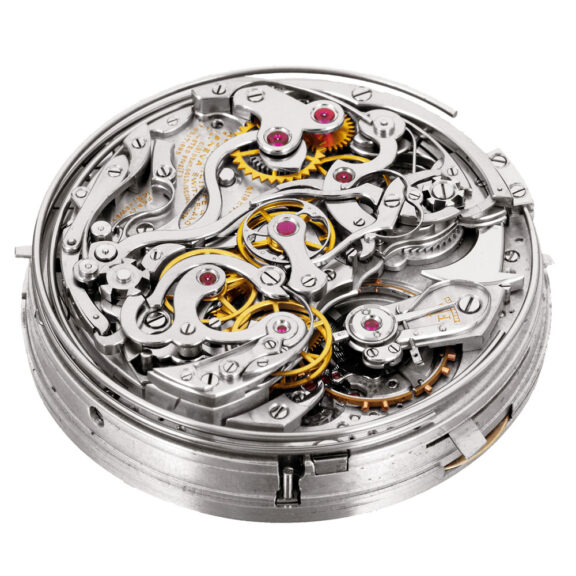
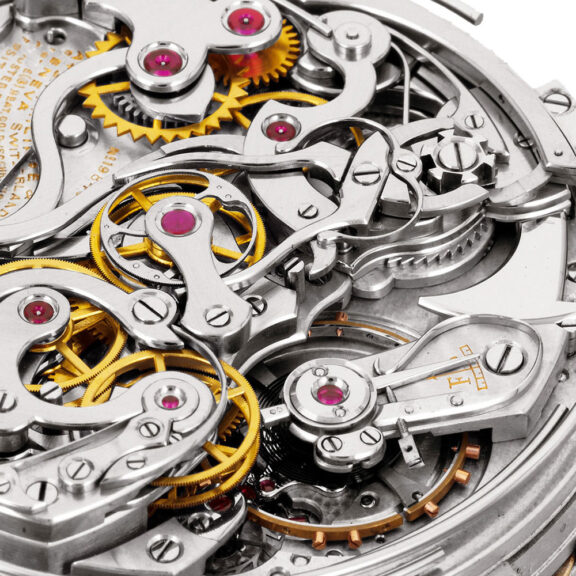
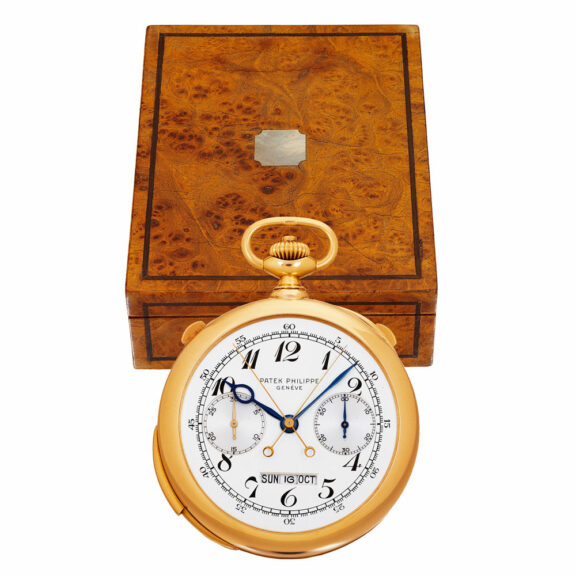
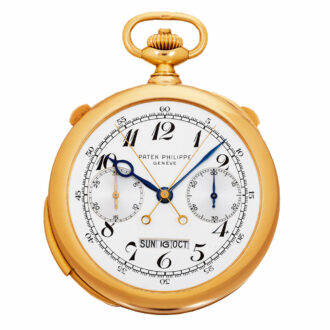
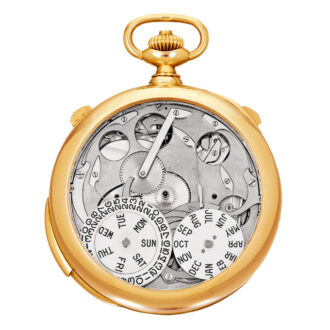
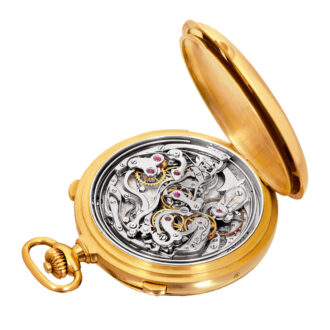
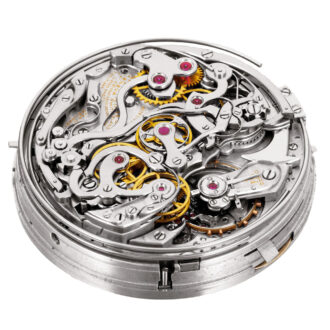
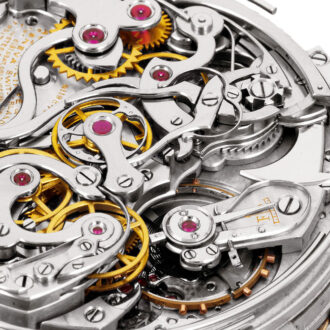
An exceptionally fine, unique and thin Swiss ultra complicated 18 carat gold open faced carillon minute repeating pocket watch with double chronograph, independent split second function, 30 minute register and American perpetual calendar especially made for John M. Morehead III, circa 1924. The rhodium plated movement with 46 jewels, a counterpoised straight line lever escapement, cut bimetallic compensation balance adjusted to heat, cold, isochronism and five positions, blued steel Breguet balance spring, swan neck micrometer regulator, repeating the minutes with three hammers on three gongs activated by a slide in the band, two visible independent chronograph mechanisms and an independent 30 minute recorder.
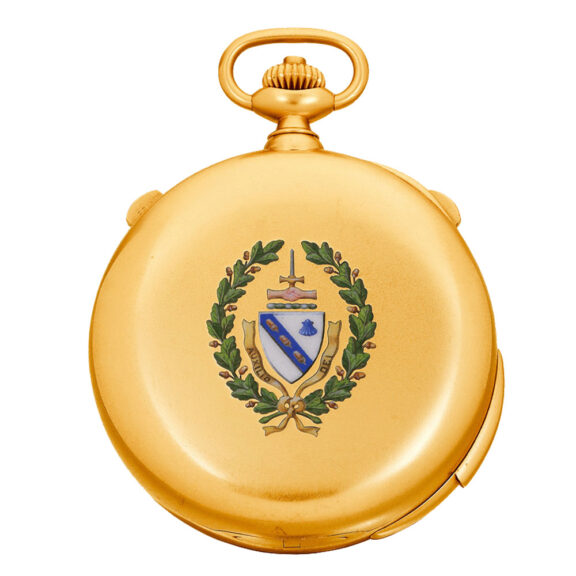
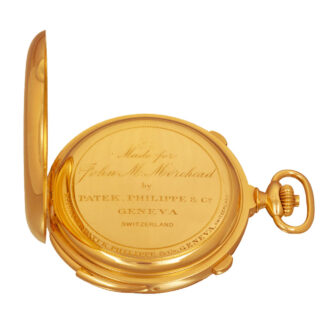
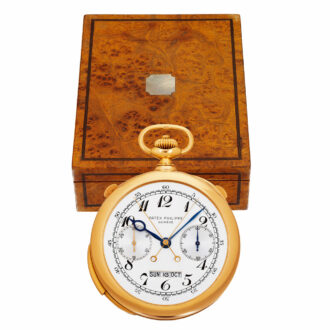
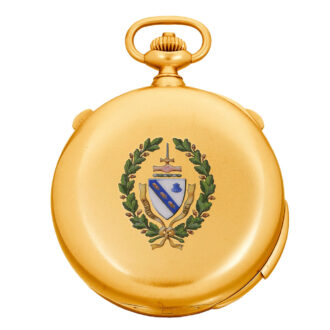
The polished case with a concealed hinge, the back cover decorated with a polychrome champlevé enamel coat of arms, crest and motto of John M. Morehead III within an oak leaf border, and a dedicated hinged gold cuvette. Silver dial with large Breguet hours, an outer minute track, a concentric fifth of a second track, Arabic five minute/second numerals, subsidiary seconds at 3 o’clock, a 30 minute register at 9, a linear aperture at 6 for the days of the week, date and months of the year, blued steel hands, and gold chronograph and register hands.
Dial, case and movement signed. Accompanied by the original Patek Philippe Certificate of Origin, spare mainspring and the original Patek Philippe burr walnut fitted presentation box.
–
Diameter: 50.5 mm
–
Signed: Patek Philippe Genève
–
Only five watches by Patek Philippe are known with a double chronograph, including this watch. The present timepiece is smaller and thinner than the other known examples and has a rejoin function which was a hitherto unknown operation in a double chronograph. The dial of this watch was probably changed by Patek Philippe relatively soon after it was made, but the company today has no record of this work being carried out. However, the exacting manner in which the dial is made leaves no doubt that the work was carried out by Patek Philippe. It is likely that the dial was ordered from the manufacturer via a U.S. agent and fitted by their workshops. This would explain why the present dial is not mentioned in the Patek Philippe, Geneva archive. One is aware of other similar instances of other dial exchanges not being recorded. Originally it was fitted with an enamel dial and it is possible that because the calendar aperture is so large it caused the enamel dial to crack, therefore a silvered dial would have been a preferable option.
The patented double chronograph was made to allow two simultaneous timings of the duration of an event as well as individual sections, thereby acting as two individual chronographs. The two chronographs are operated by separate buttons with the button on the crown activating the return to zero of both chronographs and the 30 minute recorder simultaneously. The two stacked chronograph mechanisms are independently driven by the fourth wheel in tandem. The present watch has the addition of a split second rejoin function allowing it to operate as a traditional split second chronograph or as a double chronograph. The patent for the double chronograph was issued to Patek Philippe & Co. as No. 27052 on November 13th, 1902.
–
The linear digital calendar or so-called American (perpetual) calendar is a calendar in which the date is displayed in a single linear aperture, allowing for a legible dial to be read at a glance. This type of display was invented in the early Art Deco period and is most often found in watches destined for the Anglo-American market. This kind of calendar became popular once again after the Second World War. This watch is unusual in that the calendar aperture is at 6 0’clock as opposed to the more usual at 12 0’clock.
–
The specially made hour hand with the large oval aperture is manufactured so that it causes the least visual disturbance during its two hour passage over the calendar aperture.
–
Carillon repetition. Patek Philippe only used this type of repetition in its highest quality pieces. Most were made on special request for wealthy patrons. The difficulty in producing carrillon watches is maintaining the accuracy of the timekeeping throughout the duration of the striking. This watch with its unique combination of complications is an extraordinary example of the knowhow demonstrated by Patek Philippe in the field of haute horology. The use of these particular complications in one watch marks out the owner as a very discerning individual with an excellent understanding of the horology of his era. It is very difficult to reduce the thickness of the movements of complicated watches which makes this watch particularly interesting and a technical achievement, the carillon which requires additional space for the extra hammer along with the stacked double chronograph would have normally required the watch to be thicker.
–
John Motley Morehead III was born on November 3rd, 1870 to a prominent North Carolina family with a strong tradition of public service. His grandfather, John Motley Morehead I, is known as the father of modern North Carolina. Twice elected governor of North Carolina, the first John Motley Morehead was devoted to improving education in his state. He was the founder and first president of the North Carolina railroads, a trustee of the University of North Carolina, a founder of the Edgeworth women’s college and an instigator for state institutions for the training of the blind and deaf, as well as for the care of the mentally ill. A town in North Carolina is named after him, as are numerous parks, schools and university facilities.
In keeping with his family tradition, John Motley Morehead III was not only a successful businessman, chemist and engineer, but also an internationally known inventor, author and scientist. He graduated from the University of North Carolina at Chapel Hill in 1891. He and his father discovered acetylene gas while searching for an inexpensive method for manufacturing aluminum at their mill in Spray (now Eden), North Carolina. John Motley then developed an economical process for the manufacture of calcium carbide, laying the groundwork for the development of the Union Carbide Corporation. At the time of his death in 1965, Union Carbide had more than 73.000 employees throughout the world and produced over 600 products.
John Motley Morehead III also invented an apparatus for analyzing gases and published a book on the subject that remained the authoritative source for years. He was mayor of Rye, New York. President Herbert Hoover appointed him envoy and minister to Sweden from 1930 to 1933. As a result of his exceptional work as ambassador, John Motley became the first foreigner to be honored with Sweden’s gold medal for outstanding service. In 1915, at the age of forty-four, he married Genevieve Margaret Birkhoff. A few years after Genevieve’s death in 1945, he married Leila Duckworth Houghton. Neither marriage produced children.
John Motley Morehead III gave generously to his alma mater. In 1931, he and Rufus Lenoir Patterson, a classmate and fraternity brother, donated the Morehead-Patterson Bell Tower to the University. In 1945, he created the Morehead Foundation for the purpose of erecting the Morehead Building and establishing the Morehead Award. The Morehead Building, dedicated in 1949, houses the Morehead Planetarium, the Genevieve B. Morehead Art Gallery, the Copernican Orrery, the Morehead Observatory, scientific exhibition galleries and the Morehead Foundation offices. The Foundation has tendered more than 2.300 Morehead Awards over the course of the last half-century. To his hometown High School, since renamed John Motley Morehead Senior High School, he donated the Morehead Stadium and Chimes. He made a significant gift to the local hospital, which was later renamed John Motley Morehead Memorial Hospital. John Motley Morehead’s greatest loves were his native state of North Carolina and its university at Chapel Hill. The legacy of his dedication and devotion to the University continues to thrive today through the Morehead Program. John Motley Morehead III died on January 7, 1965.
Signed: Patek Philippe Genève
Share this page: