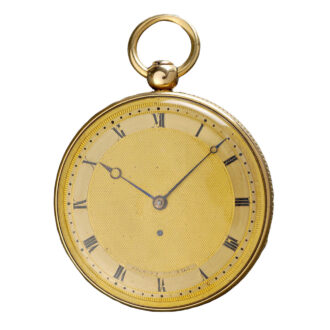
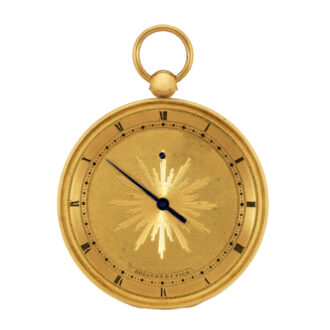
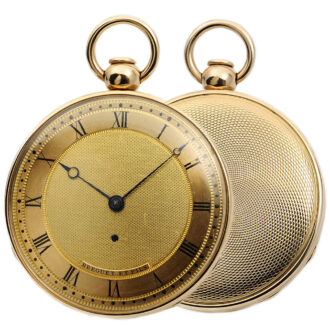
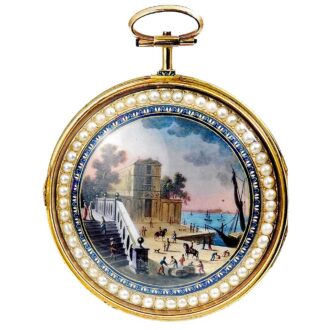
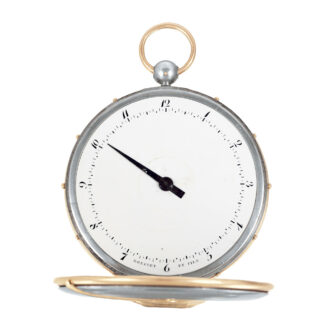
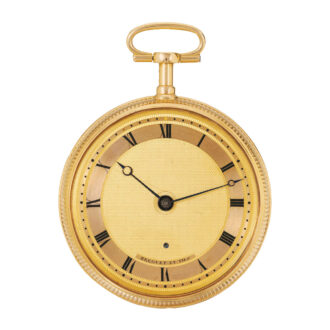
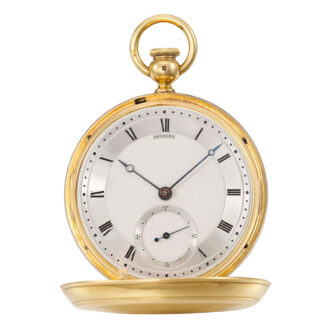
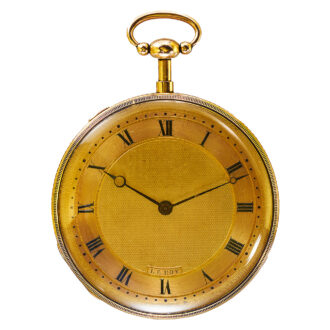
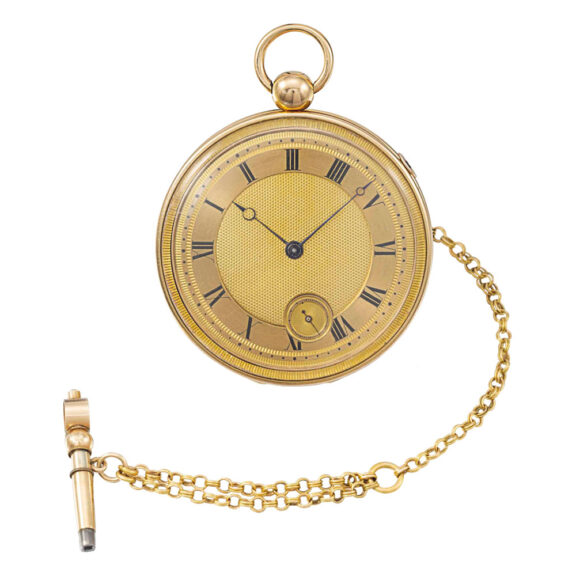
Gold repeater with free escapement with natural lift Circa 1806
- Kenmerk
- CH1684
- Diameter
- 42 mm
- Estimate
- € 200.000 - 400.000
- Price sold
- € 502.150
Historically important quarter repeating watch by Breguet
–
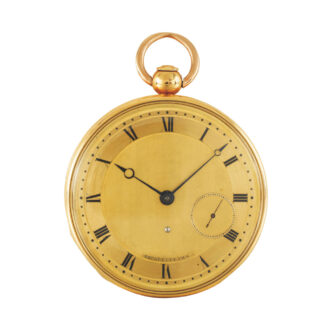
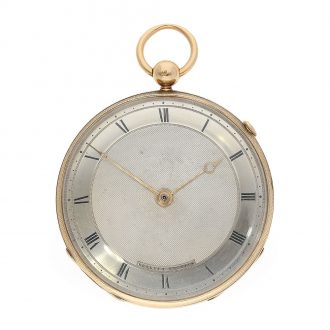
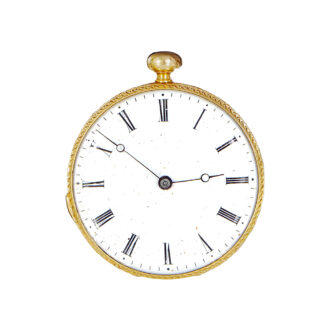
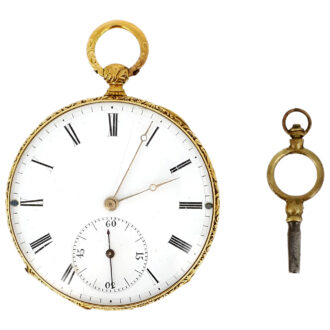
A unique and historically important French 20 carat gold open faced quarter repeating watch with free escapement with natural lift, circa 1806. Petite montre à répétition quarts, échappement libre à levées naturelles. Sold on 13 January 1806 to Monsieur Le Duc de l’Infantado for the sum of 4,200 francs. Gilded brass movement jewelled to the centre, separate removable plate holding the two escape wheels, the pivoted detent and the three armed bimetallic compensation balance with gold and platinum screws, parachute suspension on the pivot, blued steel Breguet freesprung balance spring, quarter repeating on one hammer onto a gong. Gold cuvette held by two half headed screws, engraved 2me Echapt. Libre Inv.té par Breguet en l’An 10, No. 1135. Engine turned gold dial with Roman numerals on raised blank chapter ring, secret signature to both sides of XII, blued steel Breguet hands, small eccentric sunk seconds dial between VIII and IX. Small case, hinged back decorated with engine turned concentric rings, centred by the engraved initial I, quarter repeating pull-twist push piece in the ribbed band, ball shaped pendant and round bow, short length of gold chain and gold ratchet key. Case No. 1945 by Pierre Benjamin Tavernier, dial with secret signature No. 1135 Breguet to both sides of XII, movement signed Breguet No. 1135.
–
Diameter: 42 mm
–
Signed: Breguet
–
Pedro Alcántara de Toledo y Salm Salm (1768-1841), XIII duque del Infantado. On 23 March 1802, within days of the signing of the treaty of Amiens which ended the war between France and the Allies, Breguet received an order for a watch from a high ranking Spanish nobleman and soldier, Pedro Alcántara de Toledo y Salm Salm (1768-1841), XIII duque del Infantado. He became very close to Ferdinand, the heir to the Spanish throne which led him into conflict with the weak King Charles IV and his ambitious chief minister Godoy, and he was banished from Madrid in 1805, still waiting for his watch. On 12 January 1806 Breguet dispatched the finished watch via Guttierez, a firm of couriers, to the Duke who was living quietly on his estates. In the following year Ferdinand was arrested and amongst his papers was found a nomination for the Duke to be Commander in Chief of the Spanish forces. Tried and sentenced to death as a traitor, he was reprieved by popular sentiment and the intervention of the French Ambassador.
–
A revolt in March 1808 resulted in the abdication of the king, the sacking of Godoy and the ascent of Ferdinand VII to the Spanish throne, with the Duke of Infantado at his side. All four of these were clients of Breguet, who had by then established himself as the premier watchmaker of Europe. Taking advantage of the chaos, Napoleon invited the factions including the Duke, presumably wearing his new watch, to a conference in Bayonne. At this meeting a new Spanish constitution was signed resulting in the throne passing to Joseph Bonaparte, Napoleon’s brother. The only major Spanish figure who spoke in opposition was the Duke of Infantado. Not long afterwards the Duke called the nation to arms to resist the French, for which he was condemned as a traitor yet again, but this time by Napoleon. In 1811 the Spanish parliament (the Cortes) nominated him as the President of the Council of Spain and sent him on a secret mission to the Prince Regent in London. After the end of the war with France in 1814 he retired again. He was recalled in 1823 to the Presidency of the Regency and was responsible for returning the king to the throne.
–
It is not known when and how the Duke parted with his watch No. 1135, most probably however sometime in the 1830s. It was returned to Breguet in December 1837 by a certain Madame de Montenoir of Rue de Richelieu, Paris, who brought it back for cleaning and repairing. It is not known when and where to it then vanished for over a century, until 1944, when a letter about it was received by Lord Harris who had it in his collection. The last public appearance of Breguet’s “échappement naturel no. 1135” was on 4 February 1983, shortly after which it was acquired by the present owner.
–
A superb example of timepieces made by the workshops of Abraham-Louis Breguet (1747-1823) and his successors, widely acknowledged for having set the standard by which all fine watchmaking has been judged ever since. He was born in Neuchâtel, Switzerland, but it was in Paris that he spent most of his productive life. No aspect of watchmaking escaped his study, and his inventions were as fundamental to horology as they were varied. His career started with a series of breakthroughs: the development of the successful self winding perpétuelle watches, the introduction of the gongs for repeating watches and the first shock protection for balance pivots. Louis XVI and his Queen, Marie-Antoinette, were early enthusiasts of Breguet’s watchmaking. Each watch from his workshops demonstrated the latest horological improvements in an original movement, mostly fitted with lever or ruby cylinder escapements that he perfected. Breguet took refuge in Switzerland from the excesses of the French Revolution. He returned to Paris overflowing with the ideas that produced the Breguet balance spring, his first carriage clock (sold to Bonaparte), the ‘sympathique’ clock and its dependent watch, the tact watch, and finally the tourbillon, patented in 1801. Breguet became the indispensable watchmaker to the scientific, military, financial and diplomatic elites of the age. His timepieces ruled the courts of Europe. For his most celebrated clients, Breguet designed exceptional timepieces. For Caroline Murat, queen of Naples, he conceived in 1810 the world’s very first wristwatch. Honours saluted his enormous contribution to horology. Appointed to the Board of Longitude and as chronometer maker to the navy, he entered the Academy of Sciences and received the Legion of Honour from the hands of Louis XVIII. When he died in 1823, all mourned the architect of the greatest revolution in the science and art of time-keeping.
Signed: Breguet
Share this page: