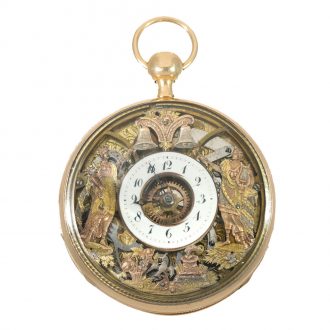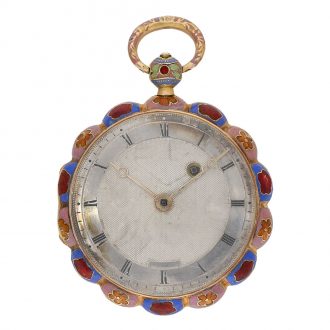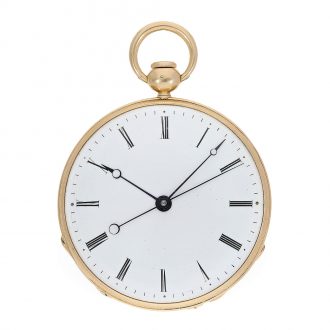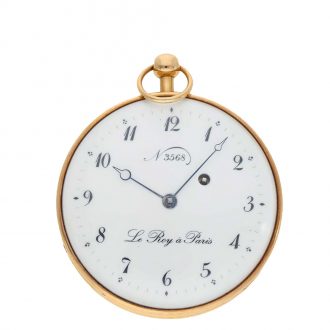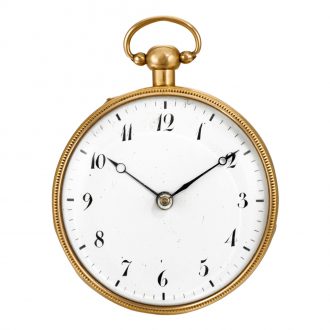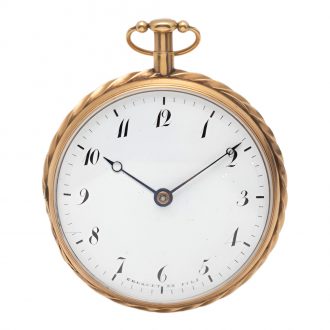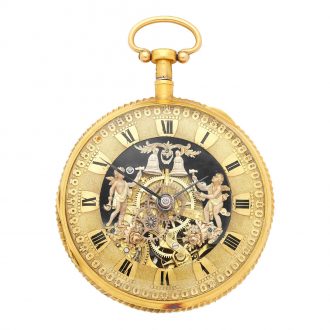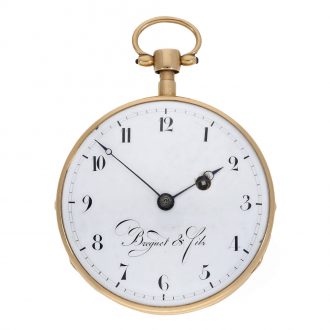
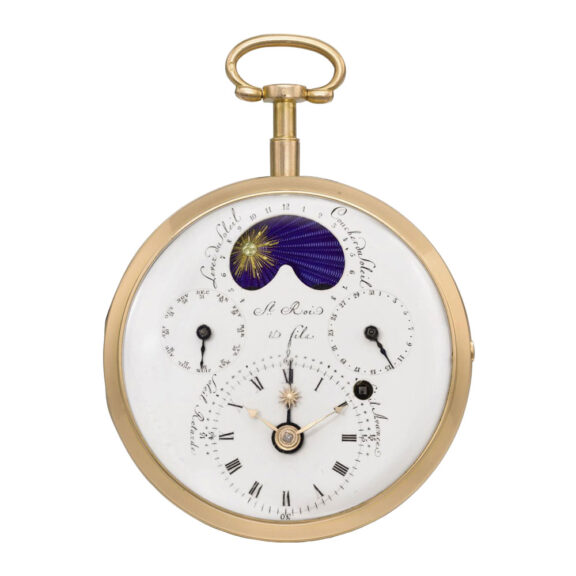
Swiss 18 carat pink gold astronomical pocket watch Circa 1810
- Kenmerk
- CH0052
- Diameter
- 59 mm
- Estimate
- € 250.000 - 500.000
- Price sold
- € 472.800
Gold astronomical virgule watch with equation of time, sunrise and sunset
–
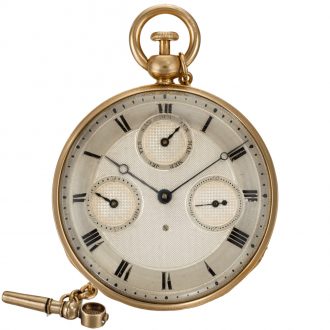
An impressive and historically important Swiss 18 carat pink gold open faced astronomical watch made by Samuel Roi & Fils in La Chaux-de-Fonds, circa 1810.
–
Movement
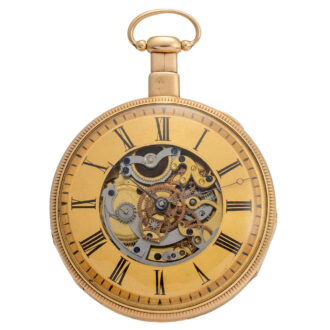
It has a gilt full plate movement with a virgule escapement and chain fusée. The balance cock is pierced and engraved with scrolls.
–
Dial
The white enamel dial combines astronomical, calendar and time indications. The off centre hour dial in the lower half shows black Roman numerals and gold arrow hands. A central hand with a sun shaped tip moves along an outer sector scale above the hour dial for the equation of time, marked Soleil Retarde (sun slow) on the left and Soleil Avance (sun fast) on the right. At 12 o’clock, a kidney shaped aperture shows a golden sun over a translucent blue enamel sunburst. A dark blue panel represents the horizon and shifts with the seasons. Around the aperture, an outer 12 hour scale is marked Lever du Soleil (sunrise) on the left and Coucher du Soleil (sunset) on the right. A subsidiary dial at 10 o’clock shows the month in French with the number of days in each month, and a subsidiary dial at 2 o’clock shows the date. The dial is signed Sl Roi & Fils in the centre.
–
Case
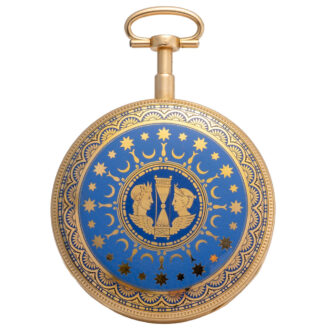
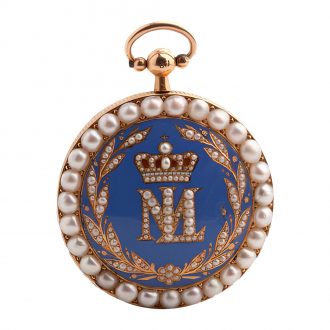
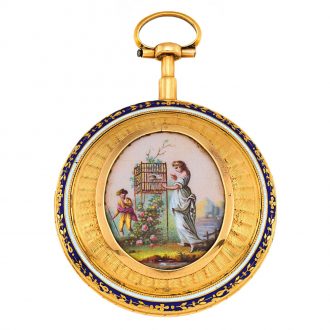
The watch is housed in a round plain pink gold case with a number.
–
Diameter: 59 mm
–
Signed: Sl Roi & Fils
–
Summary
A rare early astronomical watch by Samuel Roi & Fils with a virgule escapement. It shows the equation of time, sunrise and sunset with a moving horizon, plus a calendar with month and date.
–
Complications (5)
- Astronomical (3)
- Equation of time on a sector scale with a sun tipped hand
- Sunrise and sunset indication with a golden sun and moving horizon
- Outer 12 hour scale for the times of sunrise and sunset
- Calendar (2)
- Month with the number of days at 10 o’clock
- Date at 2 o’clock
–
The equation of time is the difference between solar time, as shown by a sundial, and the mean time of a clock. Because the Earth’s axis is tilted and its orbit around the sun is elliptical, a true solar day is almost never exactly 24 hours. It matches mean time on only four days of the year: around 15 April, 14 June, 1 September and 24 December. On other days the difference ranges from about 16 minutes behind in early November to about 14 minutes ahead in February. An equation of time display has always been one of the rarest complications in watchmaking, found only on the most sophisticated clocks and watches. This watch was unknown to horological literature before its sale. With its equation of time, sunrise and sunset, moving horizon, month with the number of days and date, it is one of the most intricate astronomical watches of the early 19th century.
–
Samuel Roi or Roy (1746–1822) founded the firm in La Chaux-de-Fonds in 1770. He trained with Josué Robert & Fils from age 16 and worked for several years in Fontaines, where he was associated with one of the Maillardets. He then returned home and set up his own workshop with his three sons, Henri-Louis, Jacques-Louis and Samuel. The firm specialised in scientific clocks and established the precision clock industry in La Chaux-de-Fonds. In 1783, the King of Prussia honoured Samuel Roi for inventing a perpetual clock. During the French Revolution, Abraham-Louis Breguet worked in Switzerland and collaborated with the firm on decimal clocks, marine chronometers and weight driven clocks made to his design. Breguet invited Samuel Roi to work for him in Paris, but he declined. In 1804, his eldest son Henri-Louis took over the management of the firm. The Musée de l’Horlogerie in La Chaux-de-Fonds holds a regulator clock by Samuel Roy & Fils from 1780.
Signed: Sl Roi & Fils
Share this page: