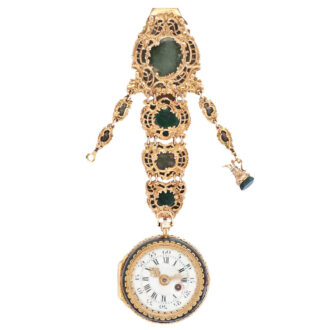
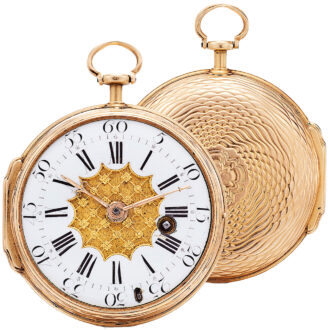
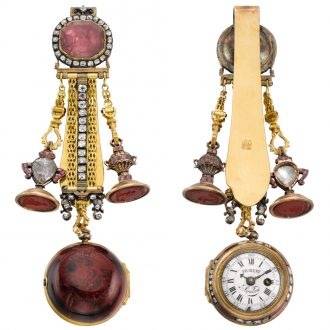
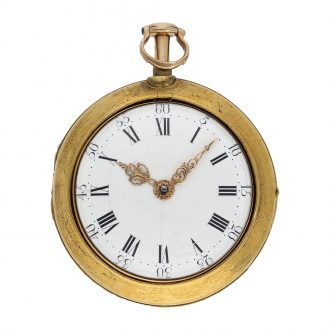
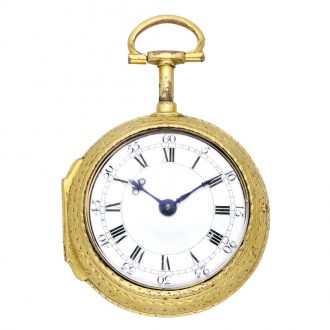
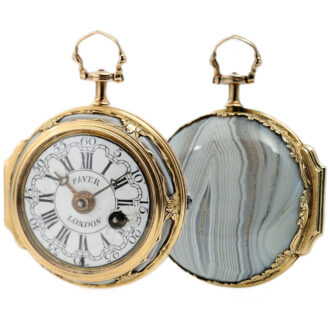
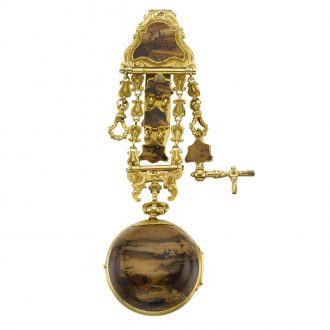
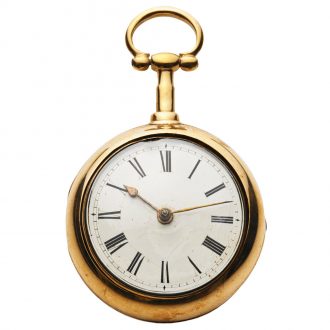
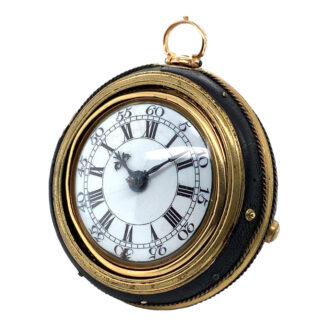
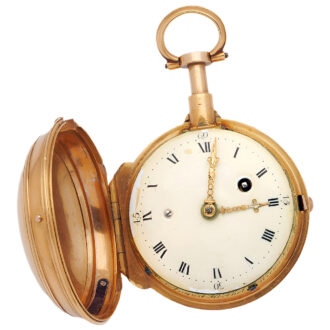
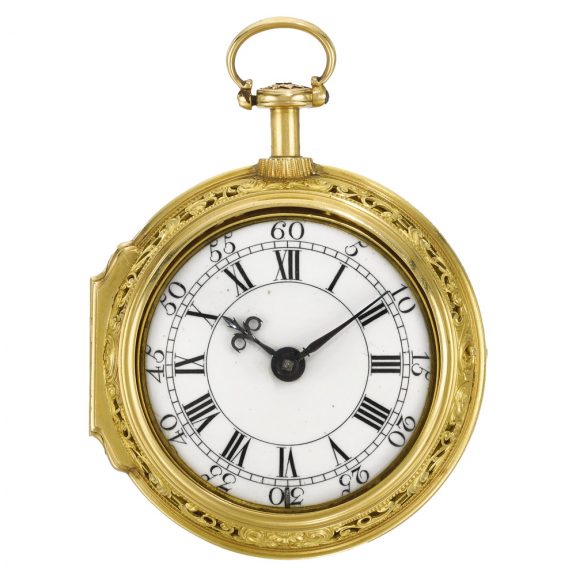
English half-quarter repeating pair cased verge watch Circa 1760
- Kenmerk
- AS1646
- Diameter
- 49 mm
- Estimate
- € 12.500 - 25.000
- Price sold
- € 24.850
Gold repeater with enamel scene by John Ellicot
–
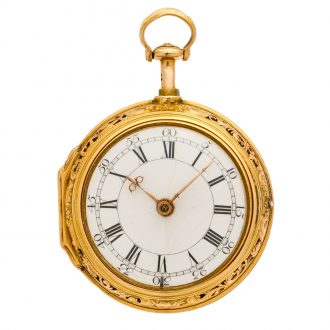
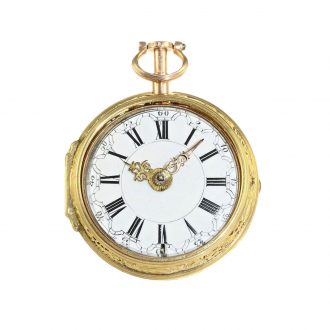
A magnificent English gold and enamel half-quarter repeating pair cased verge watch with polychrome enamel scene by George Michael Moser, circa 1760-1761. The gilded full plate movement includes a cylinder escapement, decoratively pierced and engraved balance cock, diamond endstone, fusee and chain, cylindrical pillars, and two polished steel hammers that repeat on a bell inside the back. It also has a gilt metal dust cap, with both the movement and dust cap signed and numbered by Ellicott, London and the bell signed by Drury. The white enamel dial features Roman numerals, an outer Arabic minute ring, and blued steel beetle and poker hands.
–
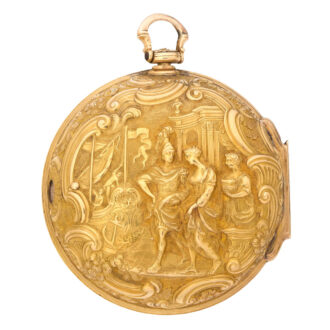
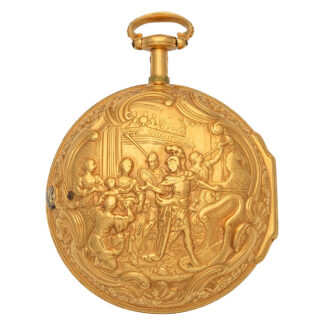
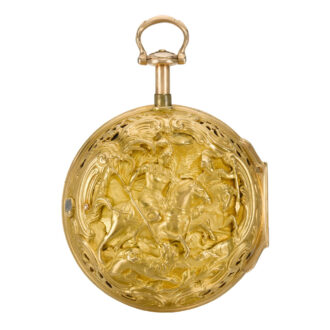
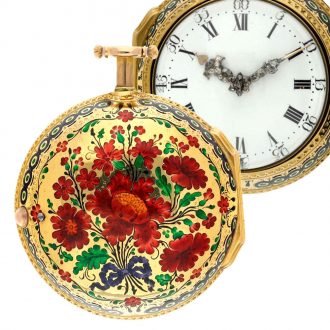
The watch has a gold inner case with engraved scrolling decorations, a pastoral scene, and a grotesque mask. The outer case is also gold and adorned with a polychrome painted enamel scene of Apollo and the Muses, surrounded by an embossed cartouche. Both the inner and outer cases are pierced for sound emission and engraved with scrolling foliage. The inner case has an indistinct maker’s mark and is numbered 4819, while the outer case is signed by G. M. Moser beneath the scene.
–
Diameter: 49 mm
–
Signed: Ellicott, London
–
The inner case shows scuffs consistent with age and wear. The enamel scene has multiple light scratches, but there are no cracks. Overall, it is in good condition. The movement is running, but the striking mechanism is not working.
–
In his book The Art of the Gold Chaser, Richard Edgcumbe describes the scene on the case back as follows: Apollo and the four muses are depicted from left to right, with Melpomène holding a sceptre, Calliope with the text of an epic poem, Clio with a laurel wreath and a book, and, likely, Polyhymnia. Edgcumbe also notes that: The figure of Calliope is directly inspired by an engraving done by Edmé Jeaurat in 1719 after Nicolas Vleughels, titled Apollon, Melpomène, Calliope, Clio… the figure of Polyhymnia may have its origins in another engraving, Uranie et Polymnie, in the same sequence. The figure of Apollo, different from Vleughels’ Apollo, has the same posture as the figure of Victory in a roundel after Antoine Coypel.
–
George Michael Moser, born on 17 January 1706 in Schaffhausen, Switzerland, and died on 24 January 1783 in London, was a renowned 18th-century artist and enameller. He was the father of celebrated floral painter Mary Moser and a founding member of the Royal Academy of Arts in 1768. Moser was the son of Michael Moser, an eminent Swiss engineer and metalworker. He trained as a coppersmith in Geneva, later mastering additional skills as a chaser, goldsmith, and engraver. After moving to London in the 1720s and marrying Mary Guynier, he became known for his elaborate gold snuffboxes, watch cases, and silver candlesticks in the rococo style. Moser also excelled in enamel compositions, particularly for adorning watches, bracelets, and other trinkets. He was appointed as the drawing master to George III during his boyhood and was involved in engraving the king’s first great seal. Moser was buried in the churchyard of St Paul’s, Covent Garden, and was remembered by Sir Joshua Reynolds as the first gold chaser in the kingdom, possessing universal knowledge of all branches of painting and sculpture, and ‘in every sense the father of the present race of artists.
–
John Ellicott (1706 – 1772) was an English clock and watchmaker known for his inventions in the 18th century. He joined his father’s workshop in London in 1728 and became one of the most important watchmakers in England at the time. In 1738, he was elected Fellow of the Royal Society. Ellicott is best known for his work on temperature-compensated pendulums developed in 1753, as well as for his improvements to the cylinder escapement and the invention of the centre second for pocket watches. He was a clockmaker to King George III and had a twelve-year partnership with his son Edward. John Ellicott died unexpectedly in 1772, and his son Edward continued the workshop until his death in 1791.
Signed: Ellicott, London / G. M. Moser / Drury
Share this page: