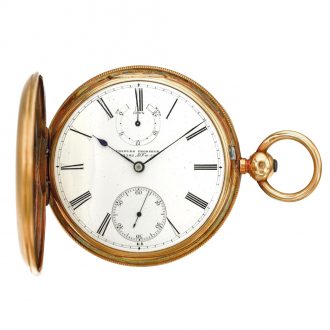
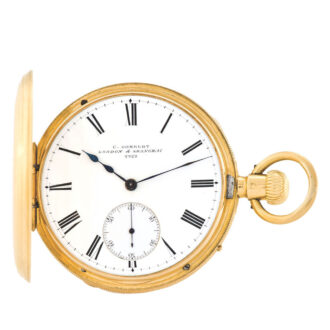
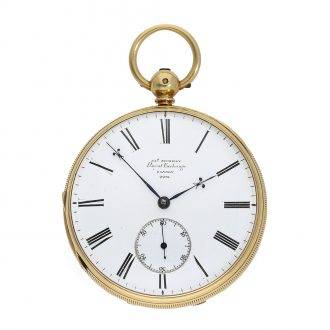
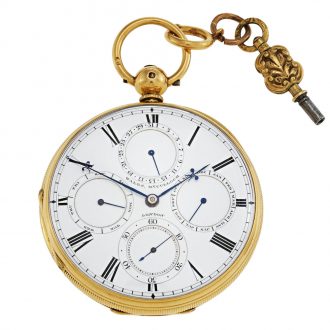
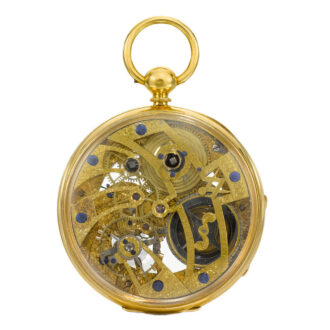
English gold skeletonized calendar watch Circa 1861-1865
- Kenmerk
- SA0466
- Diameter
- 51 mm
- Estimate
- € 10.000 - 20.000
- Price sold
- € 18.000
Extremely rare gold skeletonized lever with day, date and centre seconds
–
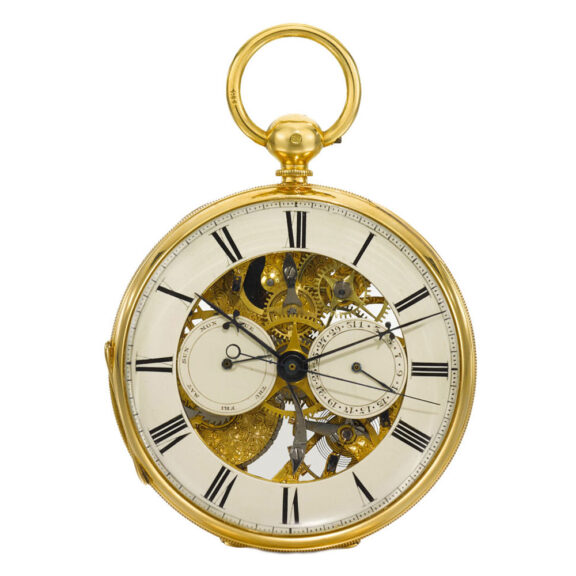
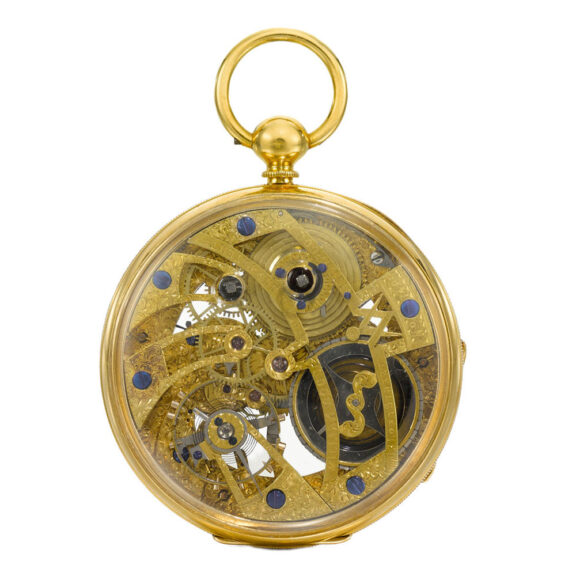
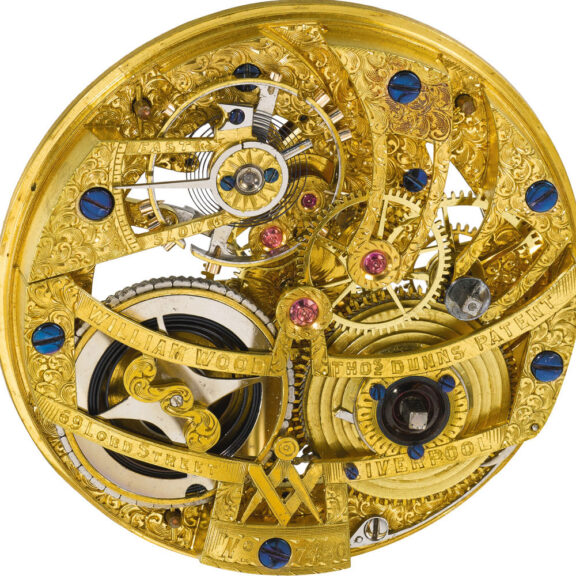
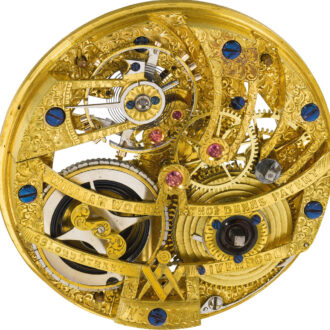
An English extremely rare gold skeletonized open-faced lever watch with day, date and centre seconds, circa 1861-1865, gilded skeletonized movement, English lever escapement, jewelled to the fusee, the bridges decorated with foliate engraving and incorporating Masonic symbols of divider and square, pierced cock and mainspring barrel, bimetallic compensation balance, fusee and chain, signed William Wood, 69 Lord Street, Liverpool, Thos Dunn’s Patent, glazed case back, glazed cuvette with apertures for winding and hand-set.
Skeletonized dial, white enamel chapter ring with Roman numerals, outer minute/seconds ring, two subsidiary dials for day and date, blued steel fleur-de-lis hands and centre seconds.
Case with plain gold bezels, ribbed band, glazed display back, round pendant and bow, pendant hallmarked and with rubbed maker’s mark possibly Robert Rowlands.
–
Diameter: 51 mm
–
Signed: William Wood 69 Lord Street, Liverpool Thos Dunn’s Patent
–
This impressive skeletonized calendar watch was made according to Thomas Dunn’s Patent. The provisional specification of Dunn’s Patent was dated 17th May 1861 and numbered 1257, with the patent itself filed on 15th November 1861. Within the patent it is written: “Watches are formed with glass cases over the inner works to keep out the dirt, and the inner framework is so lightened that nearly the whole of the works may be seen at any time, in order to detect small particles of dirt, before they injure the works”. A third part of the patent refers to the fitting of a “double shank working on a swivel” to watches “so that a neck guard and a short guard may be used together”. This pendant, with a double bow and shown in figure 1 of the patent, is not incorporated in the present watch. The present watch, however, has a calendar whereas the patent does not. While the patent is without the engraving, other features and layout of the movement are identical.
A similar skeletonized movement by William Wood, also made according to Dunn’s patent, was examined by the Antiquarian Horology’s Scottish section on 4th March 1987 at Lauriston Castle, Scotland. For a report of the visit, an illustration of the movement and part of the Dunn patent, see: Antiquarian Horology, No. 6, Vol. 16, June 1987.
Signed: William Wood 69 Lord Street, Liverpool Thos Dunn’s Patent
Share this page: