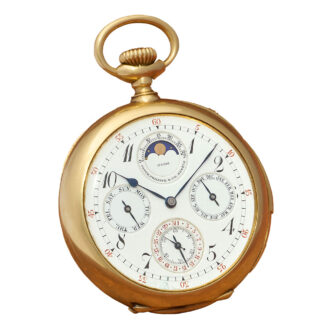
Swiss gold platinum repeater with ten complications Circa 1912
- Kenmerk
- TA2017
- Diameter
- 49 mm
- Estimate
- € 80.000 - 140.000
- Price sold
- € 79.000
Platinum gold minute repeating lever watch
–
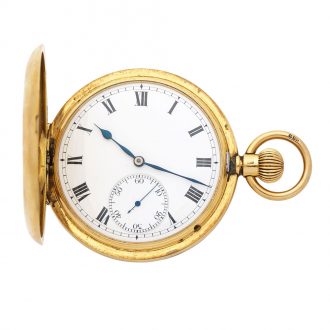
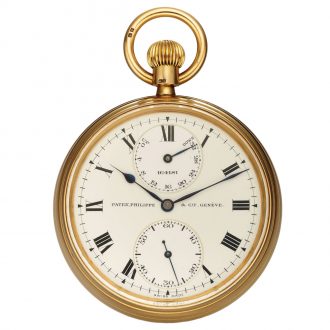
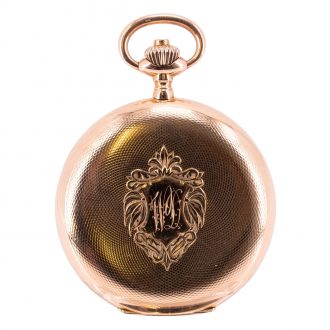
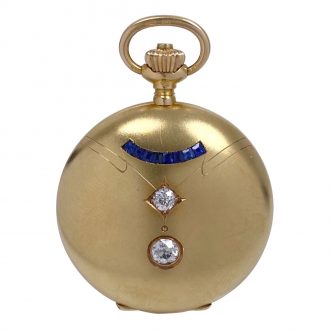
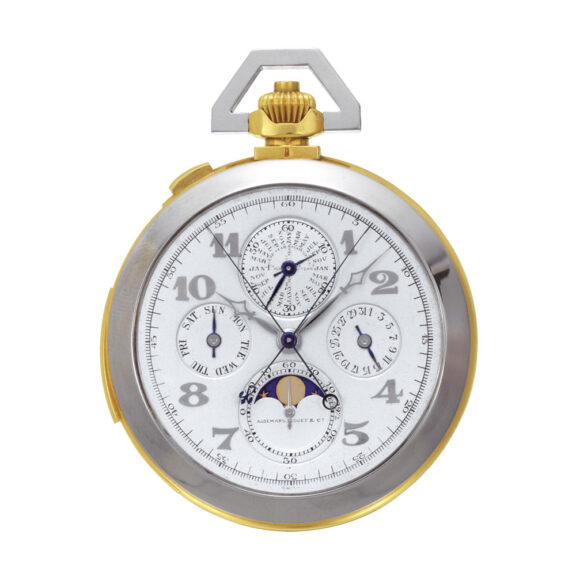
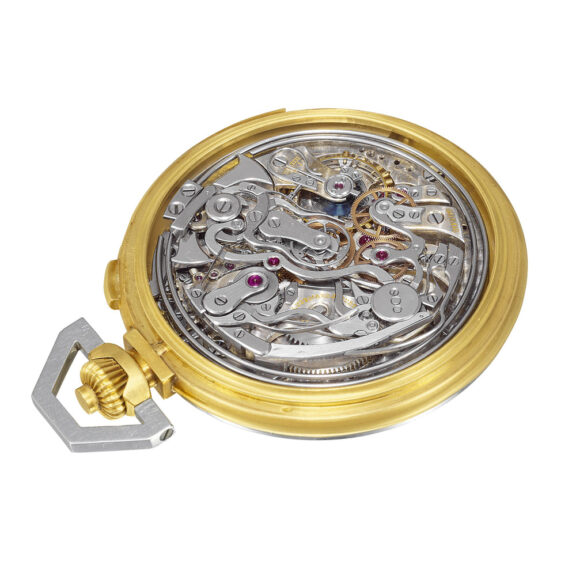
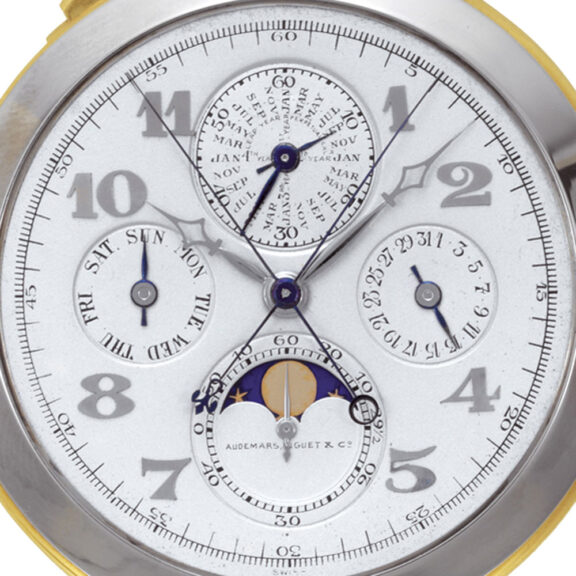
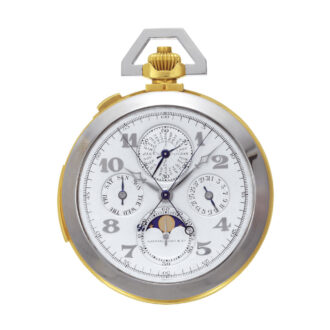
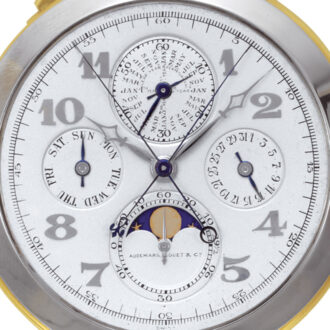
A very elegant, important, and extremely rare, thin Swiss, 18 Carat yellow gold and platinum pocket watch, circa 1912. Watch with ten complications by Audemars Piguet & Co., Swiss. Minute repeating, keyless dress watch with perpetual calendar, split-seconds chronograph, 60-minute progressive register, phases and age of the moon. A polished and brushed case, platinum bezels and bow, yellow gold band and pendant, co axial start/stop/return-to-zero button in the crown, split-seconds button in the band at 11 o’clock.
–
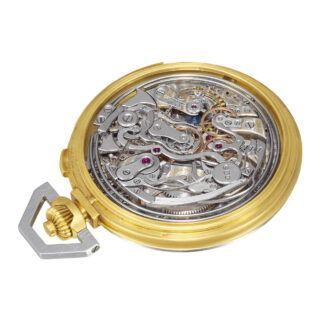
Matte silver dial with applied upright Arabic numerals, outer minute/seconds and fifths of a second division, Arabic five minute/seconds numerals, subsidiary dials for the months and four-year cycle concentric with the 60-minute progressive register, date and days of the week, moon phase aperture with seconds and lunar calendar. Platinum Cathedrale hands. A rhodium-plated movement, Geneva striking decoration, 35 jewels, wolf’s tooth winding, straight-line lever escapement, cut bimetallic compensation balance with peripheral gold temperature and meantime adjustment screws, eight adjustments, blued steel Breguet balance spring, swan-neck micrometre regulator, visible steel chronograph work, repeating on two gongs activated by a slide on the band. Dial, case and movement signed.
–
Diameter: 49 mm
–
Signed: Audemars Piguet & Co. Swiss
–
Audemars Piguet
Founded in 1875 by two watchmakers, Jules Audemars and Edward Piguet, aged 24 and 22 respectively, under the name Audemars Piguet, Manufactured Horlogerie. Jules Audemars was born in Le Brassus in 1851, where he was trained under master watchmakers of the area. After his apprenticeship, Jules Audemars began work as a repasseur until 1874, then settling in Gimel and opening a small business. He did not obtain the success he had hoped, probably due to the recession which was then beginning, and eighteen months later he decided to return to Le Brassus, looking for a new situation more in keeping with his exceptional watchmaking skill. Edward Auguste Piguet, born two years after Jules Audemars, received a similar education. Edward completed his formation as a repasseur under Charles Capt. The two met in 1875 in Le Brassus. For a time, the two watchmakers worked closely together without legally recognizing their partnership. Then, the Audemars Piguet company was officially founded, in 1889. Nevertheless, a brand was registered at the Office technique de l’Edition et de la Publicité in Bern, on December 6, 1882, for movements and watch cases. In the records, Audemars Piguet & Cie is presented as manufacture active all year long, employing 10 male employees.
–
In 1880, they opened a branch in Geneva, where commercial possibilities were the greatest. Because of his exceptional technical abilities, Jules Audemars was the technical manager of the manufacture. He patented several inventions in Switzerland and in the USA, and travelled extensively, particularly to America, where he was fascinated by the potential for trade. Edward Piguet was the financial specialist of the firm. The two men managed the company together until 1918 when Jules Audemars died at the age of 67. Edward Piguet died the following year. Certain of their models became symbolic of the skill and technique of Audemars Piguet. One of them, a minute-repeating, perpetual calendar, split-seconds chronograph pocket watch, was presented at the Paris Universal Exhibition in 1889. They also opened stores in Paris, London, Berlin and New York. They made watches of different styles: French, English, German and American, which was a most efficient strategy. They took part in several important exhibitions and fairs. Around 1915, the company started to manufacture wristwatches, which were very fashionable, though still continuing the production of traditional and complicated pocket watches. They made many repeating watches.
–
In 1920, after the death of the two founders, Audemars Piguet created the smallest minute repeating watch, and, in 1911, the 10 movements. Audemars Piguet products were sold in Le Brassus, Geneva, London, Paris, Berlin and New York. The manufacture worked in collaboration with important importers and retailers all over the world. Their clients included, among others: Dent and Frodsham in London, Tiffany in New York, Cartier and Breguet in Paris, Bulgari in Rome, and Dürrstein in Glashütte and Dresden. After the New York Stock Exchange crash in 1929, Audemars Piguet, like other manufactures, lost a large part of their American clientele. 1932 was the worst year in the firm’s history. The manufacture remained the property of the Audemars Piguet families and their descendants. In 1933, the economic situation of the firm was already much improved, and at the beginning of WWII, the major part of the Audemars Piguet production was sold to the USA. Later, seeing the strong interest from clients for skeleton wristwatches and pocket watches, Audemars Piguet included these among their standard production. They remain so today, as do their famous complicated pocket watches invented over 100 years ago.
Signed: Audemars Piguet & Co. Swiss
Share this page: