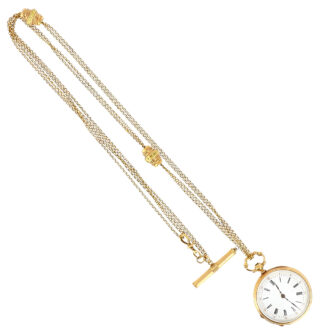
Rare Swiss gold watch with detent escapement Circa 1890
- Kenmerk
- SA0932
- Diameter
- 55 mm
- Estimate
- € 40.000 - 60.000
- Price sold
- € 45.600
Gold Observatory chronometer
–
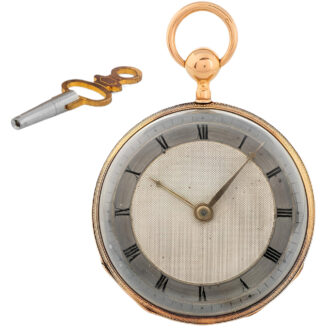
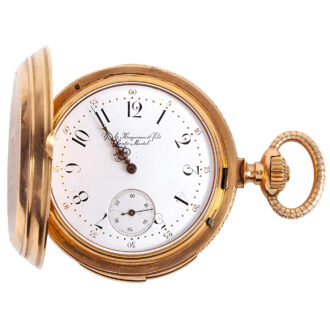
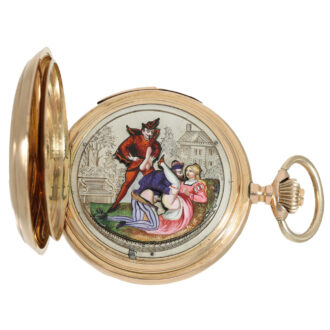
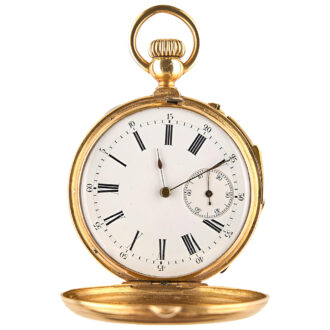
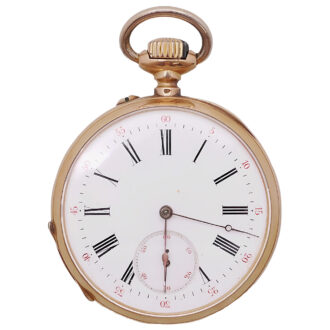
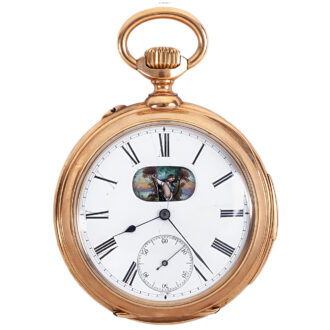
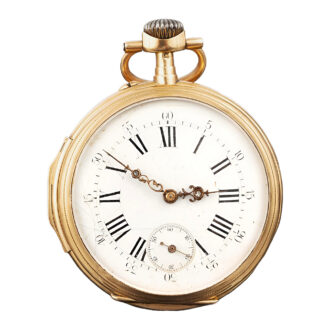
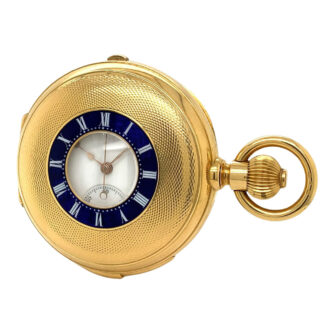
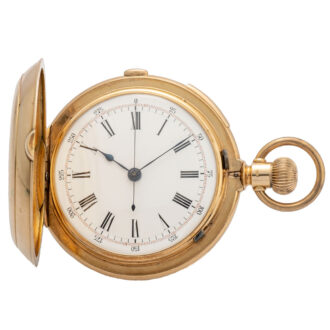
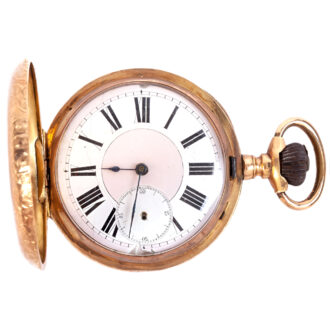
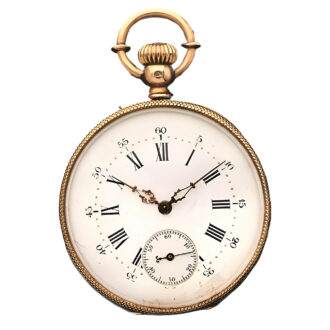
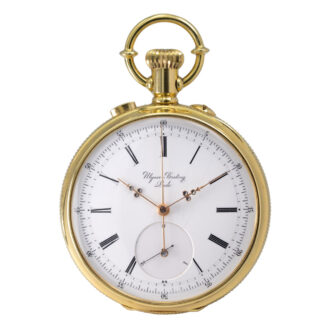
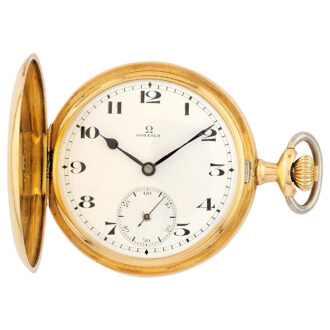
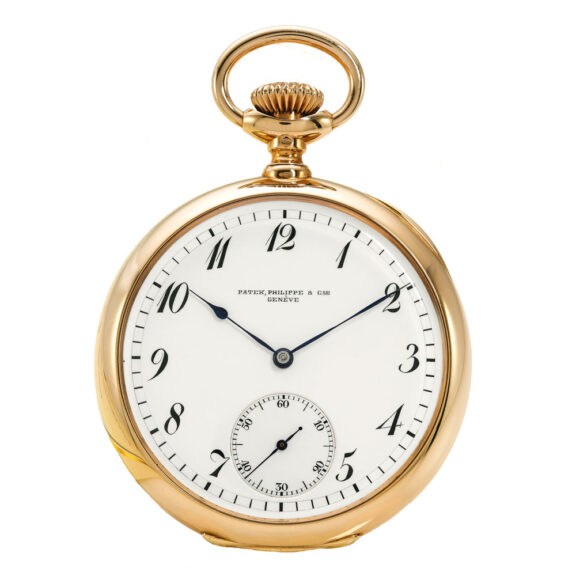
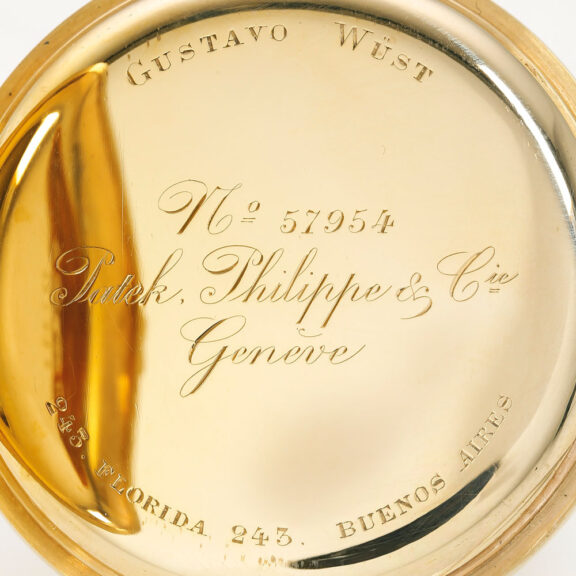
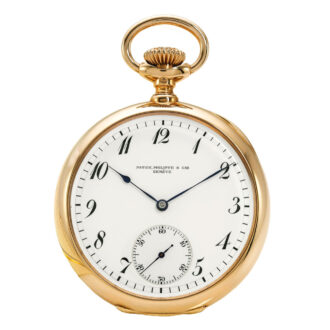
A fine Swiss extremely rare 18 carat pink gold open faced chronometer pocket watch made for the South American market by Patek Philippe in Geneva, circa 1890. The gilded brass jewelled manual wind movement with a footed detent escapement, carried on four chatons, a cut bimetallic gold setting screws compensation balance, wolf’s tooth winding mechanism and free sprung blued helical balance. White enamel dial with Breguet numerals, an outer minute track, sunk subsidiary seconds at 6 o’clock and blued spade hands. The polished case with an 18K pink gold cuvette, engraved Gustavo Wüst 243 Florida 243 Buenos Aires. Dial, case and movement signed, cuvette numbered. Comes with an Extract from the Archives confirming its manufacture in 1890 and sale in 1901.
–
Diameter: 55 mm
–
Signed: Patek, Philippe & Cie Genève
–
This watch passed the Observatoire de Genève test on January 24th, 1895.
–
The detent escapement
A costly, extremely delicate escapement used in chronometers, composed of a wheel with pointed teeth, which rest on a jewel called the locking stone. This jewel is carried by a spring called the detent, an extension of which the horn extends within the range of action of the discharging pallet, which unlocks the wheel each time the balance oscillates. The tooth of the wheel leaves the locking stone, and another tooth, acting on the impulse pallet on the impulse roller, gives an impulse to the balance. The parts described above are designed to make the impulse occur close to the point of rest, the point of equilibrium of the spring balance. When the balance turns clockwise, the pallet passes the tip of the detent spring, its only function being to bend the spring. Sometimes the detent spring was replaced by a pivoted lever. This type of escapement, most commonly used in the 19th century’s precision chronometer, is a type of échappement libre.
–
–
A fine Swiss extremely rare 18 carat pink gold open faced chronometer pocket watch made for the South American market by Patek Philippe in Geneva, circa 1890. The gilded brass jewelled manual wind movement with a footed detent escapement, carried on four chatons, a cut bimetallic gold setting screws compensation balance, wolf’s tooth winding mechanism and free sprung blued helical balance. White enamel dial with Breguet numerals, an outer minute track, sunk subsidiary seconds at 6 o’clock and blued spade hands. The polished case with an 18K pink gold cuvette, engraved Gustavo Wüst 243 Florida 243 Buenos Aires. Dial, case and movement signed, cuvette numbered. Comes with an Extract from the Archives confirming its manufacture in 1890 and sale in 1901.
–
Diameter: 55 mm
–
Signed: Patek, Philippe & Cie Genève
–
This watch passed the Observatoire de Genève test on January 24th, 1895.
–
The detent escapement
A costly, extremely delicate escapement used in chronometers, composed of a wheel with pointed teeth, which rest on a jewel called the locking stone. This jewel is carried by a spring called the detent, an extension of which the horn extends within the range of action of the discharging pallet, which unlocks the wheel each time the balance oscillates. The tooth of the wheel leaves the locking stone, and another tooth, acting on the impulse pallet on the impulse roller, gives an impulse to the balance. The parts described above are designed to make the impulse occur close to the point of rest, the point of equilibrium of the spring balance. When the balance turns clockwise, the pallet passes the tip of the detent spring, its only function being to bend the spring. Sometimes the detent spring was replaced by a pivoted lever. This type of escapement, most commonly used in the 19th century’s precision chronometer, is a type of échappement libre.
–
In 1748, French watchmaker Pierre Le Roy (1717-1785) invented the first detent escapement. In 1783, it was generalized by English watchmaker Thomas Earnshaw (1749-1829) with his standard spring detent escapement and used until mechanical chronometers became obsolete.
–
–
Although John Arnold (1736-1799) and Swiss watchmaker Ferdinand Berthoud (1727-1807) both had their own version of this escapement in 1779, neither of their designs could match Earnshaw’s design in popularity. Due to the virtual absence of sliding friction between the escape wheel and the pallet during impulse, the spring detent escapement could be more accurate than lever escapements. Unfortunately, the spring detent escape is very delicate, not self starting, and harder to manufacture in quantity. In 1805, Earnshaw and Arnold’s son (at that time John Arnold was deceased) were awarded by the Board of Longitude for their contributions to chronometers.
Signed: Patek Philippe and Cie Genève
Share this page: