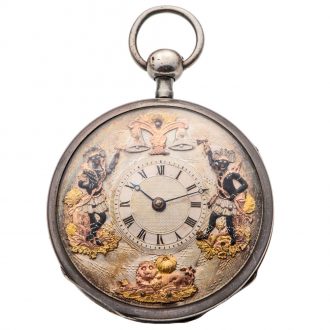
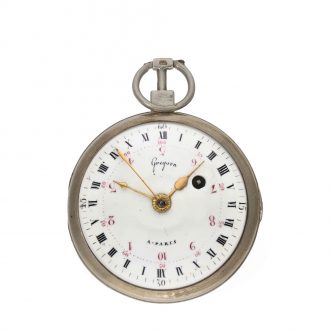
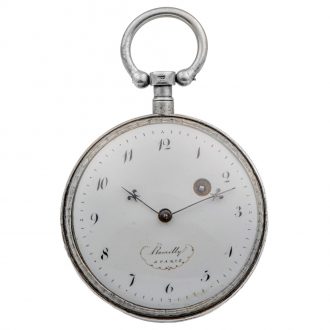
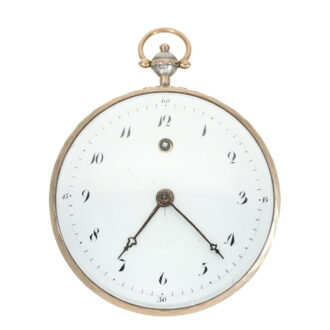
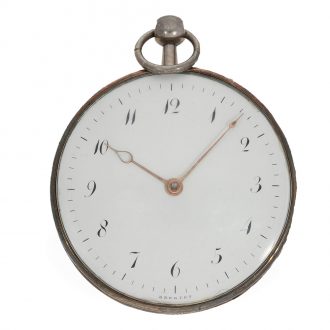
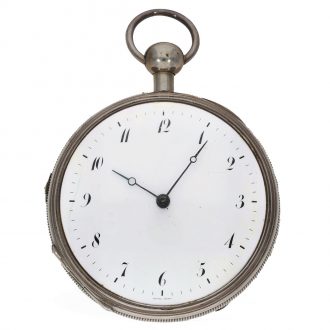
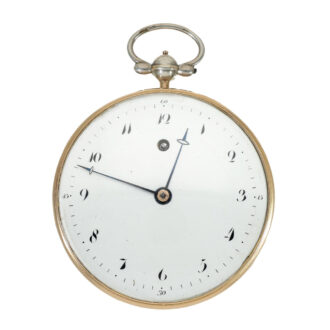
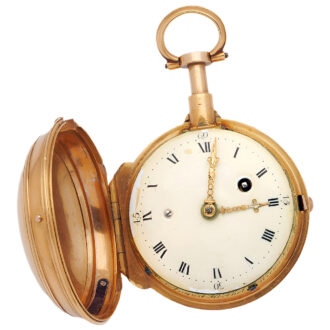
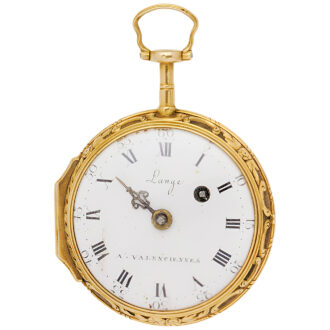
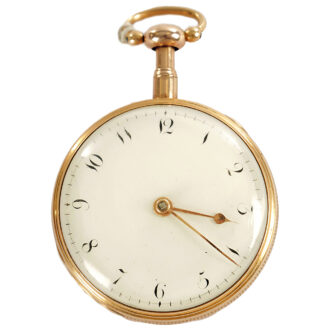
French calendar watch with Debaufre escapement Circa 1800


- Kenmerk
- AA0321
- Diameter
- 59 mm
- Estimate
- € 12.500 - 25.000
- Price sold
- -
Unusual double sided pocket watch with visible balance and calendar
–
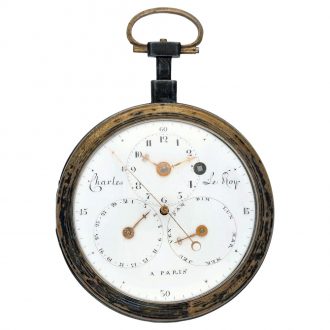
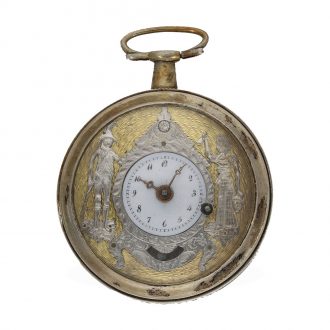
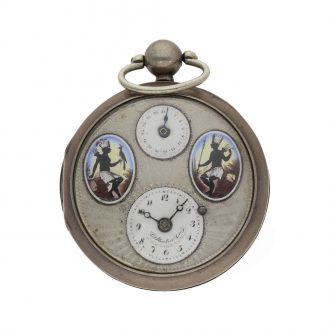
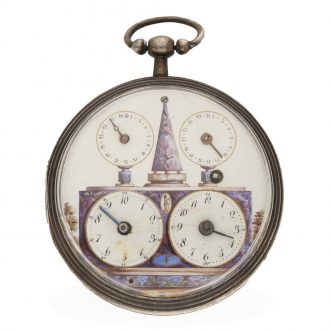
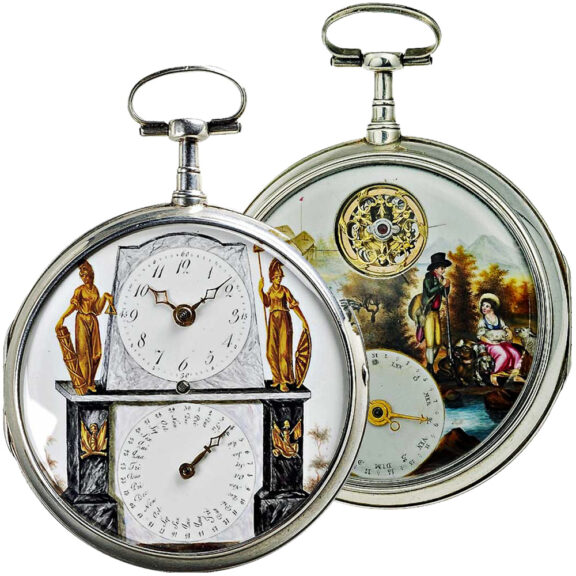
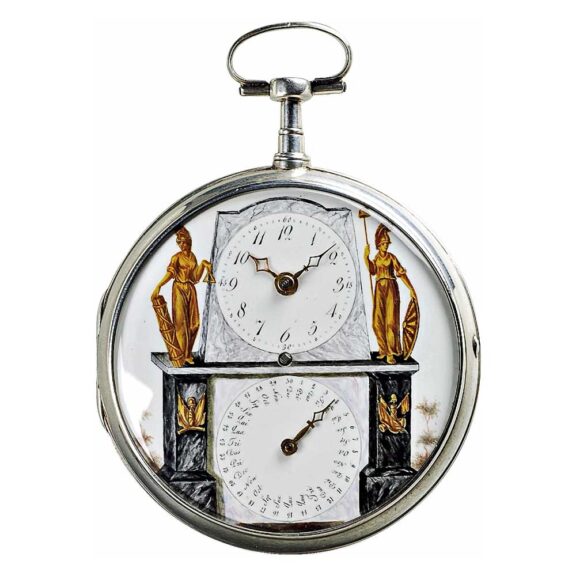
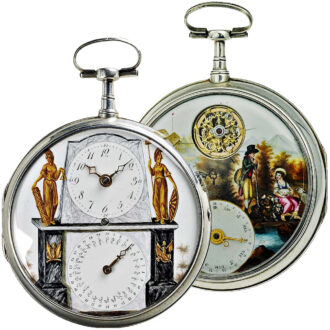
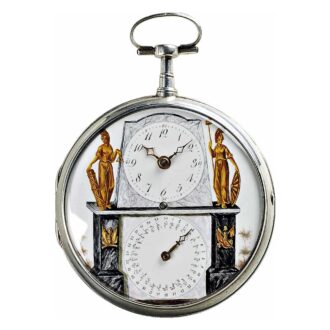
An unusual double-sided pocket watch of the French Revolution, with visible balance, calendar, Debaufre escapement and painted motif Victory of the French Revolution, circa 1795-1800.
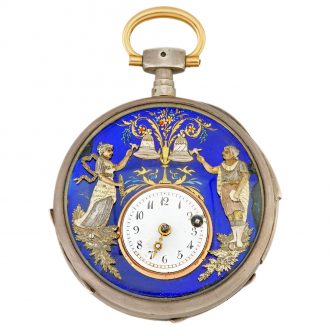
The face of the watch shows two dials: The traditional hours in the top half and a decimal calendar (30 days) in the lower half. Both dials sit in a marble monument painted in different grey- and brown hues. Two statues flank the upper dial; on the left is the personification of the French Republic with a Phrygian cap (the symbol of freedom), a square (the symbol of equality) and the fasces (the symbol of justice). On the right is the goddess Minerva as a personification of victory, with a Phrygian cap on her spear.
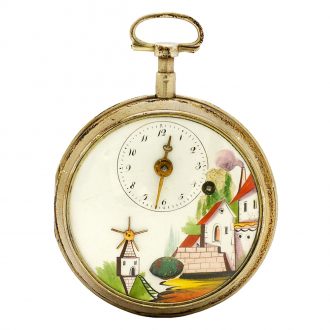
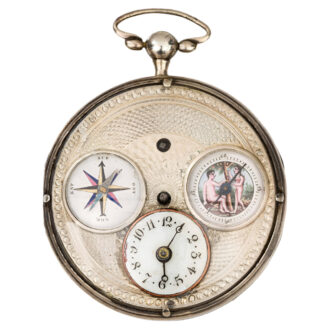
The back is fully covered with polychrome painting and shows a bucolic scene by a river: on the left, a shepherd fishing who raises his hand in a warning gesture; on the right, a huntsman is leaning on his rifle while he talks to a shepherdess. In the background, a farm building with a flagpole is visible – on the flagpole sits a Phrygian cap again.
At the lower edge of the scene sits a dial with a Gregorian calendar with the date (31 days) and days of the week combined with their planetary symbols. The balance is visible at 12 o’clock.
The case is silver, the front- and back dials are enamel and the back has a visible balance. It has a bridge movement, a going barrel, a three arm brass balance and is key wind.
–
Diameter: 59 mm
–
Weight: 100 g
–
Signed: No name
–
An unusual form of pin wheel Debaufre escapement
The escapement used in this watch may be unique. It’s made with two brass wheels with alternating inward facing pins replacing the two standard steel discs; the polished steel pins act alternately on a cut away cone on the balance staff. Using steel pins instead of two steel discs is a very interesting experiment.
–
Decimal time and the Republican calendar
On October 24, 1793, according to the proposal of the mathematician and politician Charles-Gilbert Romme (1750-1795), the National Convention adopted a decree replacing the Gregorian calendar with the revolutionary calendar based on the decimal system.
The day which starts at midnight is then composed of ten hours; these are divided into one hundred minutes, themselves subdivided into one hundred seconds.
The Republican calendar (“calendrier républicain”) is established, the year begins at the autumnal equinox (year one of the Republic began on September 22, 1792), and is divided into twelve months of thirty days each (or three decades), plus five or six complementary days (“jours complémentaires”), which are devoted to the celebration of Republican holidays (“sans-culottides”).
–
The writer and politician Philippe Nazaire François Fabre (1750-1794), known as Fabre d’Eglantine, is responsible for creating new month names inspired by the seasons; they are :
for autumn: vendémiaire, brumaire and frimaire;
for winter: nivôse, pluviôse and ventôse;
for spring: germinal, floréal and prairial;
for the summer: messidor, thermidor and fructidor.
–
The month is divided into three decades of ten appointed days: primidi, duodi, tridi, quartidi, quintidi, sextidi, septidi, octidi, nonidi and décadi.
However, the French did not get used to this new measure of time. On 18 germinal and III (April 7, 1795), the decimalisation of time for an indefinite period, the Convention must suspend. Napoleon I (1769-1821), Emperor of the French (1804-1815), definitively put an end to the Republican calendar on 22 Fructidor an XII (September 9 1805) and officially restored the Gregorian calendar on January 1, 1806.
Share this page: