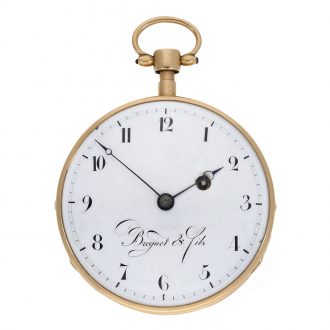
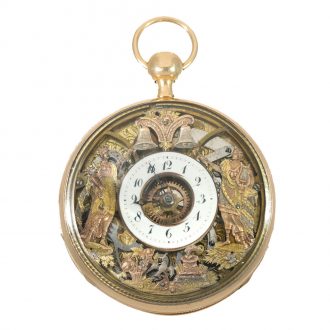
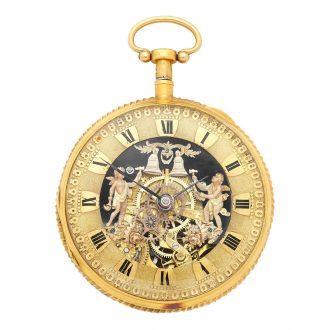
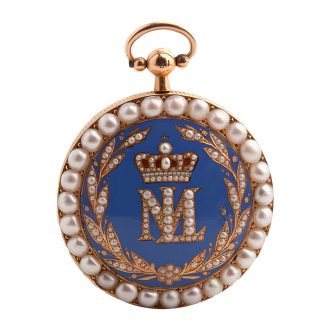
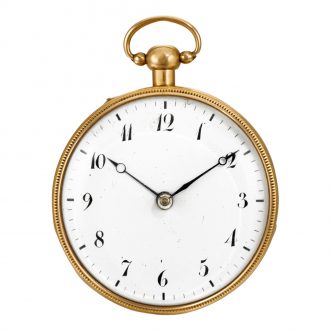
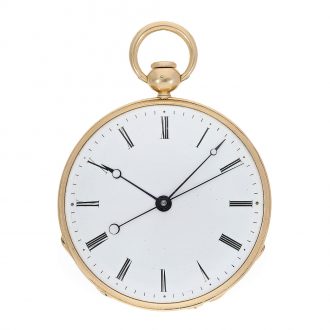
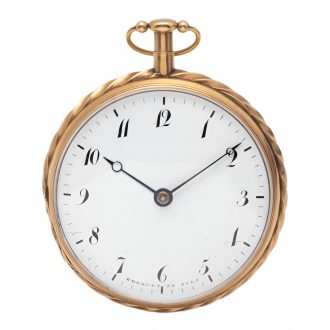
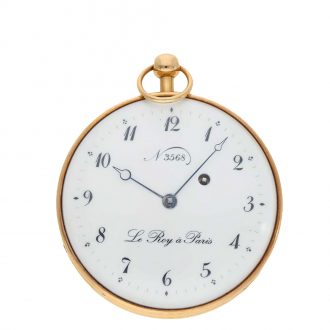
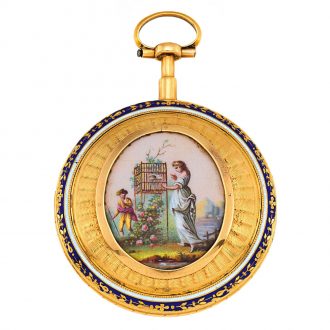
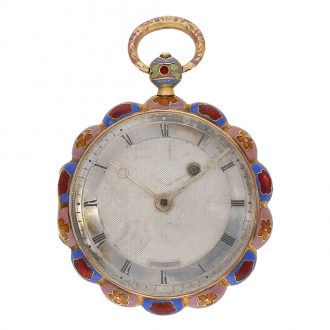
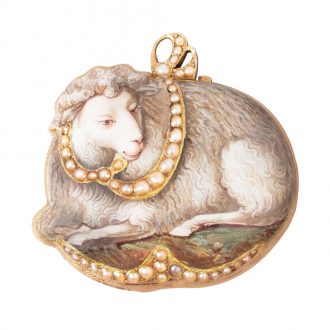
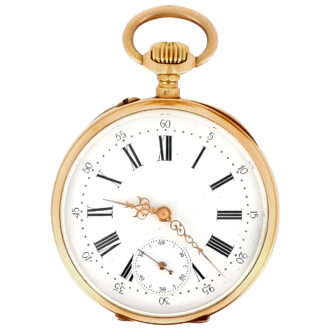
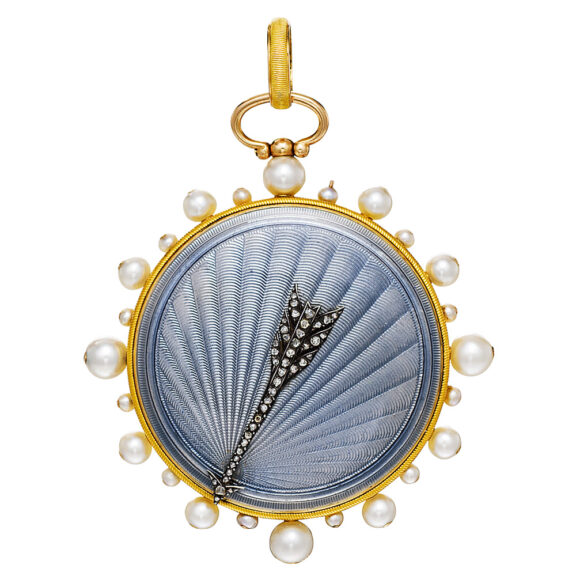
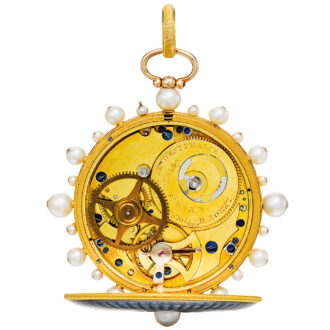
French gold watch studded with diamonds and pearls Circa 1810
- Kenmerk
- AA0238
- Diameter
- 38 mm
- Estimate
- € 35.000 - 60.000
- Price sold
- -
Small gold and enamel cylinder watch by Charles Le Roy
–
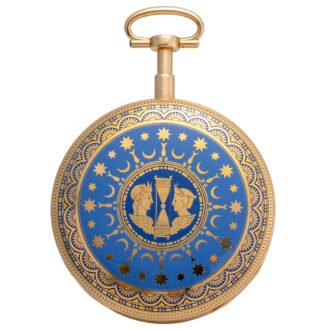
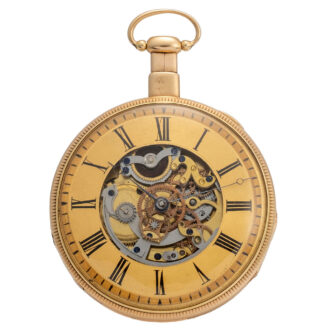
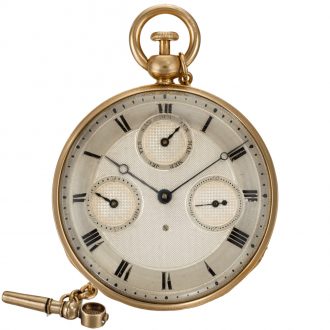
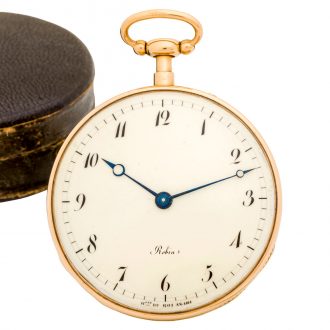
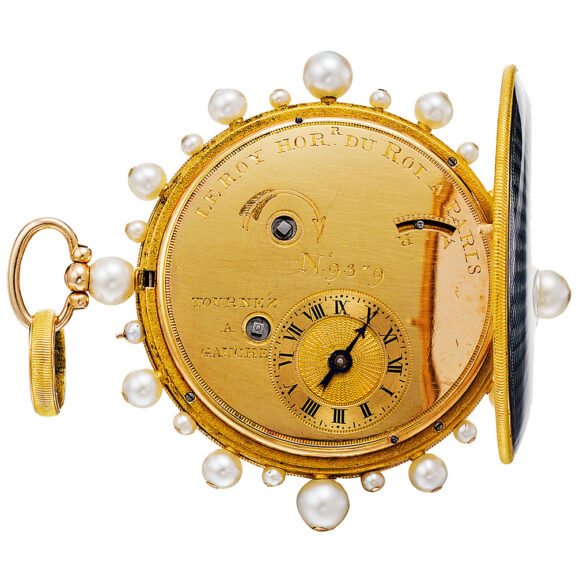
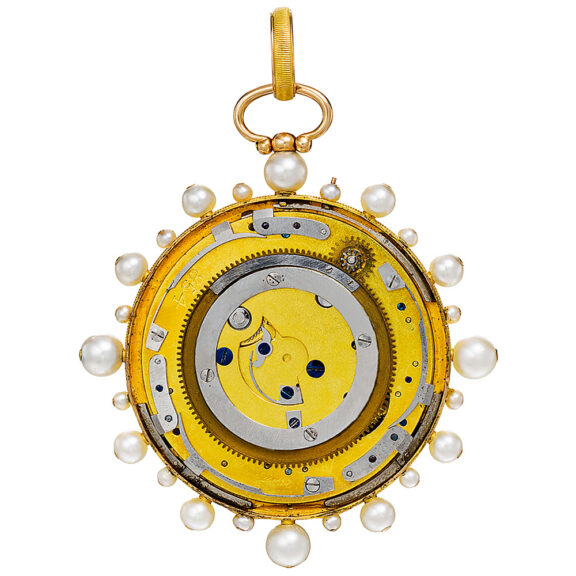
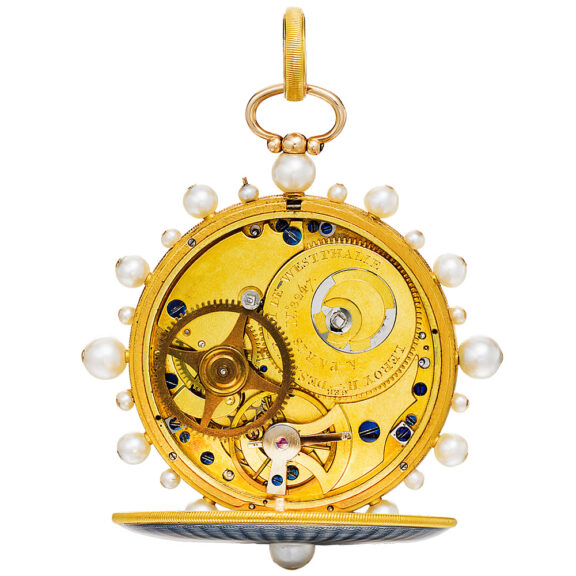
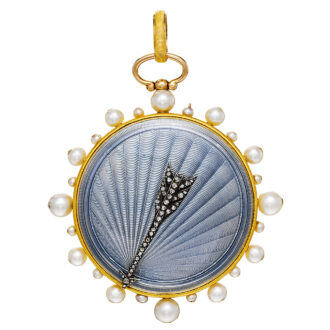
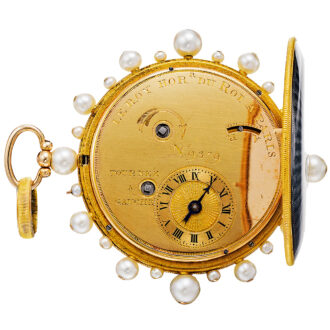
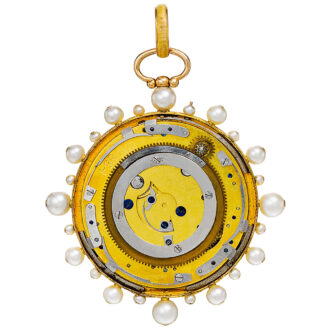
A small French 20 Carat yellow gold, enamel, pearl and diamond set montre médaillon à tact cylinder pocket watch with a tactile feature, circa 1810. Round shaped case, forme collier, set with diamonds and pearls. Grey flinqué enamel with sunburst effect, an eccentric ellipse pattern, revolving the case back, with an à tact arrow handset and applied rose cut diamonds (total weight approximately 0.13 carats). The cover is decorated en suite with a central sunburst effect, both with finely reeded rims, the band set with 24 touch pieces including the pendant, 12 pearls for the hours and 12 seed pearls for the half hours. The polished cuvette is detachable with apertures for winding, setting, regulating and the dial. A gold plate with a small eccentric engine turned dial, Roman numerals. Ebauche gilded brass movement, going barrel, cylinder escapement, steel wheel, monometallic balance (probably in gold) and blued steel flat hairspring.
Dial, case and movement signed.
–
Diameter: 37.5 mm (without pearls)
–
Diameter: 42.8 mm (with pearls)
–
Signed: Le Roy Horr du Roi à Paris
–
Flinqué enamel is translucent enamel over guilloché engine turned.
–
A seed pearl is a small natural pearl. Usually less than a one quarter grain in weight and smaller than 2mm in diameter, off-round in shape. They are formed in either a saltwater oyster or freshwater mussel. In the nineteenth century seed pearls were immensely popular. The pearls were imported from India and China.
Today the term ‘seed pearl’ is more widely used to describe a small pearl that has been created as a result of a pearl farmer trying to stimulate the formation of a cultured pearl in a mollusc.
–
Basile-Charles Le Roy (1765-1839) is the founder of the Le Roy company in 1785 in Paris, 13-15 Galerie Montpensier, Palais-Royal. Circa 1806 he was appointed ‘‘Horloger de S. A. I. & R. Madame, Mère de l’Empereur et Roi’’ (Clockmaker of His Imperial and Royal Highness Madame, Mother of the Emperor and King), Lætitia Bonaparte (1750-1836), mother of Napoléon Bonaparte (1769-1821), Emperor of the French (1804-1814 and 1815). Circa 1810 he became “Horloger de S. M. le Roi de Westphalie” (Clockmaker of His Majesty the King of Westphalia), Jérôme Bonaparte (1784-1860), King of Westphalia (1807-1813), youngest brother of Napoléon I.
–
This watch demonstrates the strong influence of Abraham-Louis Breguet (1747-1823) on one of the best Parisian makers of his time, Bazile-Charles Le Roy although he was not his pupil. The present piece can be compared with the best quality produced by the eminent maker, the father of modern watchmaking. A few montres médaillon à tact were created by other makers during Breguet’s life and even after his death. Most of the rare examples which were not made by one of his pupils, Charles Oudin (1768-1840) in Paris, carry the signatures of Le Roy and Lépine in Paris (house founded by Jean-Antoine Lépine (1720-1814), at this time led by Claude-Pierre Raguet-Lépine (1753-1810), his son-in-law.
–
Apart from the highly decorative watches made by Breguet for the Islamic Market on the advice of his friend, Esseid Ali Effendi (or Morali Seyyed Ali Effendi, circa 1750-1809), first Ottoman ambassador in Paris (1797-1802), he also produced gold and enamel, pearl or diamond-set montres à tact, namely for those clients of his who were fond of highly decorative watches enhanced with enamel and precious stones. Although the decorative elements remained largely functional, such watches, less austere in appearance than Breguet’s usual production, enjoyed a certain success despite their high price. Virtually every member of the Bonaparte family owned at least one example.
–
Unlike Breguet’s montres médaillon à tact which are built on the basis of the “souscription” calibre (with central barrel), the watches made by Le Roy are built with a Lépine-type calibre. Breguet classified his “souscription” watches as “petite”, “moyenne” and “grande”. Of about 915 subscription type watches that Breguet made, only about 35 “Petites” are known to exist. Most of these are montres médaillon à tact. This proves the rarity of this kind of pieces. It appears that Breguet first made them in the spring of 1799, the first one being sold to Madame de Bétancourt, the wife of Breguet’s most trusted friend, Augustin de Bétencourt y Molina (1758-1824), a hydraulic engineer. When looking through Breguet’s records, one notes that these enamelled, diamond-set montres médaillon à tact are among his most expensive watches (without horological complication), between 1 500 and 1700 francs!
–
Charles-Bazile Le Roy also made very few watches of this kind under his type, only nine are known today.
–
The à tact feature was often used when the owner wanted to check the time discreetly. Later, in the mid-19th century, Genevan watchmakers built other types of montres à tact, so-called montres d’aveugles (watches for blind people). Some examples are known made by Bautte (house founded by Jean-François Bautte (1772-1837) in 1791), Patek Philippe (house founded in 1839) and Ekegrèn (house founded by Henri-Robert Ekegrèn (1823-1896) in 1857).
Signed: Le Roy Horr du Roi à Paris
Share this page: