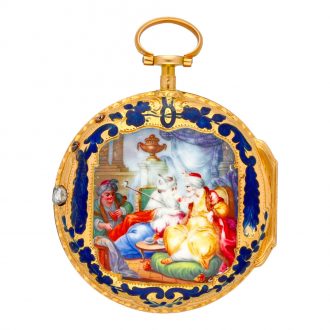
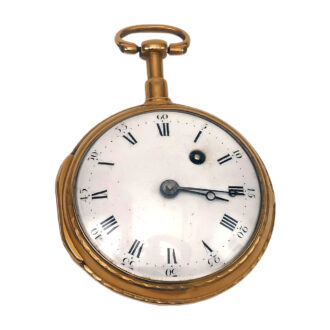
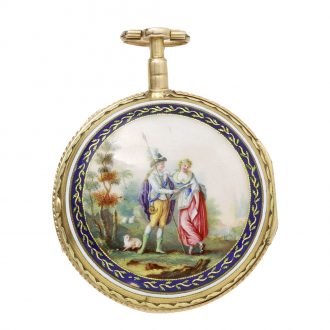
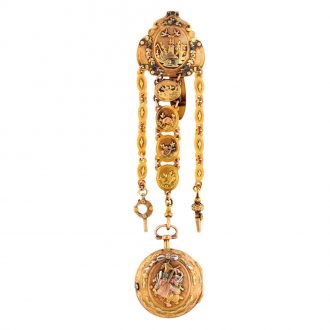
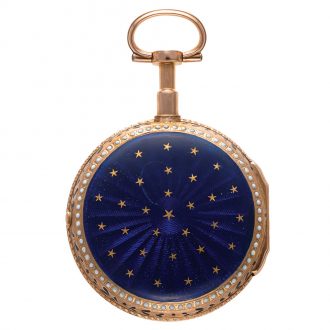
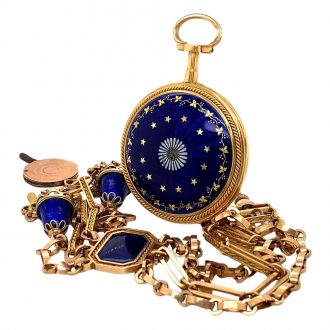
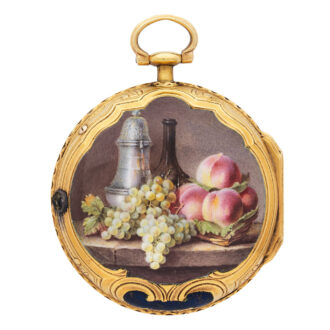
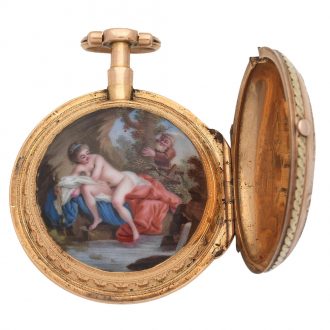
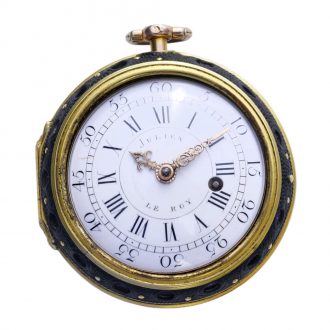
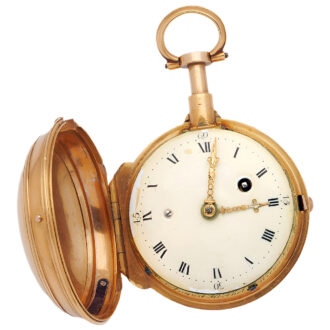
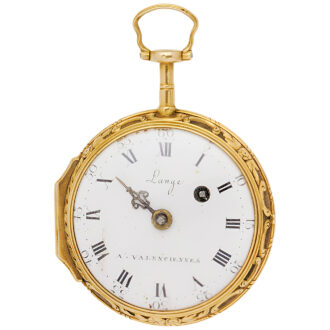
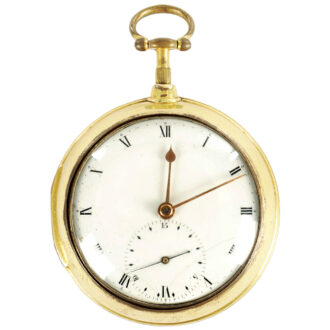
French 18K gold double virgule watch, enamel scene Circa 1775
- Kenmerk
- FF0040
- Diameter
- 41 mm
- Estimate
- € 6.000 - 12.000
- Price sold
- -
–
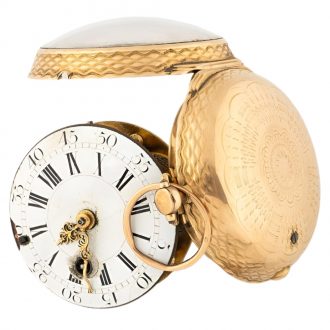
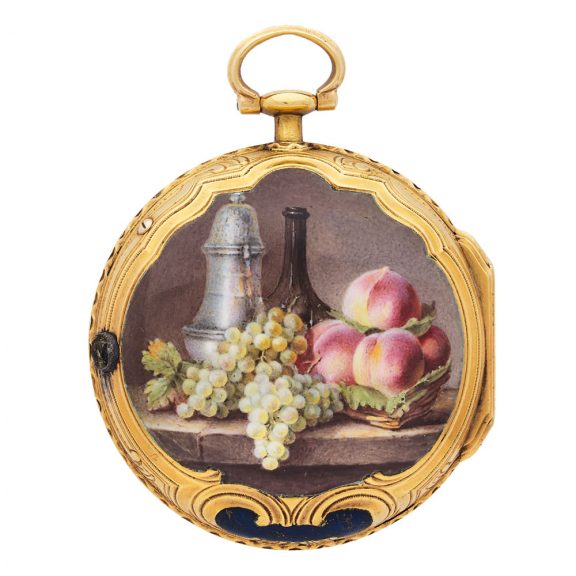
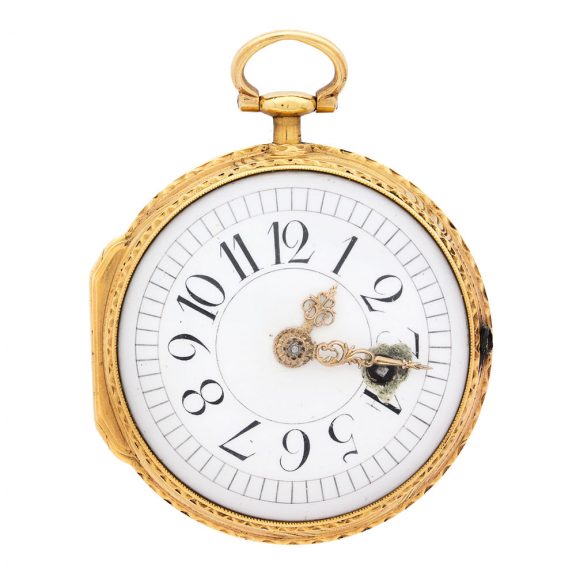
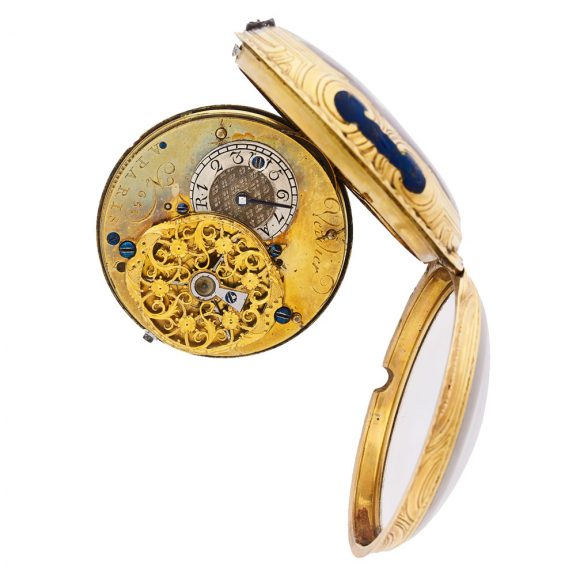
A French 18 carat gold and painted enamel scene Still life with grapes pocket watch attributed to Hamelin with double virgule escapement, circa 1775. Full plate gilt movement with key winding, double comma escapement, pierced and engraved balance cock, blued balance spring, fusee and chain, silver adjustment disc, decorative pillars between the two plates, signed Verdier in Paris.
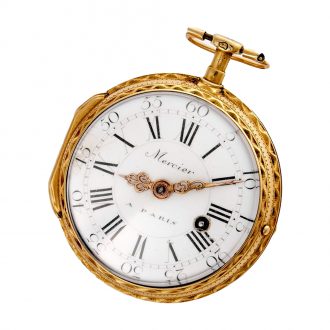
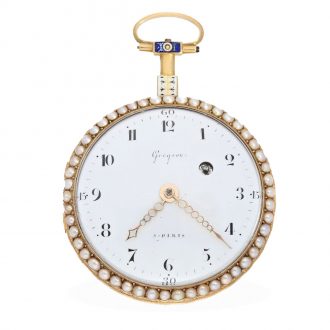
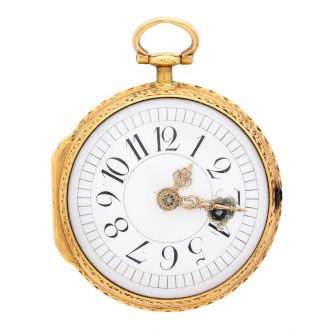
Later white enamel dial with large Arabic numerals, external railway minute track, decorative gilt hands and opening for the winding square.
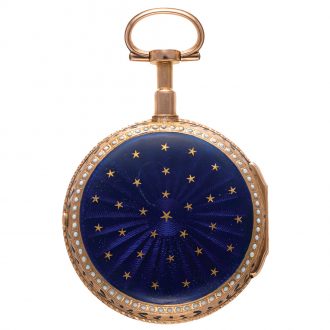
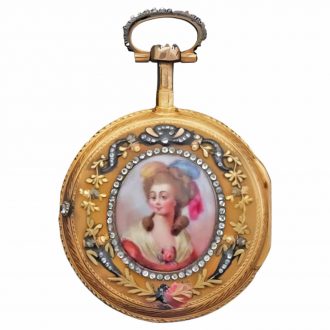
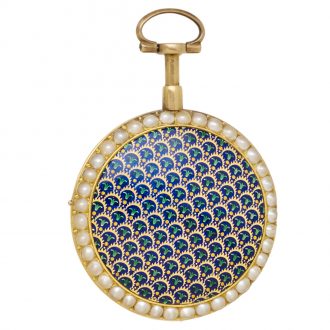
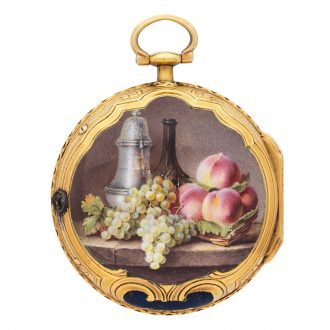
Round gold case with a polychrome painted enamel scene in the Dutch style attributed to Hamelin, representing a still life with fruit, case band with blue enamel cartouches.
–
Diameter: 41.5 mm
–
Weight: 62.9 g
–
Signed: Verdier à Paris
–
Still Life with Grapes attributed to Hamelin. Signed enamel miniatures by Hamelin are extremely rare. There appear to be only four snuff boxes recorded incorporating signed works by him. Two of these are mounted on boxes by Jean Ducrollay, one in the Wallace Collection (illustrated in R. Savill, The Wallace Collection – French Gold Boxes, London, 1991, no. 6) and a second, dated 1758, is in the collection of the Taft Museum. The third, signed and dated 1758, formerly in the collection of Louis Surmont, Paris.
–
Verdier, Horloger à ParisJean-Jacques-Baptiste Verdier was a Parisian clockmaker active in the 18th century, renowned for the quality and elegance of his creations. His works, often signed “Verdier à Paris”, reflect the refinement of French clockmaking of the period. Jean-Jacques-Baptiste Verdier worked in Paris and became a master in 1737. He is recorded as having established himself in 1739 on the Rue des Marais, and he became a Juré in 1773. The Double Comma Escapement: The Subject of a ScandalThe double comma escapement was the subject of one of the greatest watchmaking scandals in 18th-century France. In 1753, the King’s burgomaster, Jean-André Le Paute, published a description of a new escapement for watches derived from the pinwheel escapement that had been used with great success in clocks.
The new escapement, the details of which were given in Le Paute’s book, was called the double comma escapement.
However, Pierre-Augustin Caron, 21, son of another clockmaker to the King, André-Charles Caron, wrote in an open letter to the Mercure de France that in July 1753 he had shown Le Paute the escapement of his own invention, and that the latter had copied it and claimed it as his own.
The affair caused such a stir that the case was brought before the Royal Academy of Sciences, which on March 4, 1754, ruled in favour of Caron as the inventor. In December 1754, the clockmaker Jean Romilly presented to the Academy another version of the double comma, which the institution decided had been invented independently of Caron. Thus, both clockmakers were credited with its invention.
Although the double comma gave good results, it was very rarely used, probably because of the difficulty of its manufacture and its extreme fragility. Today, watches with this escapement are extremely rare, such as our example which has a double comma.
Although it is not signed, the high quality enamel of this watch can be compared to the work of the best French enamel painters of the time, such as Hamelin, he is considered one of the best French enamelers of the 18th century.
Signed: Verdier
Share this page: