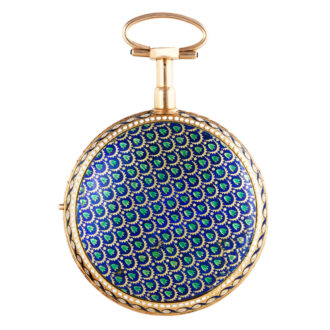
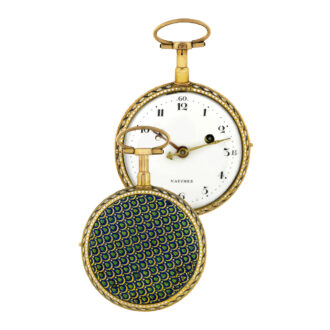
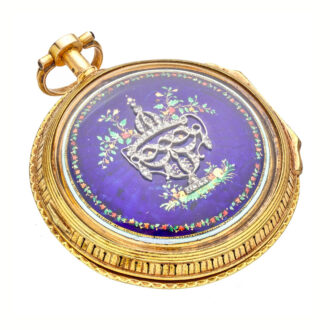
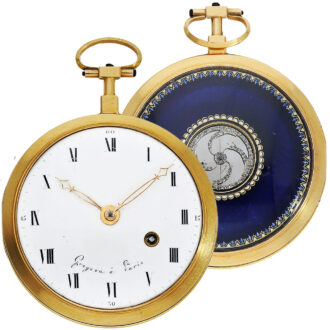
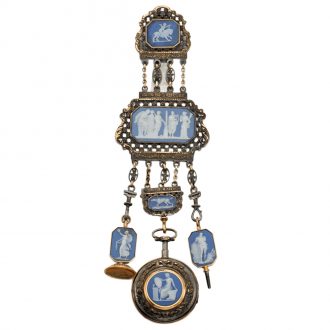
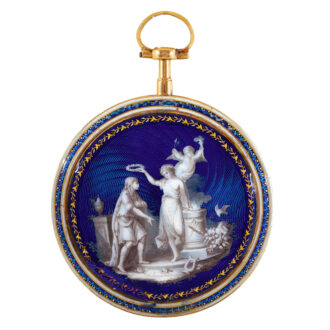
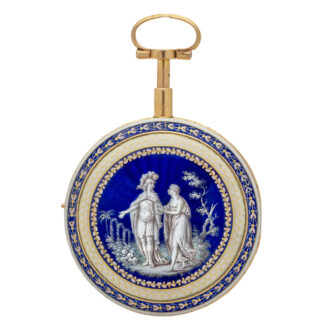
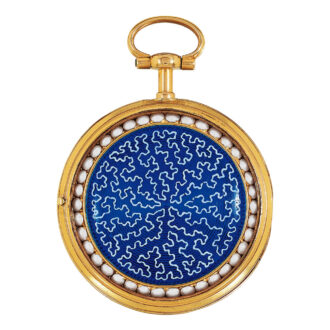
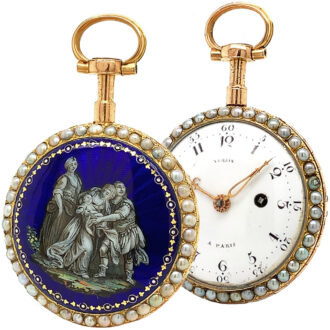
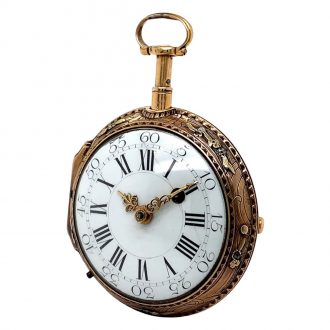
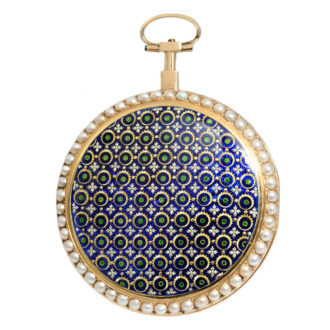
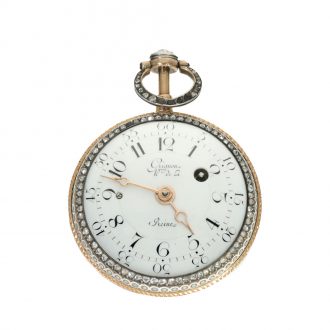
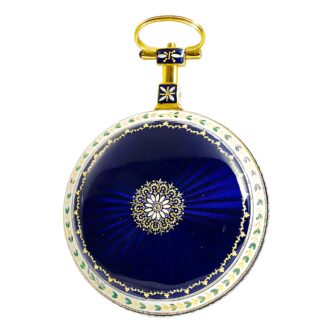
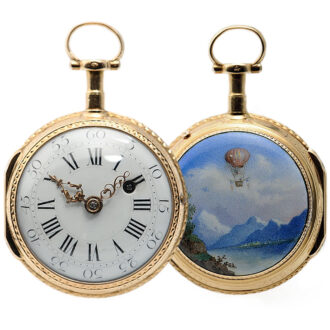
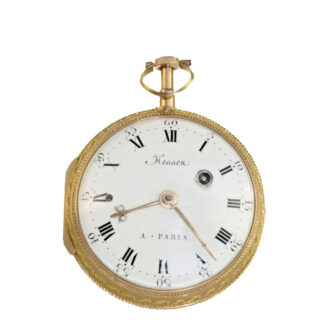
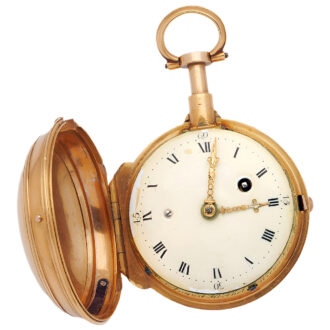
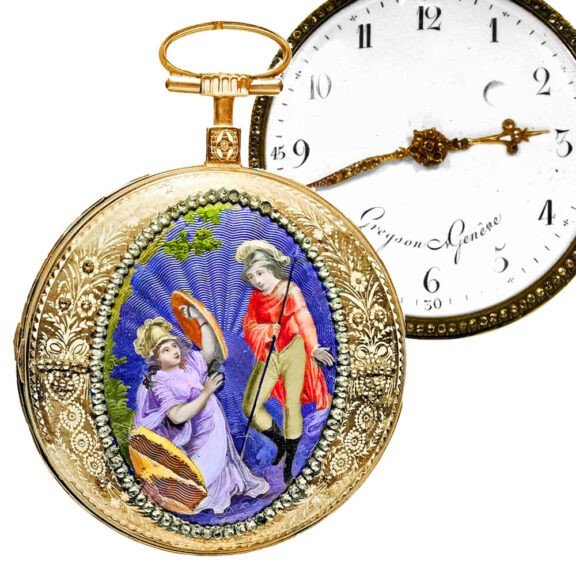
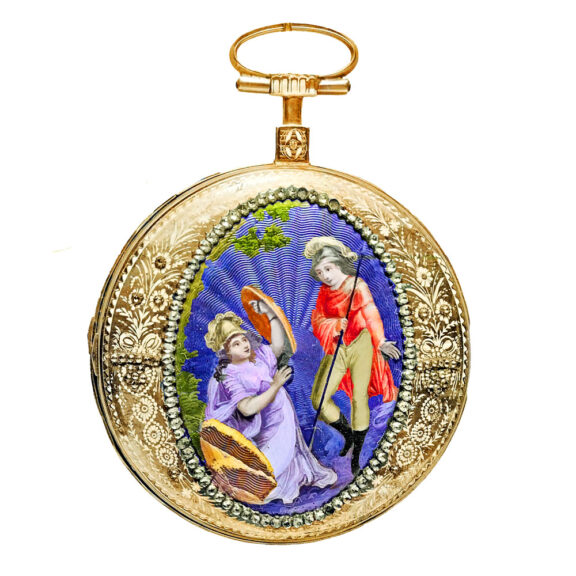
French gold, painted enamel and diamond-set pocket watch Circa 1785
- Kenmerk
- AM0234
- Diameter
- 48 mm
- Estimate
- € 4.500 - 7.500
- Price sold
- -
Gold and enamel watch by Jean-Pierre Gregson
–
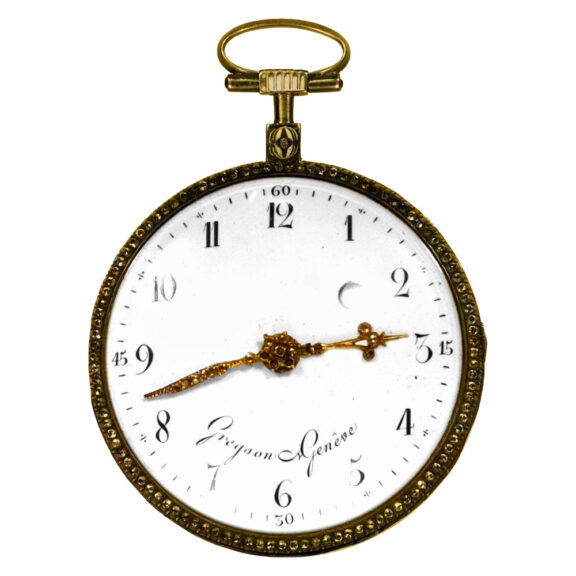
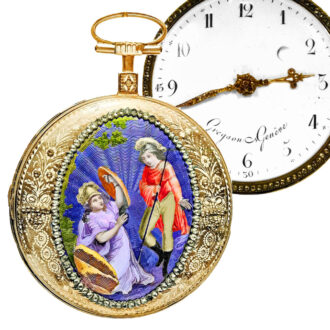
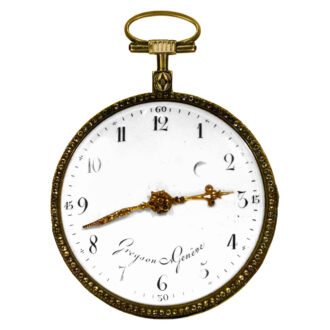
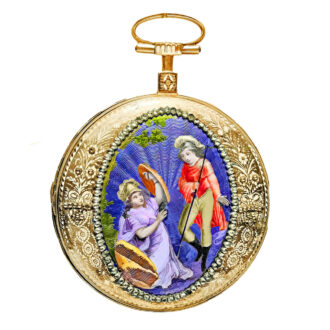
An impressive French gold, enamel and diamond set pocket watch, circa 1785. Cylinder movement. Floral engraved gold case, adorned with a diamond set frame and an oval medallion with a polychrome enamel scene on the back. White enamel dial with radial Arabic numerals, an outer minutes track with fifteen-minute numerals and exceptionally beautiful diamond-set hands. Signed on dial and movement.
–
Diameter: 48 mm
–
Signed: Gregson à Genève
–
Jean-Pierre Gregson, Paris court watchmaker of English descent
Jean-Pierre Gregson was originally from England. In 1776, he became a royal clockmaker in Paris and established himself in the Rue Dauphine, parish of Saint-André-des-Arts. He learned his trade in London before moving to Paris in the second half of the 18th century. He was married in England to Élisabeth Jefferson.
–
Gregson was evidently a very capable master and was among the first watchmakers to use Lépine’s bridge calibre. In 1776, he was appointed watchmaker to the court, which was soon reflected in the names of his watches. Initially signed ‘Gregson à Paris’, the addition ‘Hger du Roy’ was added later. His important position is also reflected in the fact that 1786, he was appointed a commission member to set up a royal factory. The other members were France’s most famous watchmakers – Breguet, Berthoud and Lepaute. He passed his business to Braille or lt. Baillie in 1787.
–
After the outbreak of the French Revolution, being a clockmaker to the royal court was not exactly business-friendly, and Gregson hurriedly resigned his title. While he still signed his repeater watch no. 2181 as “Hger du Roi”, he was only “Hger à Paris” for watch number 2276.
–
Gregson had a penchant for intricate escapements and outlandish shapes. He often used cylinder or comma escapements in his pocket watches. The wolf’s teeth can also often be found. Among other things, he built gold enamel clocks with a comma escapement, clocks with a visible balance wheel and sweep seconds hand. He also made pocket watches with detent escapements.
–
In 1790, he returned to his safe home in London. He established a new workshop in London called “Gregson London”. There, he continued to build clocks in the French style; he retained the numbering system here as well. Between 1800 and 1815, he associated for a time with a colleague named Jefferson, and Gregson used the signature ” Gregson & Jefferson, London “.
Signed: Gregson à Geneve
Share this page: