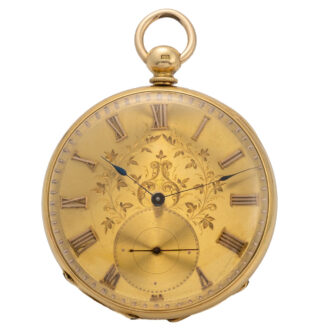
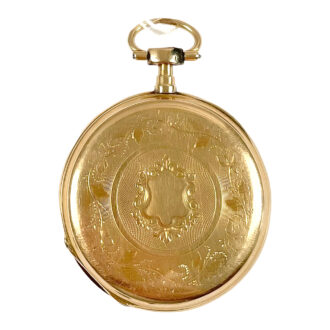
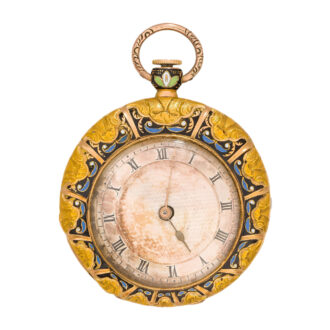
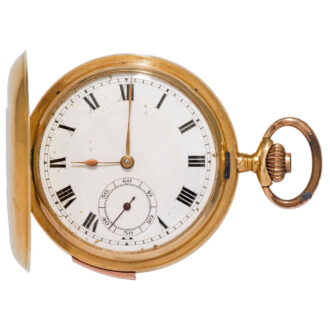
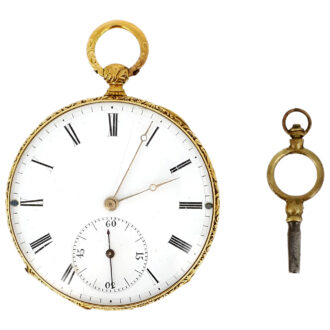
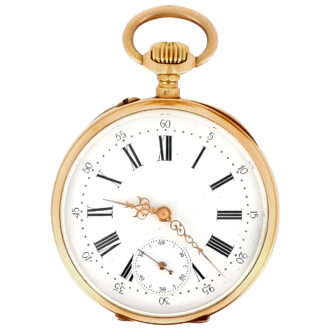
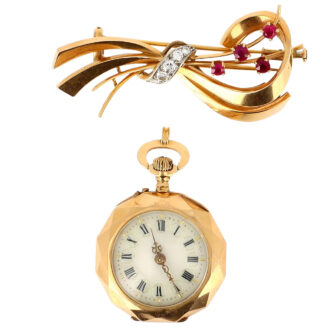
Swiss gold repeater with grande and petite sonnerie Circa 1850
- Kenmerk
- TA2039
- Diameter
- 53 mm
- Estimate
- € 30.000 - 60.000
- Price sold
- € 142.150
Gold hunting cased lever clockwatch
–
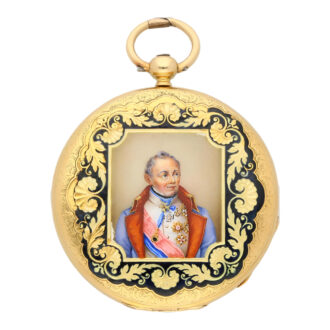
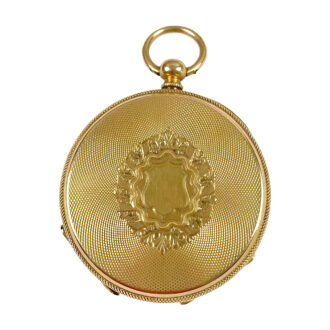
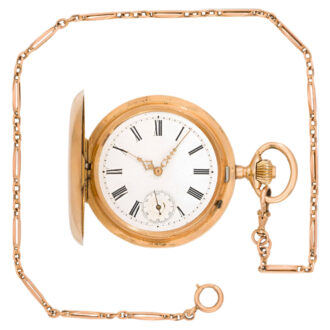
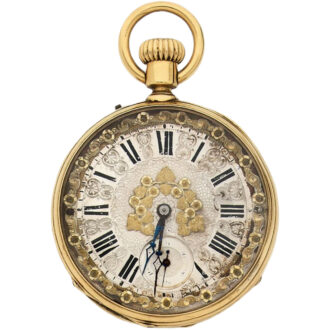
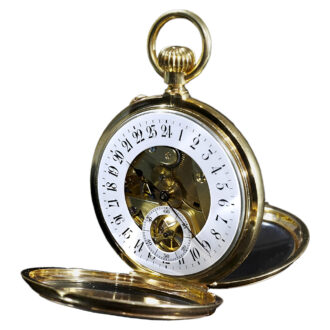
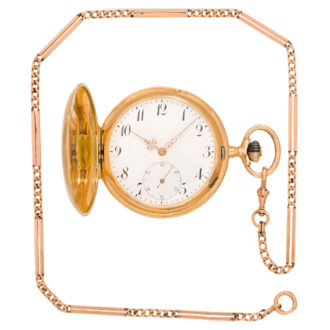
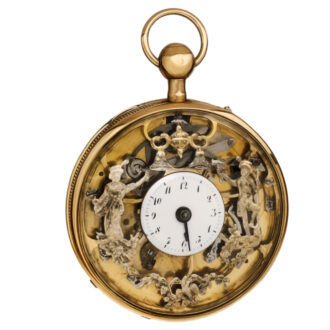
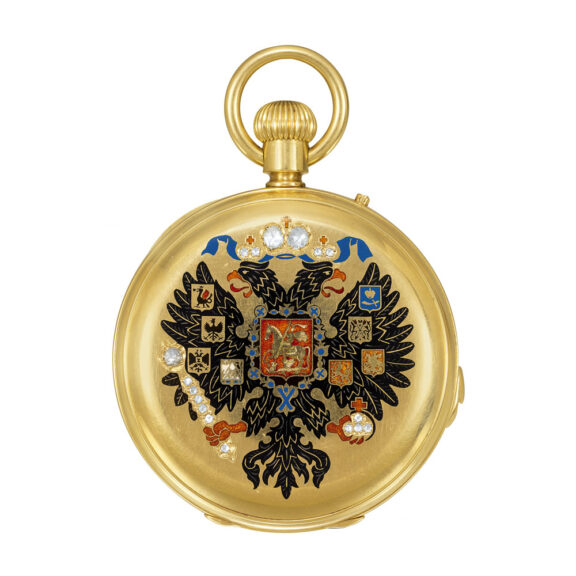
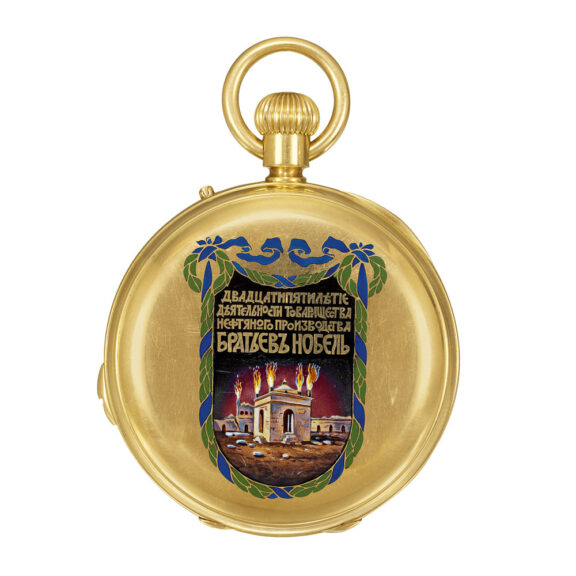
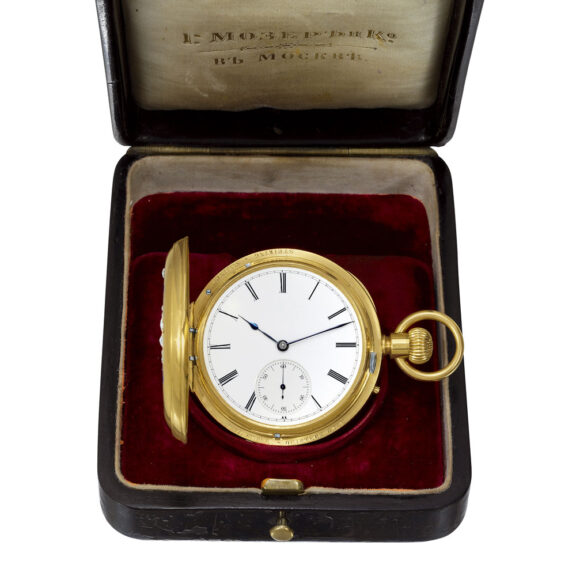
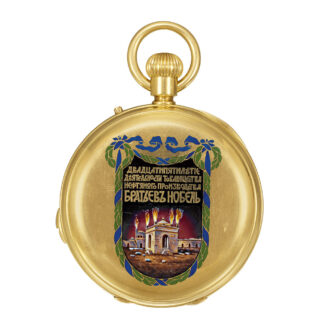
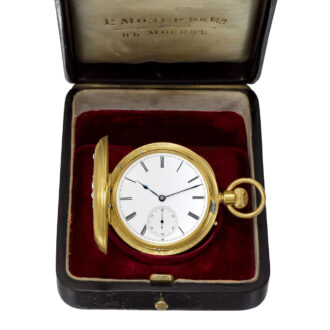
A very fine and extremely rare Swiss 18K yellow gold hunting cased pocket watch, circa 1850. With trip-quarter repeating, polychrome enamel and rose-cut diamond-set, Grande & Petite sonnerie, keyless, two-train clockwatch. Accompanied by a long 18K gold chain and the original fitted Moser box. Made by Hy. Moser & Cie. Swiss, specially made for the Nobel Brothers Petroleum Company, Baku Azerbaijan, circa 1890.
–
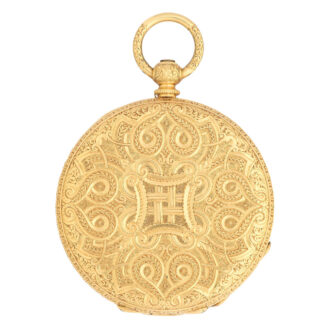
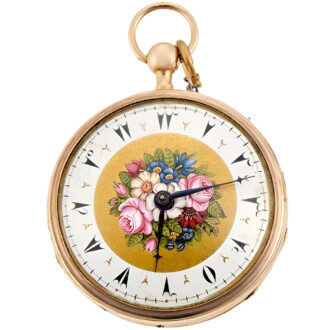
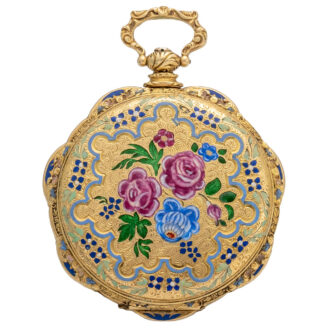
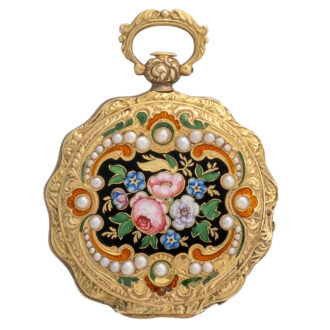
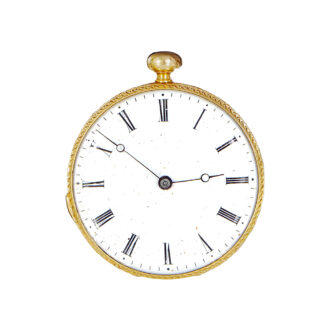
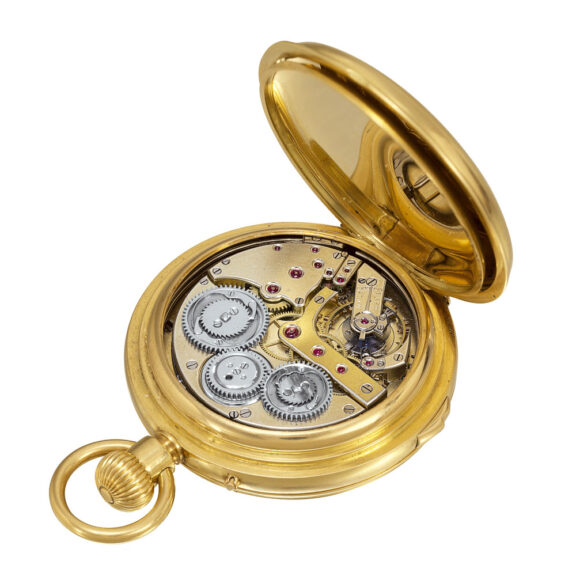
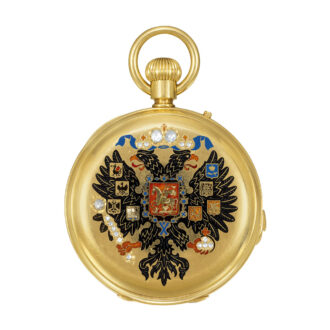
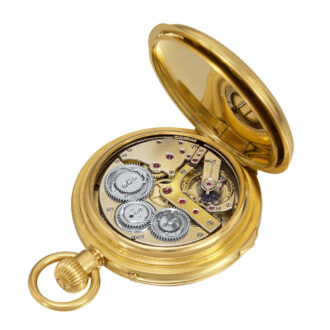
A solid, polished case, the front cover decorated with the Russian Imperial arms in black, red and blue champleve enamel and with rose-cut diamond-set crowns, orb and sceptre, the back cover decorated with the finely painted polychrome enamel logo of the Nobel Brothers Petroleum Company depicting the Fire Temple of Atashgah near Baku within a red and blue champleve enamel border of ribbons and laurel leaves. Hinged gold cuvette, glazed gold-rimmed cover over the movement. White enamel dial, radial Roman numerals, outer minute track, subsidiary seconds. Blued steel spade hands. A frosted gilt movement, 35 jewels, two-train with tandem winding, straight-line counterpoised lever escapement, cut bimetallic compensation balance, blued steel Breguet balance spring, index regulator, striking/silent and full strike/quarters only selection levers in the bezel, repeating on gongs activated by a trip slide on the band. Cuvette signed.
–
Diameter: 53 mm
–
Signed: Hy. Moser & Cie. Swiss
–
The dial has some scratches
–
Johann Heinrich Moser (1805 – 1874)
Swiss watchmaker, son of a clockmaker, moved to St. Petersburg about 1827, where he opened a watch business (Nevskii Prospect and Malaya Konyushennaya St.). He had also a branch in Moscow. Moscow registers show that he had an office there from 1827 to 1874 on Ilinka St. In 1874 the son Henry Moser, Jr. took over the business. The Moser Co. did business all over Russia, including such far places as Vladivostock in Siberia. In the third quarter of the 19th century, they became suppliers to the Tsar.
–
Nobel Brothers Oil Company
Branobel (short for Brothers Nobel) was the oil company set up by Ludvig and Robert Nobel in Baku, Azerbaijan. Founded in 1876, it was, during the late 19th century, one of the largest oil companies in the world. About 12% of the money left to establish the Nobel Prizes by Alfred Nobel came from his shares in the company; he was its largest individual investor. The Nobel Brothers Petroleum Company was an oil-producing company established in St. Petersburg in 1879. On April 10, 1902, the company signed a contract for the purchase of oil fields in Romany, which were owned by the oil producer Isabey Hajinsky. On October 17th, 1905, in accordance with the Committee of Ministers, the company purchased the oil fields owned by oil producer A. Adamov. The company’s fixed capital in 1914-1917 was 30 million rubles. By 1916, it was the largest oil company in Russia, producing 76 million poods of oil. The Russian General Oil Corporation, established in London in 1912 by the most important Russian and foreign banks, united 20 companies. These included A.I. Mantashev & Co., G.M. Lianosov & Sons, Moscow-Caucasus Trade Company, Caspian Partnership, Russian Petroleum Society, Absheron Petroleum Society and others. The fixed capital in oil in 1914 was 23 million rubles. By 1917 it had increased to 125 million rubles under the management of the Russian-Asian Bank. On April 28, 1920, the Bolsheviks seized power in Baku and the Branobel’s oil business was nationalized.
Signed: Hy. Moser & Cie. Swiss
Share this page: