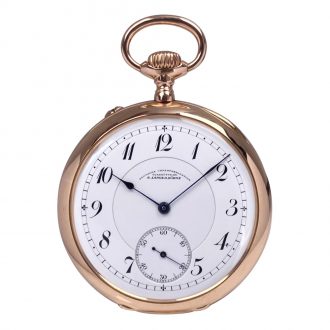
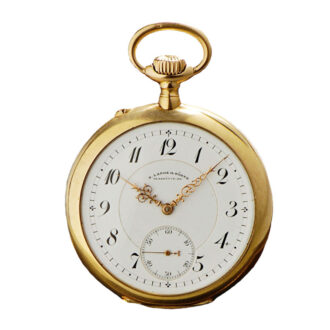
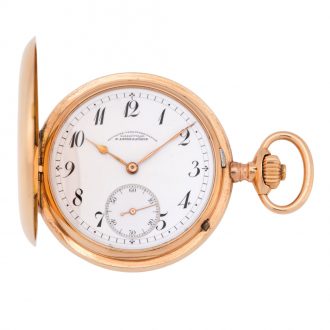
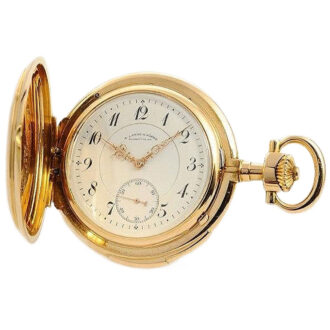
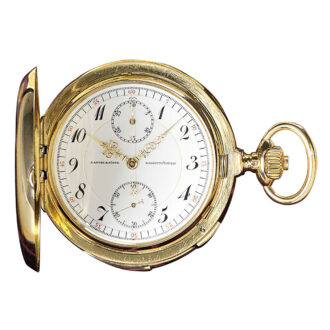
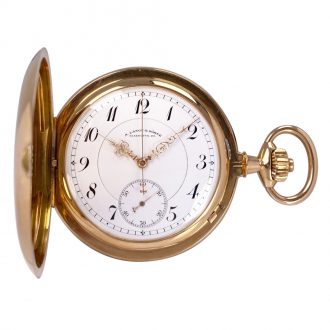
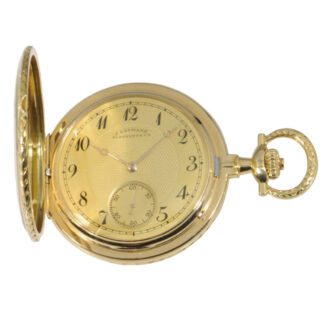
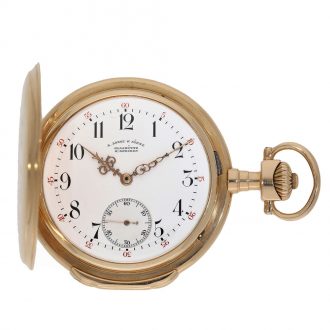
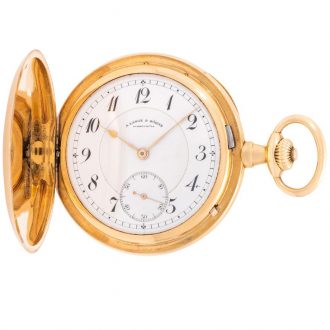
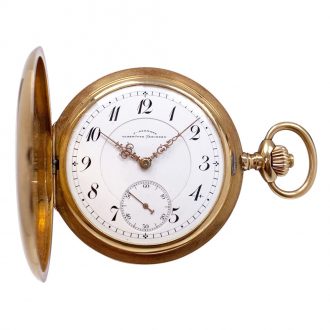
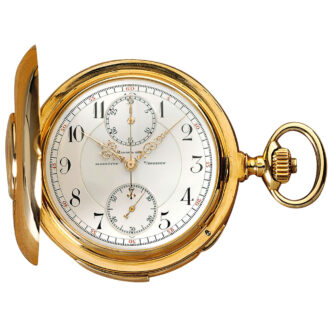
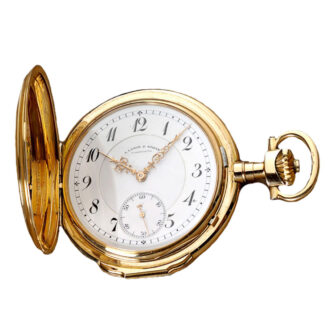
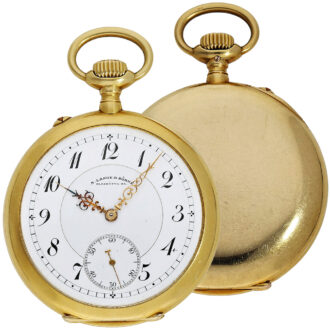
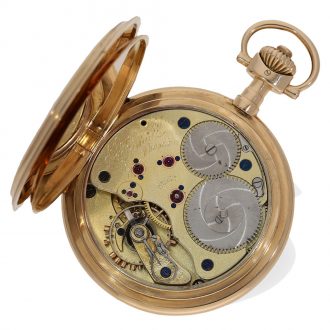
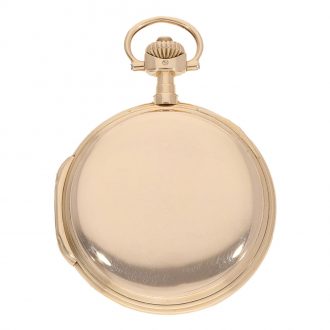
German 18 carat gold Louis XV gold full hunter case watch Circa 1912


- Kenmerk
- HC1738
- Diameter
- 55 mm
- Estimate
- € 4.500 - 10.000
- Price sold
- € 5.450
Very fine large watch with Guillaume integral balance
–
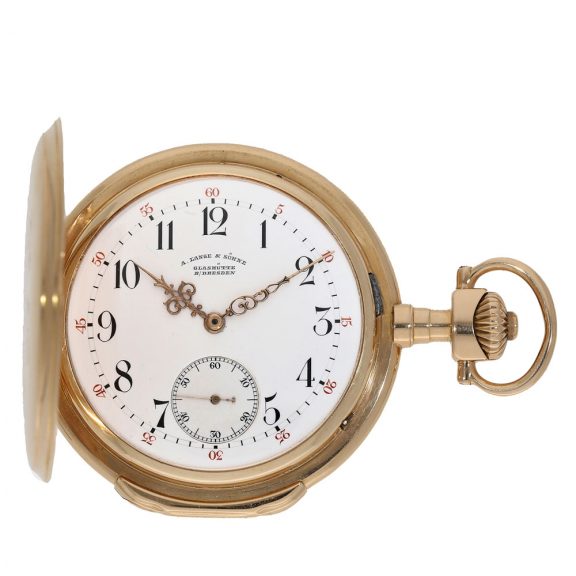
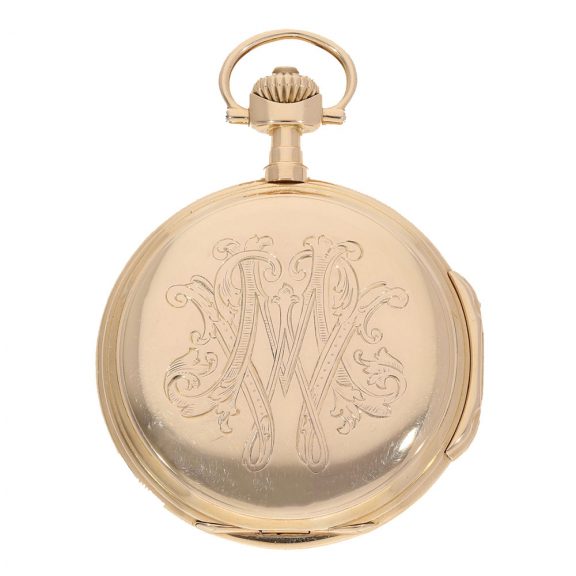
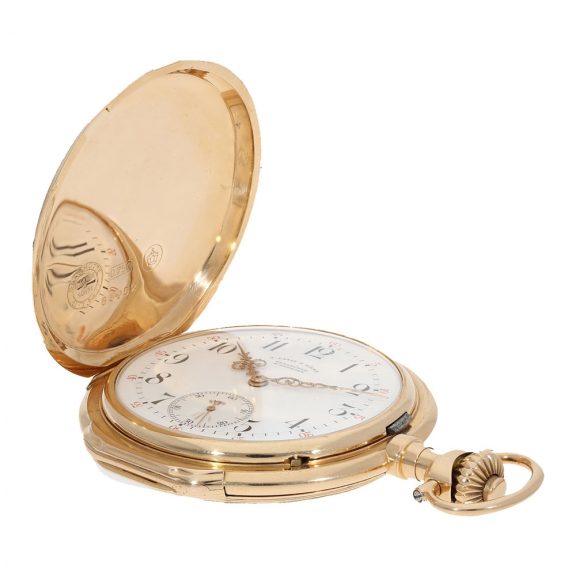
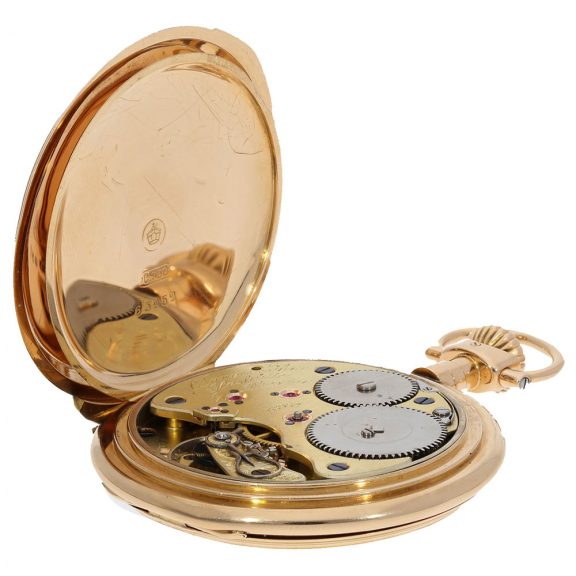
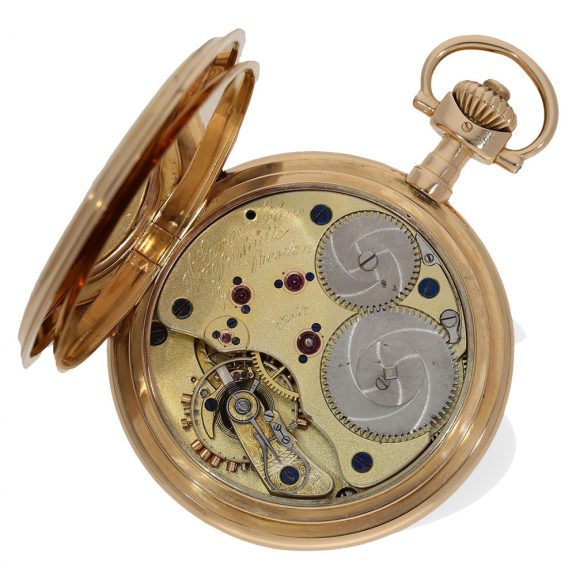
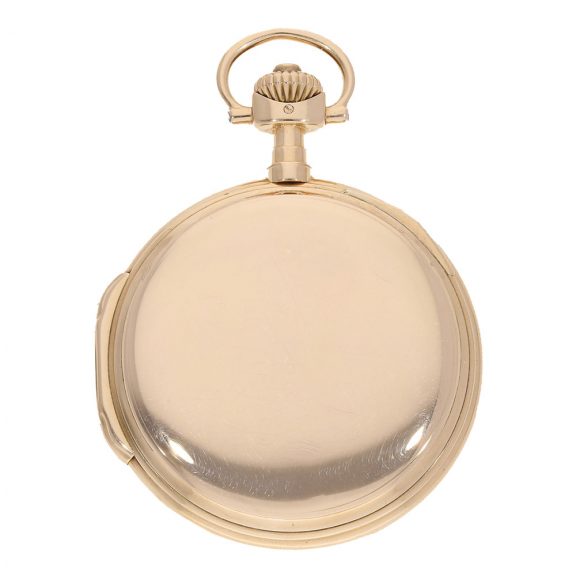
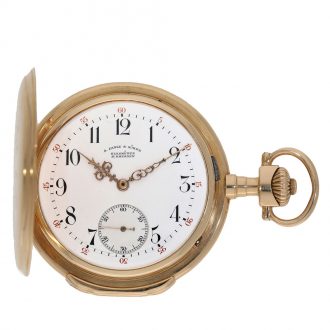
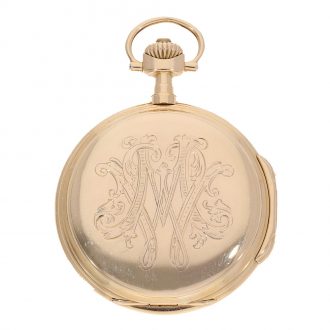
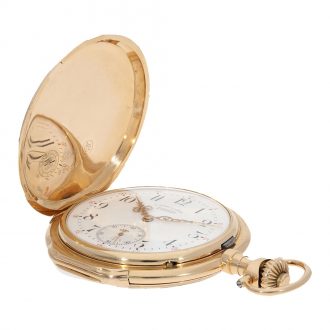
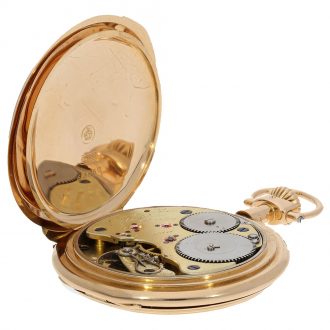
A very fine large Louis XV gold hunting case watch, 1A Guillaume integral balance, A. Lange & Söhne in Glashüute, Germany, circa 1912. The numbered case of this watch was crafted from 18 carat gold, bears the watchmaker’s stamp and has a monogram on the front lid. The white enamel dial features an outer ring with red Arabi 5 minute numerals, black Arabic hour numerals, a subsidiary seconds scale at 6 o’clock and Louis XV gold hands. The numbered best quality 1A movement is fitted with a lever escapement, screwed gold chatons, a gold escape wheel, a gold lever, a Guillaume integral balance and a diamond end stone.
The case and movement have matching numbers and the dial and movement are signed.
–
Diameter: 54,5 mm
–
Weight: 118 g
–
Signed: A. Lange & Söhne, Glashütte, B/Dresden
–
Guillaume integral balance
The Guillaume integral balance is a specific type of temperature-compensating balance wheel used in high precision mechanical watches and marine chronometers. It was developed by the Swiss physicist Charles-Édouard Guillaume, who won the Nobel Prize in Physics for his work on nickel steel alloys.
The primary purpose of the Guillaume balance is to eliminate the “middle temperature error” (also known as Dent’s anomaly) that was a persistent problem in earlier chronometers with standard compensation balances. This error caused a watch to run at a slightly different rate at moderate temperatures compared to the average of its rates at temperature extremes.
–
Key features of the Guillaume balance
Material: It is a bimetallic balance, typically made of an alloy of steel and nickel called anibal and brass. The different thermal expansion rates of these metals allow it to flex in response to temperature changes.
Design: Unlike an ordinary compensation balance which has two long, curved bimetallic strips, the Guillaume balance uses shorter, four section bi metallic strips cut at a specific angle (90°C to the bar).
Function: As the temperature changes, these sections curl inwards or outwards, moving small compensation weights closer to or further from the balance staff. This changes the balance’s moment of inertia and effectively adjusts the balance spring’s acting length, thereby keeping the watch’s rate consistent across a wider range of temperatures.
Legacy: The innovation, first used around 1904, significantly improved timekeeping accuracy and became a hallmark of observatory grade chronometry, used by renowned watchmakers like Patek, Philippe, Zenith and Ulysse Nardin.
Guillaume’s further work led to the invention of Elinvar, an alloy with an almost invariable elasticity that, when paired with a monometallic balance, offered even better temperature compensation.
Signed: A. Lange & Söhne, Glashütte, B/Dresden
Share this page: