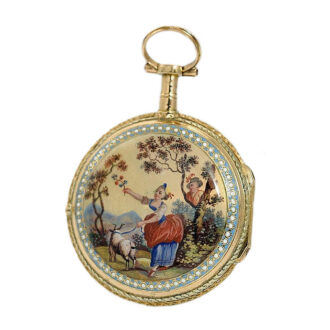
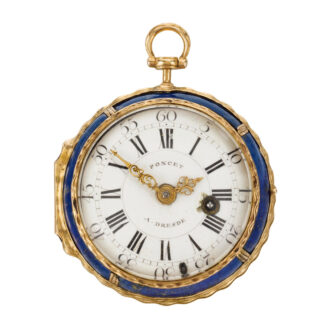
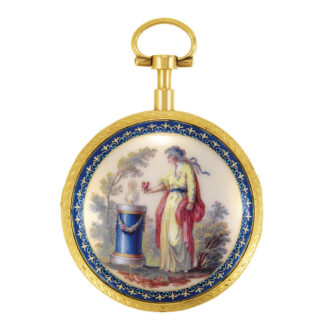
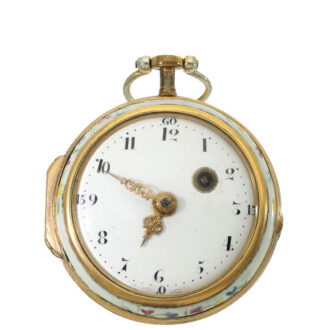
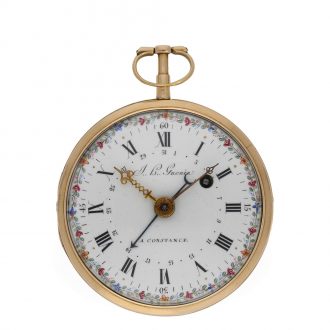
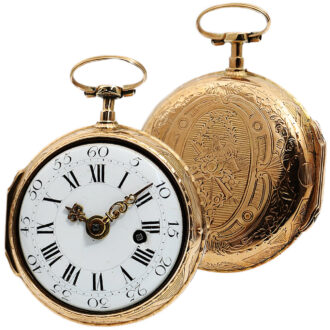
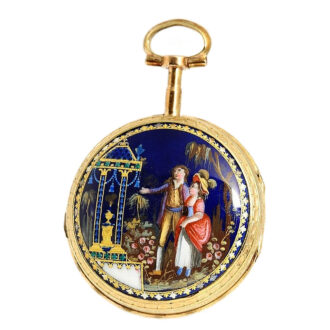
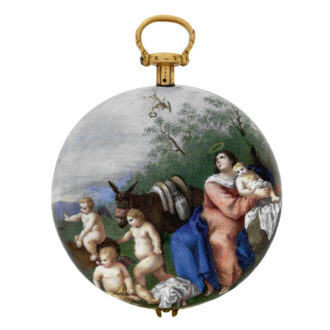
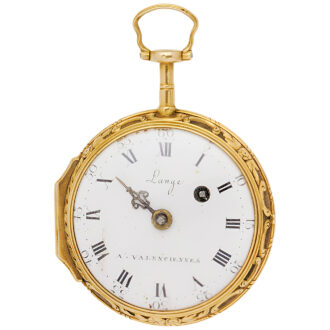
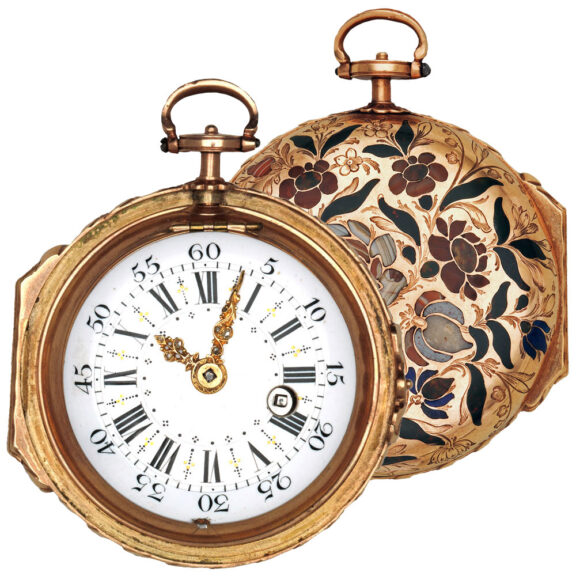
German gold watch decorated with hardstones Circa 1770-80
- Kenmerk
- AM0053
- Diameter
- 44 mm
- Estimate
- € 4.500 - 8.000
- Price sold
- -
Gold watch signed by Le Roy Paris, attributed to Christian Gottlieb Stiehl
–
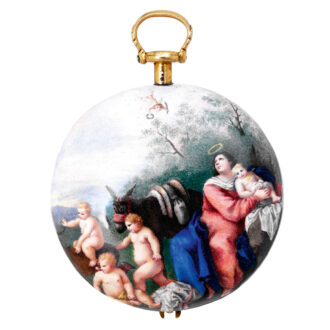
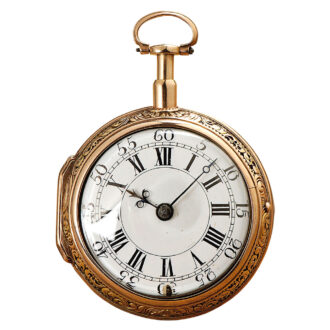
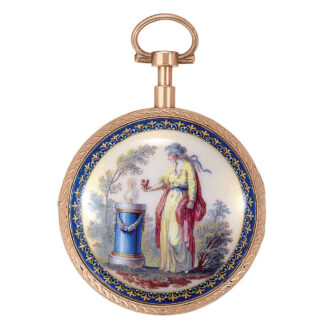
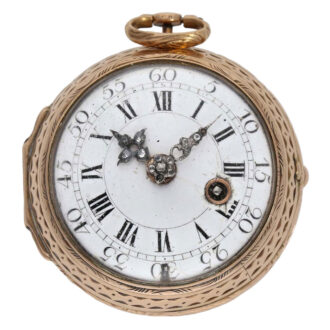
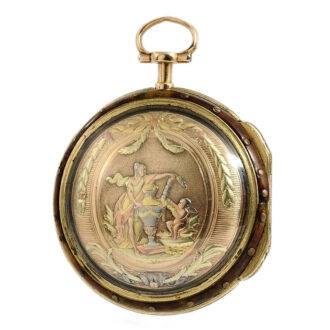
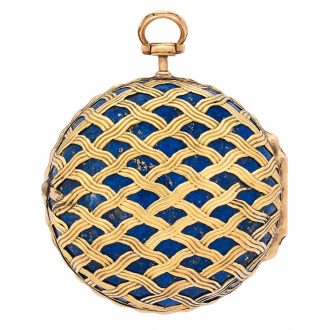
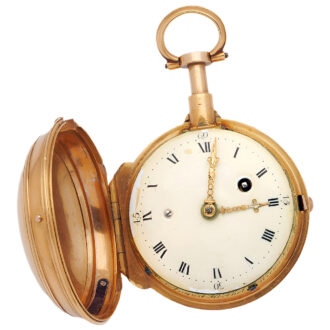
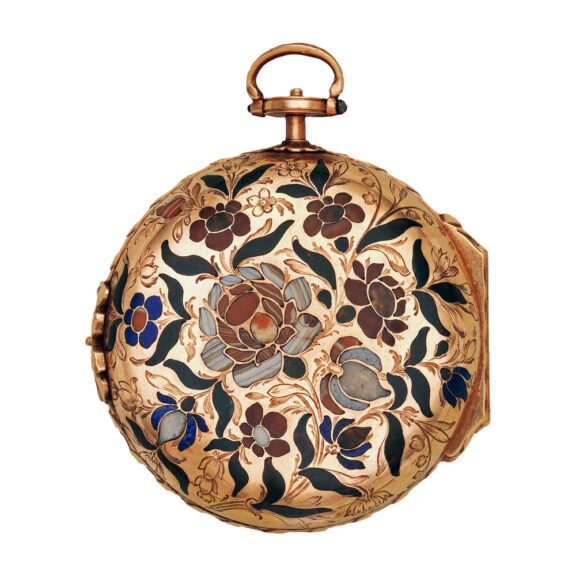
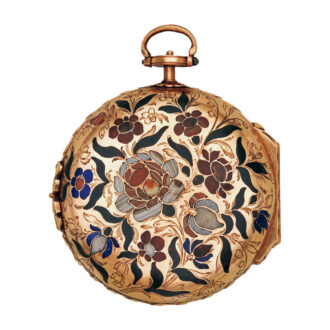
A German gold enamel pendant watch with a technique of setting hardstones in gold, circa 1770-1780.
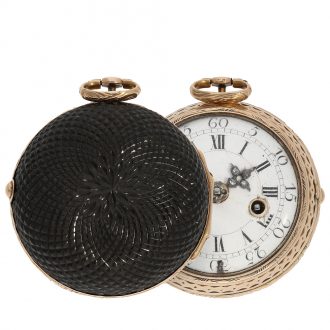
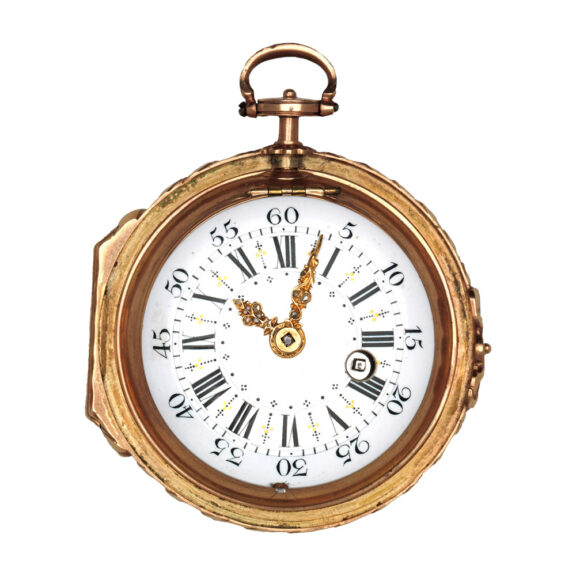
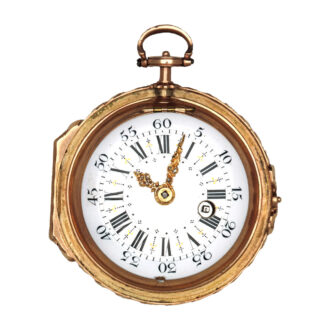
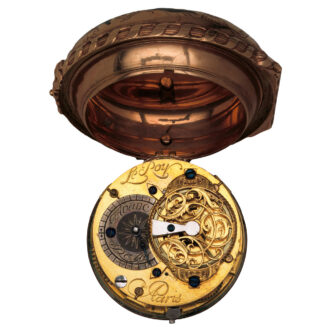
Signed verge movement. Enamel dial with Roman radial hours, outer minutes track with Arabic five minutes numerals and gold Louis XV-style hands. Gold enamel case with a technique of setting hardstones in gold usually associated with Johann Christian Neuber (1736–1808) of Dresden.
–
Diameter: 44 mm
–
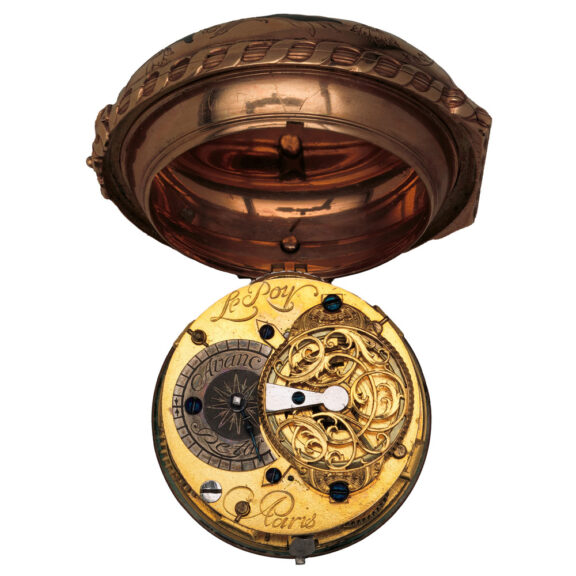
Falsely signed on movement on the back plate: Le Roy A Paris
–
This watchcase displays a technique of setting hardstones in gold that is usually associated with Johann Christian Neuber (1736–1808) of Dresden. However, it was probably inspired by enamelled gold watchcases made in Paris a few years earlier. Stiehl, who held appointments to Augustus the Strong, King of Poland and Elector of Saxony (1670–1733), and his successor, Augustus III (1696–1763), is known for his floral designs, which are freer and less geometric than Neuber’s.
The movement may also have been made in Dresden. P.J. Marperger, the author of Horologiographia (Dresden, 1723), a book on the watch and clock market in Germany, wrote that “some important people . . . simply cannot appreciate anything that does not come from France or England.” He advocated a heavy tax on foreign clocks and watches and allowed accredited (meaning German) clockmakers to engrave London or Geneva on their dials. Movement falsely signed: Le Roy A Paris, probably German (Dresden), ca. 1770–80. Watchcase attributed to Christian Gottlieb Stiehl (German, 1708–1792).
–
Christian Gottlieb Stiehl(1708–1792), who also worked in Dresden and held an appointment to Augustus the Strong, King of Poland and Elector of Saxony (1670–1733), as well as to his successor Augustus III (1696–1763), is known for comparable lapidary work. His floral designs are freer and less geometrical than Neuber’s; without a signature or maker’s mark, it is to Stiehl that the Museum’s watchcase can reasonably be attributed.
The movement of the watch is a typical product of about the third quarter of the eighteenth century, except that it is signed Le Roy A Paris, doubtlessly in the hope of benefiting from the excellent reputation of the Paris workshop of Julien Le Roy (1686–1759) and his son Pierre Le Roy (1717–1785). When compared with watches known to be products of the Le Roy workshop, this watch has been confidently identified as not among that select group.
Signed: Le Roy A Paris
Share this page: