Rare Swiss gold full hunter for the Polish market Circa 1891
- Kenmerk
- SB0110
- Diameter
- 34 mm
- Estimate
- € 4.000 - 8.000
- Price sold
- € 6.000
Gold full hunter by Patek, Philippe & Cie
–
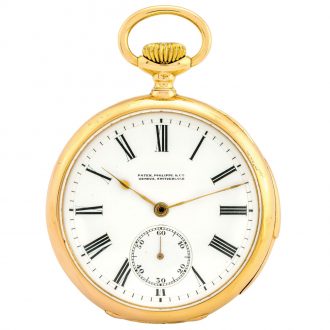
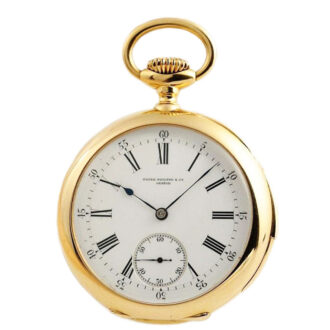
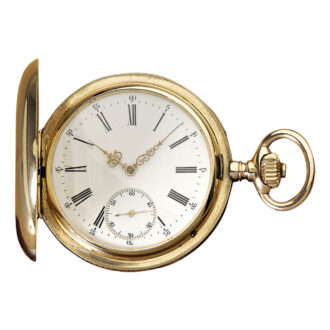
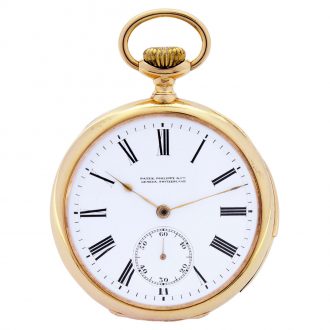
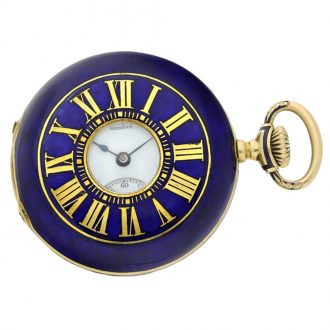
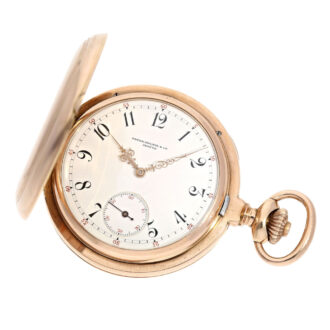
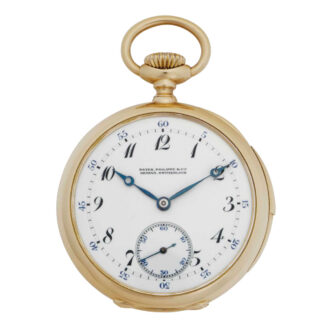
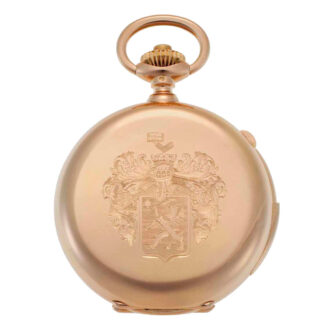
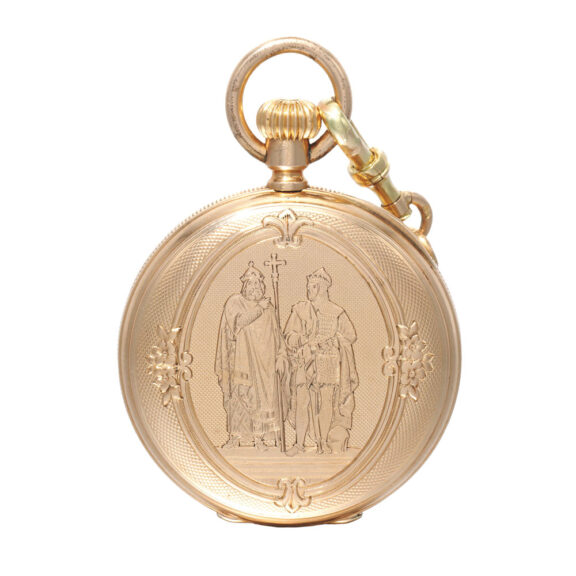
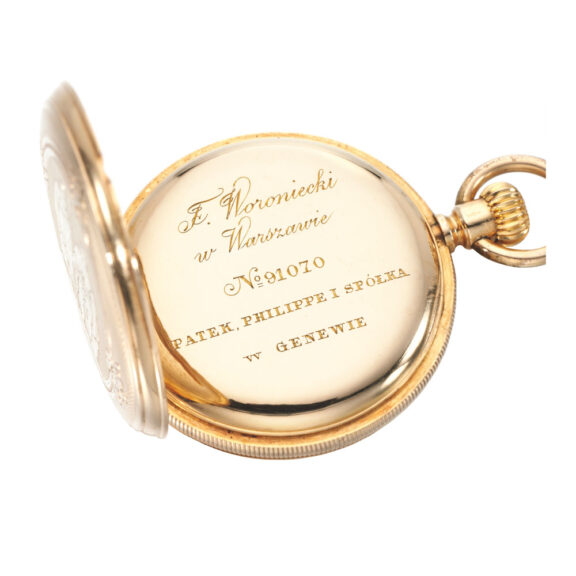
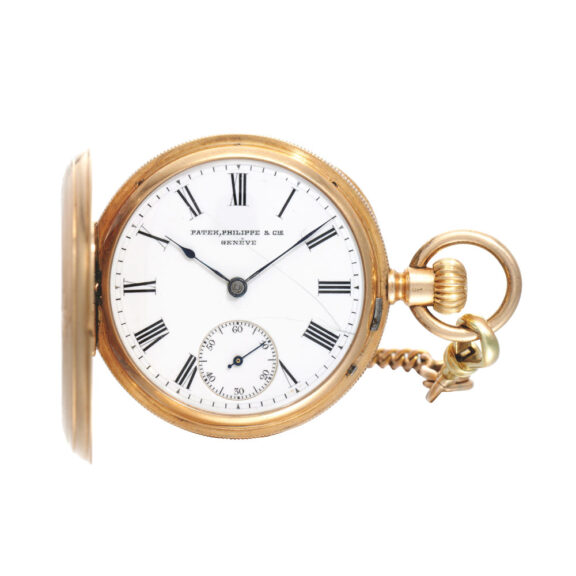
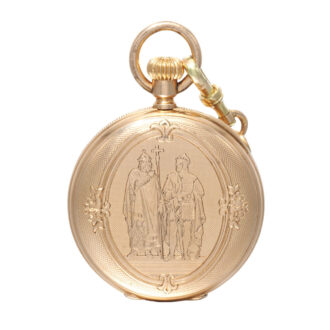
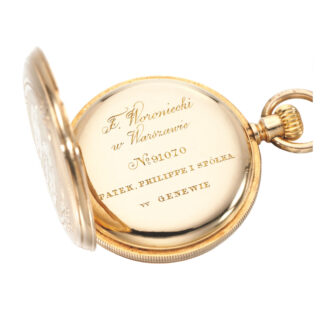
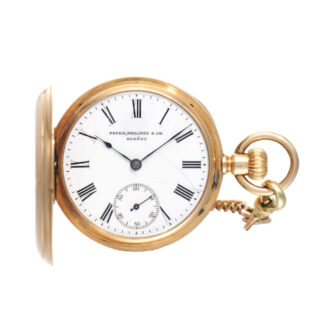
A rare Swiss 14 carat gold hunting cased pocket watch made for the Polish market, circa 1891. Manual winding jewelled movement. 14 Carat gold engraved cuvette. White enamel dial, Roman numerals and subsidiary seconds at 6 o’clock. Front cover with engraved portrait of Adam Mickiewicz (1798-1855) one of Poland’s greatest poets and writers, the back depicting a representation of the statue of Miecislaus with the first Archbishop of Gnesen and the first King of Poland Boleslaw I Chorby ‘The Brave’. Cuvette, dial and movement signed. Cuvette engraved ‘F. Woroniecki, Nº 91070’. With a gold associated chain. With a Patek Philippe Extract from the Archives confirming sale on February 25th 1898.
–
A rare Swiss 14 carat gold hunting cased pocket watch made for the Polish market, circa 1891. Manual winding jewelled movement. 14 Carat gold engraved cuvette. White enamel dial, Roman numerals and subsidiary seconds at 6 o’clock. Front cover with engraved portrait of Adam Mickiewicz (1798-1855) one of Poland’s greatest poets and writers, the back depicting a representation of the statue of Miecislaus with the first Archbishop of Gnesen and the first King of Poland Boleslaw I Chorby ‘The Brave’. Cuvette, dial and movement signed. Cuvette engraved ‘F. Woroniecki, Nº 91070’. With a gold associated chain. With a Patek Philippe Extract from the Archives confirming sale on February 25th 1898.
–
Diameter: 34 mm
–
Signed: Patek, Philippe & Cie Genève
–
This watch is historically important to both Poland and to the Patek Philippe firm. Antoni Patek, a Polish national and a Catholic, was instilled with nationalist sentiment after being forced by the French government to resettle in Switzerland. The figures on the back cover, Archbishop of Gnesen (Archbishopric of Gnesen founded in 999) and Duke Boleslaus I Chorby (‘The Brave’), who crowned himself King of Poland in 1025, are therefore symbols of Polish independence. It is interesting to say that this watch was ordered to commemorate the 900th Anniversary of Poland, 14 carat gold being the typical alloy made for watches for the Polish market. It has been sold to the official Patek Philippe representative in Poland in 1898 but presented and given in 1899.
–
A similar watch is shown on the 1851 London’s World Exhibition’s catalogue and is illustrated in Huber, M., & Banbery, A., Patek Philippe, 1982, p. 73 and 110.
–
Signed: Patek, Philippe & Cie Genève
–
This watch is historically important to both Poland and to the Patek Philippe firm. Antoni Patek, a Polish national and a Catholic, was instilled with nationalist sentiment after being forced by the French government to resettle in Switzerland. The figures on the back cover, Archbishop of Gnesen (Archbishopric of Gnesen founded in 999) and Duke Boleslaus I Chorby (‘The Brave’), who crowned himself King of Poland in 1025, are therefore symbols of Polish independence. It is interesting to say that this watch was ordered to commemorate the 900th Anniversary of Poland, 14 carat gold being the typical alloy made for watches for the Polish market. It has been sold to the official Patek Philippe representative in Poland in 1898 but presented and given in 1899.
–
A similar watch is shown on the 1851 London’s World Exhibition’s catalogue and is illustrated in Huber, M., & Banbery, A., Patek Philippe, 1982, p. 73 and 110.
Signed: Patek, Philippe & Cie Genève
Share this page: