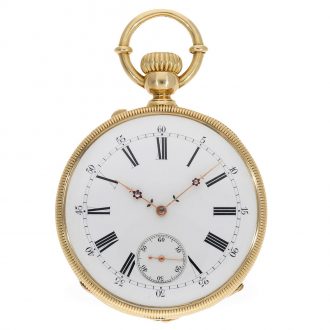
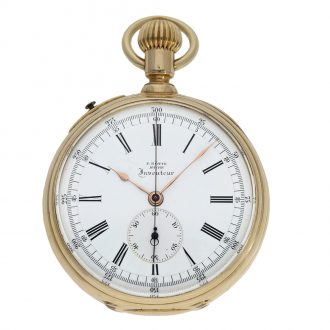
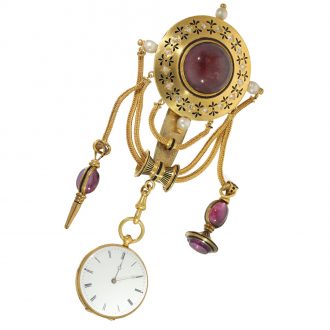
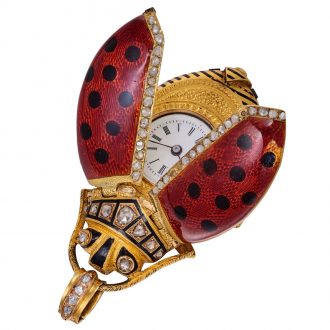
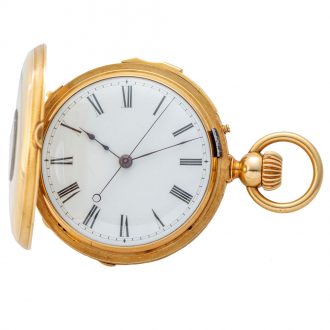
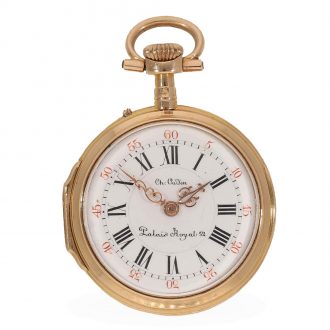
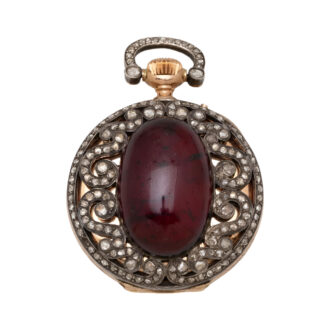
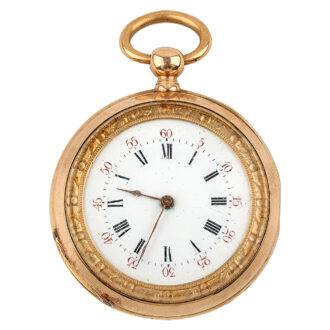
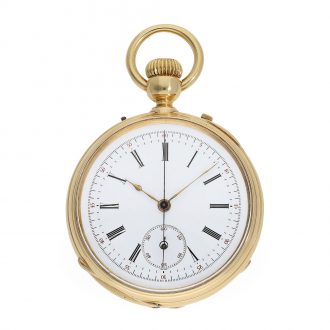
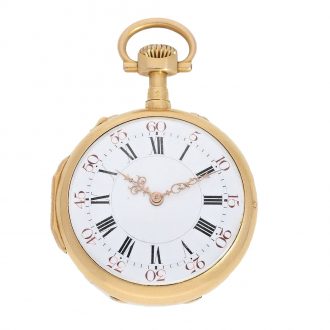
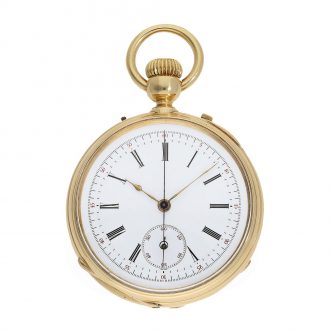
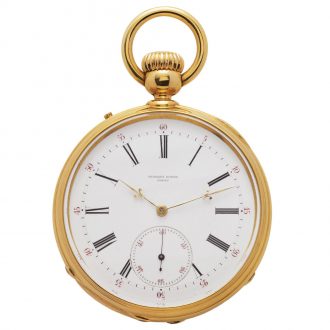
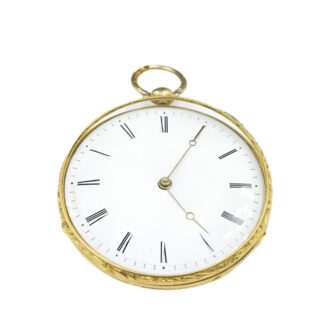
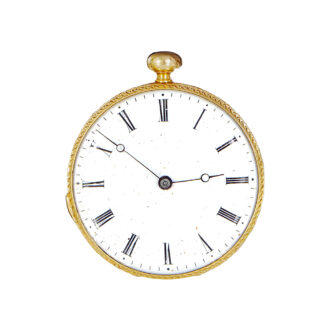
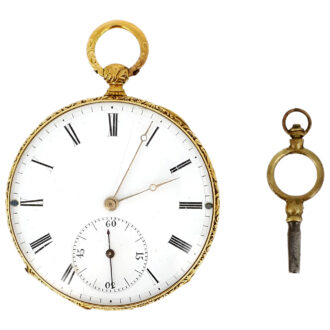
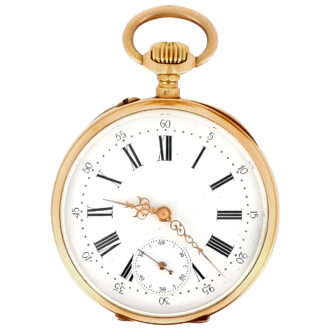
French yellow gold keyless lever pocket watch Circa 1870
- Kenmerk
- TA3883
- Diameter
- 50 mm
- Estimate
- € 4.000 - 7.500
- Price sold
- € 5.500
Gold open faced by Charles Oudin
–
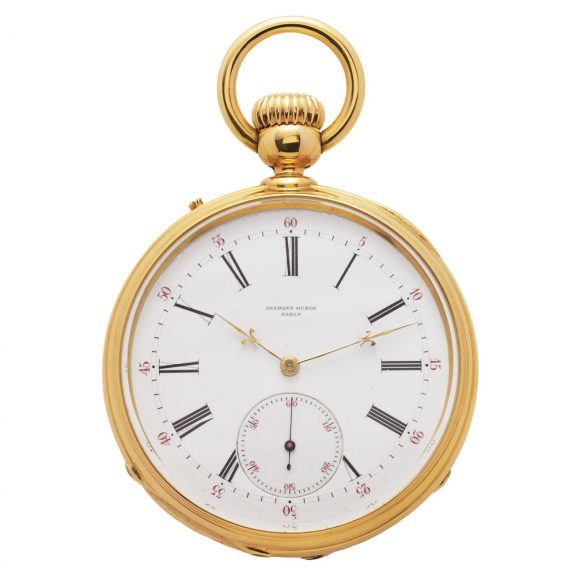
A French 18K yellow gold keyless pocket watch, circa 1870. The case with polished borders and a hinged gold cuvette with the inscription Médailles aux Expositions Depuis 1806. White enamel dial with radial Roman numerals, outer minute track and five-minute red Arabic markers, sunk subsidiary seconds dial and gold fleur de lys hands. Matte gilt movement, 19 jewels, wolf’s tooth winding, gold wheel train, straight line counterpoise lever escapement, cut bimetallic compensation balance, blued steel helical balance spring, micrometre regulator. Dial, case and movement signed.
–
Diameter: 50 mm
–
Signed: Charles Oudin, Horloger de la Marine Paris
–
Oudin, Charles, (1768-1840), Paris watchmaker France.
Jean “Charles” Oudin was born in 1768 at Clermont (de l’Oise) to Nicolas Oudin and Marguerite Magisson. At 18, he went to Paris, where he became a student of Abraham-Louis Breguet. As did his cousin Joseph Jacques Oudin. Breguet recognized his student’s talent early on and encouraged him; soon, Oudin was the best student and watchmaker at Breguet. In 1795, during a business trip by Breguet, Oudin was asked to take care of the business and become workshop manager, but Oudin politely declined this. He preferred to stay at the workbench as a watchmaker. As one of Breguet’s finest watchmakers, he worked closely with Breguet on developing the new “Perpetuelles” ( Automatic Winding ). Breguet’s “Souscription” pocket watches were no secret to him and were later made by him. In later years, Oudin designed and built complicated movements for his former teacher.
–
After 14 years at Breguet, he became self-employed and founded his own business around 1801. In 1897, he married Anne Antoinette Virginie Le Roy, a daughter of Bazile Le Roy (1731-1804) and sister of Bazile-Charles Leroy (1765-1828). First, he worked in the Rue Vivienne in Paris. Later, in the Galerie de Pierre, Palais Royal 52, near the Louvre and the new commercial centre of Paris. Galerie de Pierre was renamed Galerie Montpensier in 1815 and was not far from his father-in-law’s shop. Breguet permitted him to write “Eleve de Breguet” (Breguet’s apprentice) on his signature.
–
Oudin took part in the national exhibitions in both 1806 and 1819. At the Exhibition in 1806, he was awarded a gold medal for a watch that could be wound with the suspension eyelet; such a mechanism he invented and manufactured was a truly exceptional achievement at the time. In 1805, he built a striking clock for Empress Josephine. A special feature of various Oudin watches is blued plates; he also made various watches with decimal time displays. Charles developed an equation of time mechanism for clocks, which was also used for Breguet’s Souscription clocks. His nephew “Joseph” Jacques Oudin was a specialist in “Perpetuelles” and very precise clocks, but bankruptcy was declared in 1812 despite promising beginnings. He left France for America shortly after 1812 and was in New Orleans by 1818. According to various sources, Joseph was joined by his nephew in 1820, which meant he had returned.
–
The clientele became more and more important, and Horuhrmacher became the clients of the House of Oudin, among others, Empress Josephine, Empress Eugénie, the Tsar and Tsarina of Russia, the King and Queen of Spain, the King of Portugal, Napoleon III, the kings of Italy and Greece, Pope Pius VII, and the Count of Chambord. From 1830, marine chronometers were also manufactured. Like Breguet, the Charles Oudin company was named Horloger de la Marine. In 1836, he handed over his business to his son Charles-Raymond Oudin and moved to rue de Richelieu No. 34, where he died on March 4, 1840, aged 72.
Signed: Charles Oudin, Horloger de la Marine Paris
Share this page: