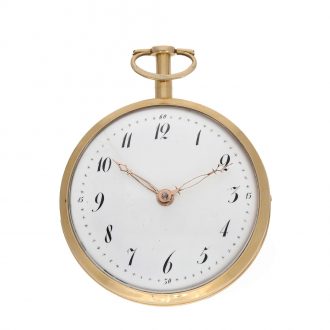
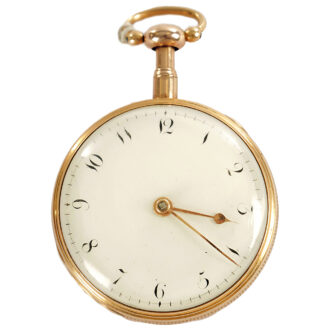
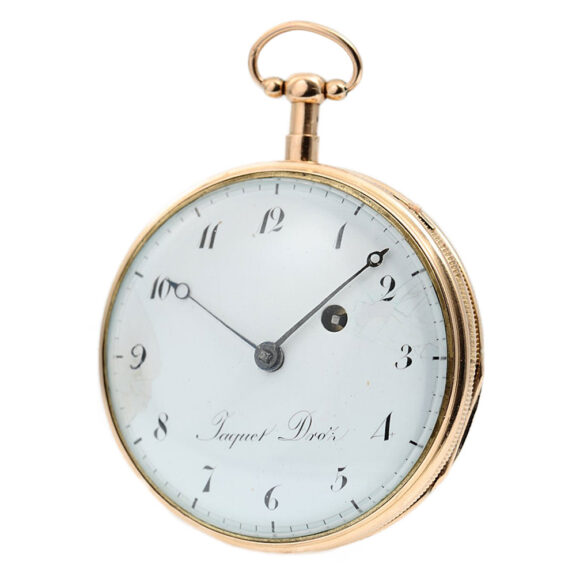
Swiss 18K rose gold quarter repeating pocket watch Circa 1790
- Kenmerk
- AD8470
- Diameter
- 54 mm
- Estimate
- € 2.750 - 5.000
- Price sold
- -
Gold open faced verge watch by Pierre Jaquet-Droz
–
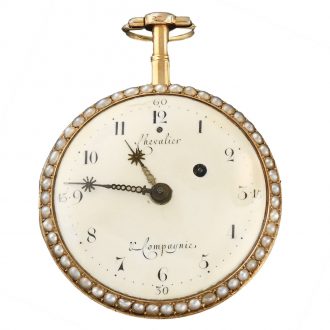
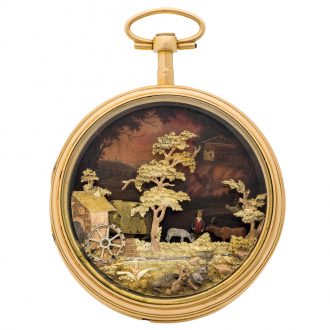
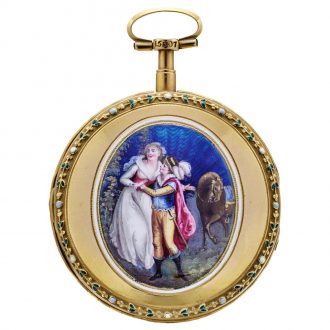
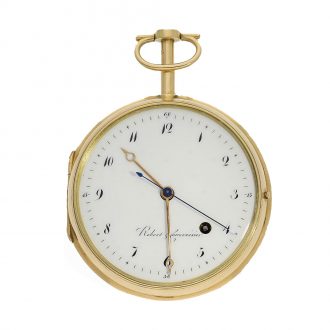
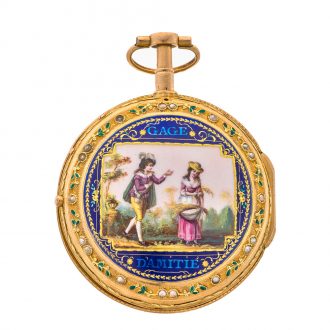
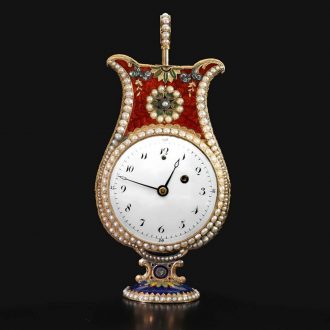
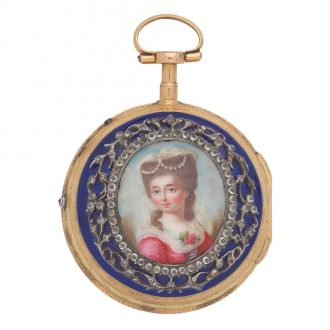
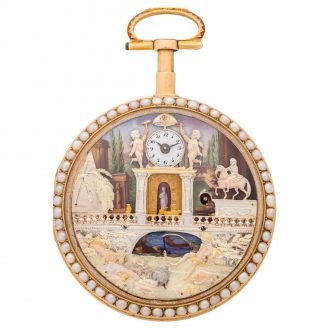
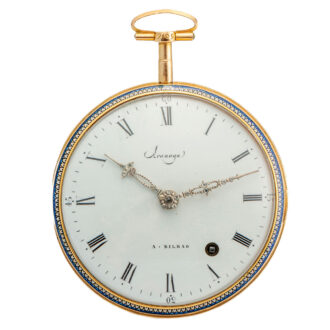
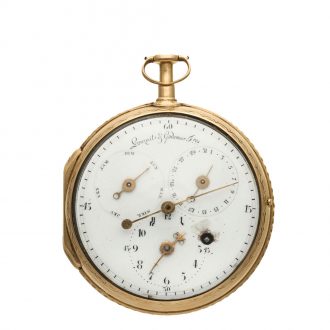
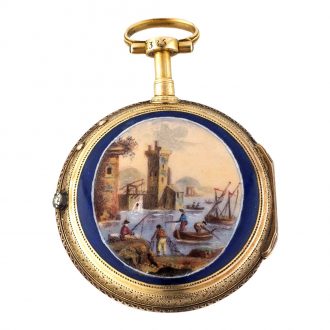
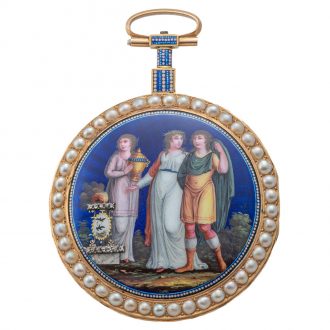
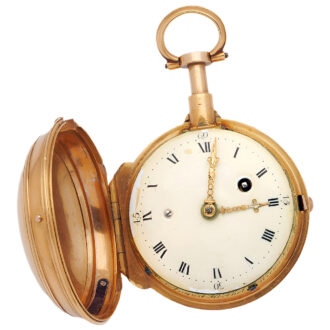
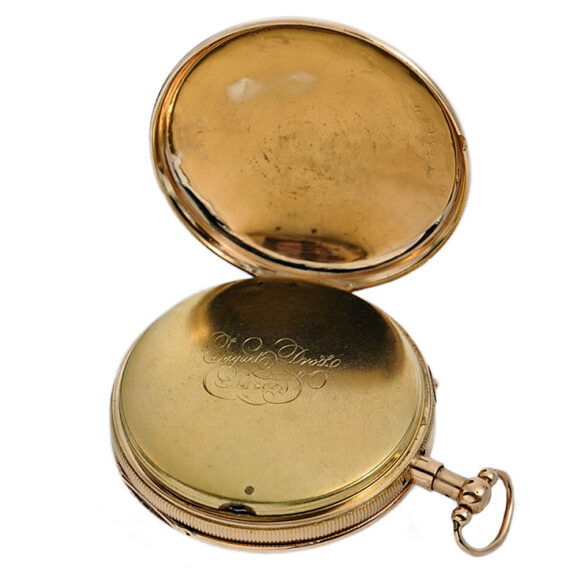
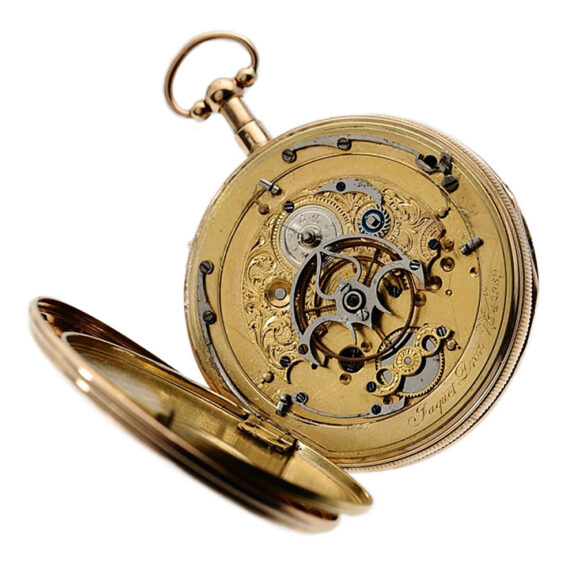
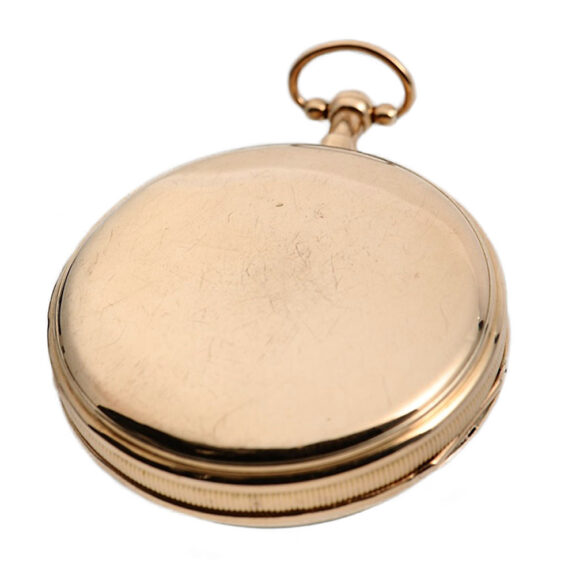
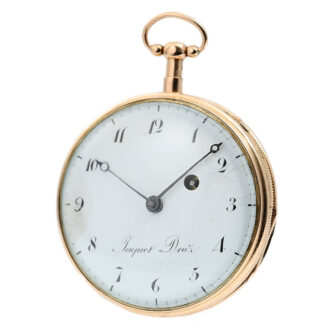
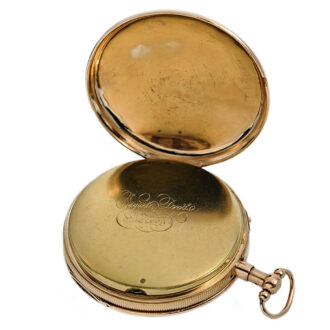
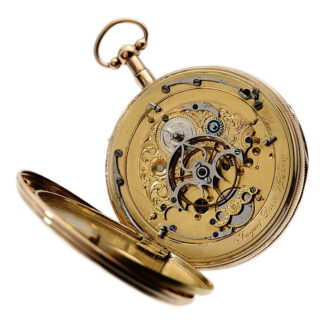
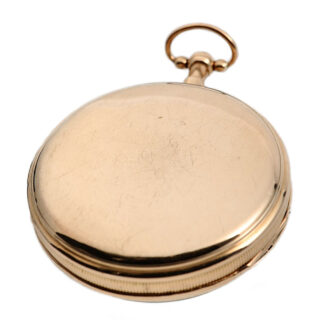
A Swiss 18 carat rose gold open faced quarter repeating gentleman’s pocket watch, circa 1790. Polished case, reeded band, pusher for repetition through the pendant. Signed white enamel dial with Arabic hours, outer minute track and blued Breguet hands. Signed, gilt full plate movement with applied floral decorations, key wind, chain and fusee, two hammers and two gongs, verge escapement, three arm brass balance and a steel balance bridge.
–
Diameter: 54 mm
–
Weight: 122 g
–
Signed: Pierre Jaquet-Droz
–
Pierre Jaquet-Droz was born on July 28, 1721, on a small farm (La Ferme de Sur Le Pont) in La Chaux-de-Fonds, Switzerland, as the son of a farmer who was an occasional clockmaker as well. He studied humanities and philosophy in Basel from 1738 to 1739. He became interested in clockmaking and precision mechanics under the tutelage of older relatives from the Brandt-dit-Grieurin, Sandoz and Robert families. On October 25, 1750, Jaquet-Droz married Marianne Sandoz, the daughter of Civil Lieutenant Abraham Louis Sandoz. Soon after the birth of his two children, Julie in 1751 and Henri-Louis in 1752, at the age of 34, Pierre lost his wife, followed by his daughter in 1755. He never remarried. In 1758, Pierre made the long and difficult journey to Spain, to present his works to King Ferdinand VI. When he returned to La Chaux-de-Fonds in 1759, the sum of money he brought back from Spain enabled him to concentrate on making watches, clocks and automata. Jaquet-Droz worked together with his son and a neighbour’s son, Jean-Frédéric Leschot, whom he had taken in after the death of the boy’s mother and thought of as his adoptive son. From 1773 onwards, Jaquet-Droz and Leschot perfected and marketed increasingly sophisticated automata. Their work culminated with the three humanoid automata: The Writer, The Draughtsman and The Musician, presented in La Chaux- de-Fonds in 1774. Encouraged by this success, the Jaquet-Droz family took to the road to exhibit their products. From La Chaux- de-Fonds they travelled to Geneva, Paris, London, Holland, Flanders, Spain, Russia and beyond. Pierre decided to set up a workshop in London, under the management of his son, Henri-Louis. Exhausted by his travels, the latter delegated some of his responsibilities to Jean-Frédéric Leschot. Leschot was tasked in particular with overseeing the business relationship with the prominent trading company James Cox in London, whose agents in Canton opened up the Far Eastern market for the Jaquet-Droz Company and for many years represented it in China, India and Japan. They also set up a branch in Neuchâtel, Switzerland. For ten years, the company continued to expand. It sold clocks, automata, watches and singing birds all over the world, primarily in China. In 1784, Jaquet-Droz decided to move to Geneva, Jean-Frédéric Leschot soon joined him and they decided to open the city’s first clockmaking manufacture, simultaneously introducing the production of timepieces featuring complications. In 1788, the success and prosperity of Jaquet Droz & Leschot peaked, but only for a short time. In 1790, drafts made on their principal correspondent in China came back unpaid and their main client in London failed, putting the company in the red. These misfortunes darkened Pierre Jaquet-Droz’s final years. He left Geneva to live in Bienne, Switzerland, where he died in 1790. This in combination with the death of his son Henri-Louis in 1791 at the age of 39, the French Revolution in 1789 and the Napoleonic Wars meant the end of a period of great creativity and prosperity for Jaquet-Droz & Leschot. The Jaquet- Droz brand joined the Swatch Group in 2000. In 2010, the company moved its atelier to La Chaux-de-Fonds.
Signed: Pierre Jaquet-Droz
Share this page: