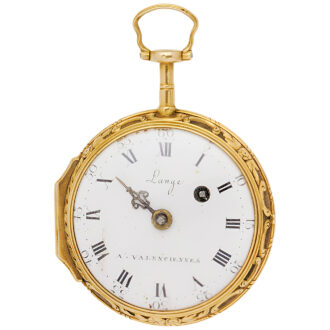
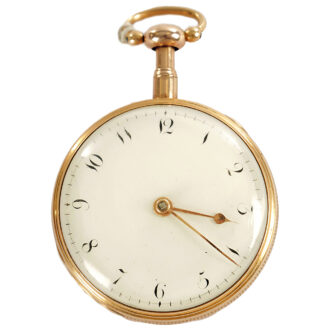
Swiss gold enamel repeating automaton pocket watch Circa 1795
- Kenmerk
- AA0243
- Diameter
- 61 mm
- Estimate
- € 25.000 - 50.000
- Price sold
- -
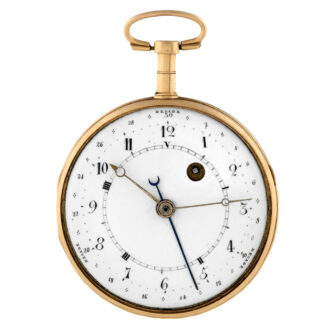
Gold and enamel quarter repeating automaton watch
–
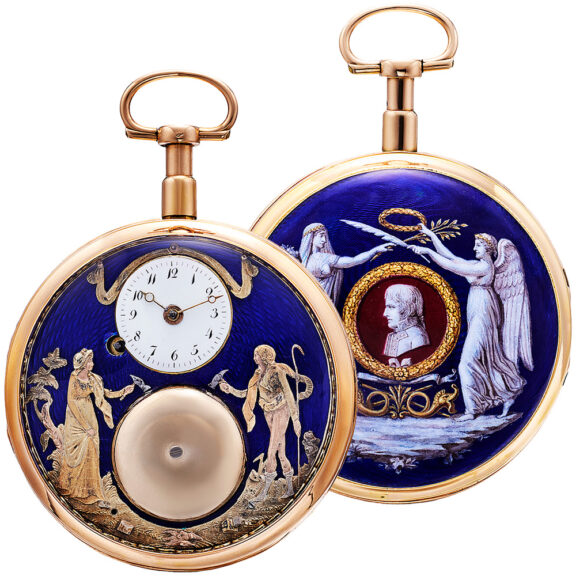
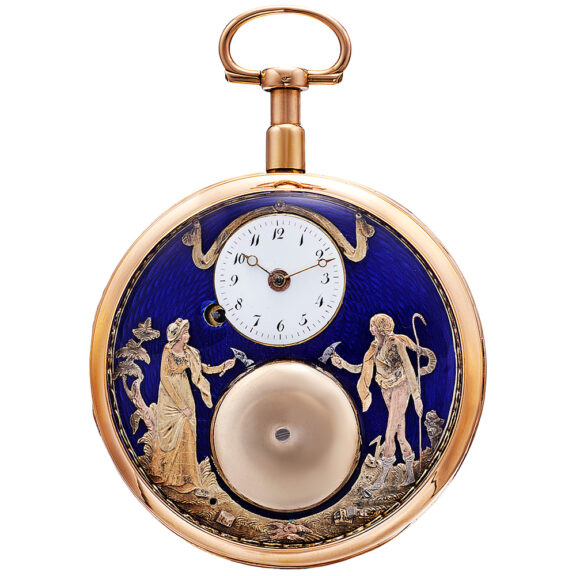
An unsigned historical key-winding Swiss pocket watch with quarter-repeater by two striking jacquemarts (jacks) on one bell, circa 1795.
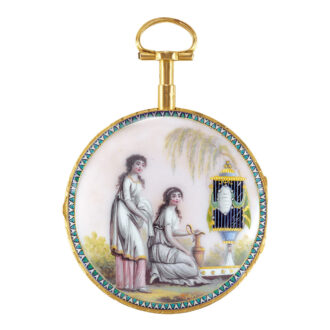
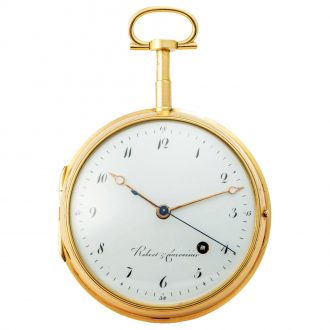
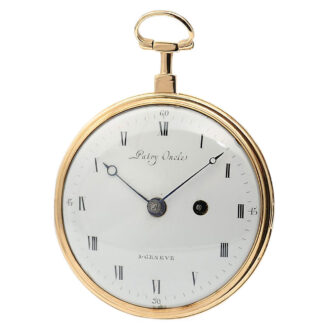
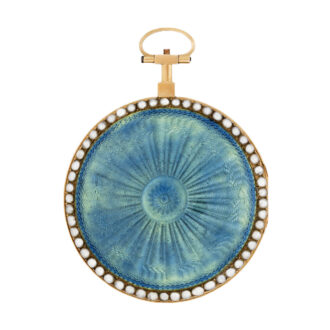
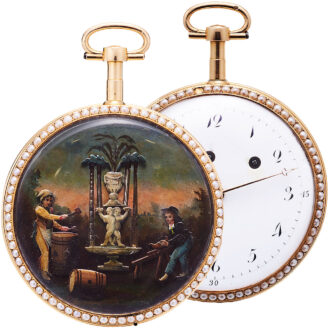
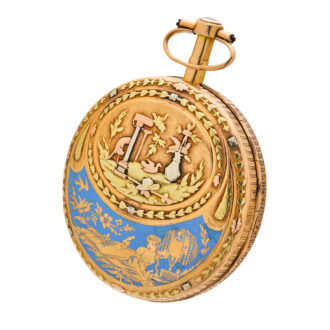
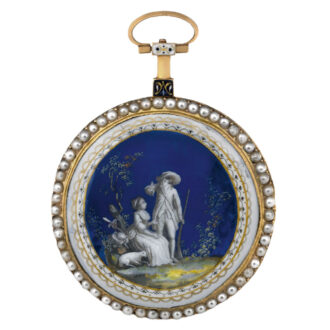
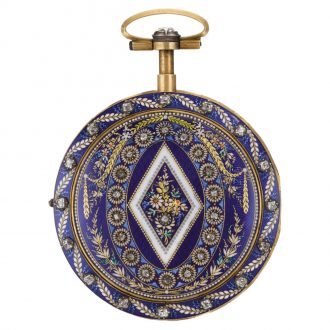
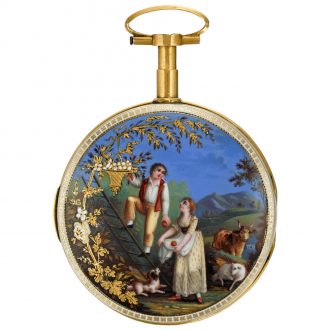
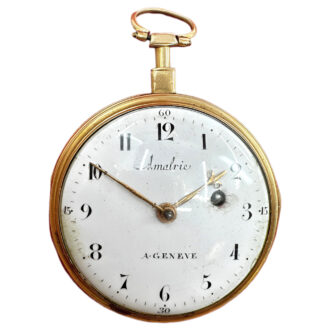
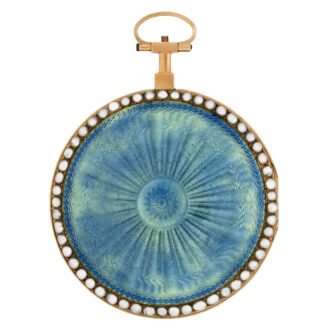
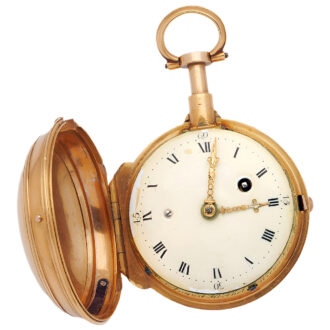
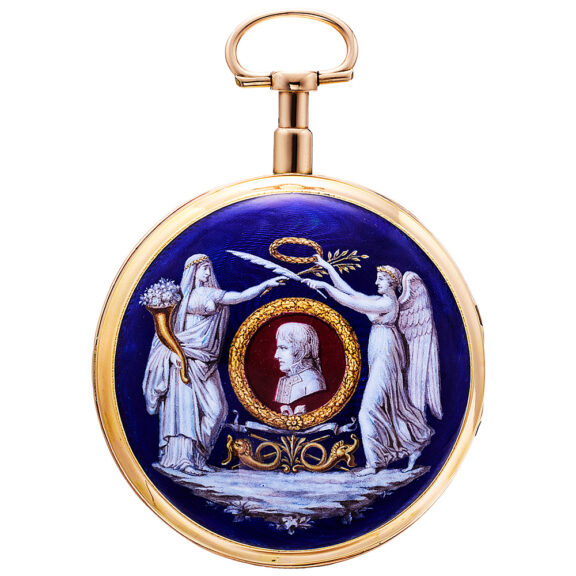
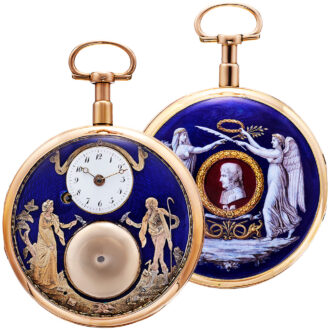
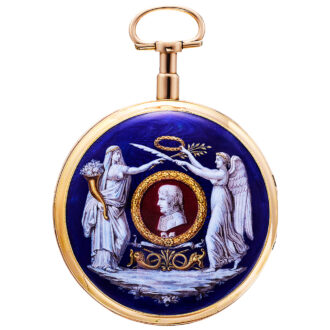
Round-shaped 18-carat yellow gold case. Royal blue flinqué enamel (translucent enamel over guilloché engine turning) case back with a polychrome scene showing an Allegory of Victory and Peace glorifying General Napoléon Bonaparte, to whom France will owe him Victory and Peace (La France Lui Devra la Victoire et la Paix). Enamel dial at 12 with Breguet numerals, outer minutes track, and gold Breguet hands. Full plate, gilded brass movement with fusee and chain, verge escapement, monometallic balance, blued steel flat hairspring, and a pierced and engraved gilded continental cock.
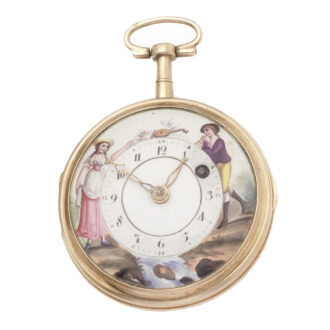
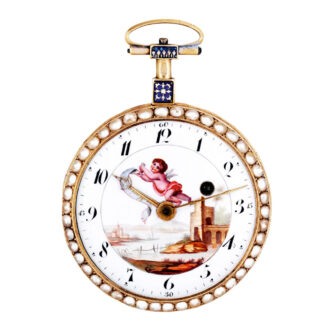
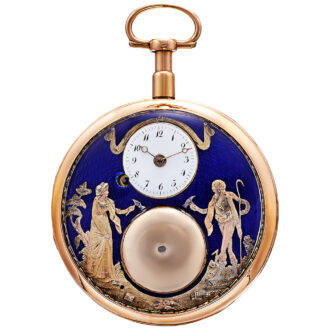
This Directoire large pocket watch has one horological complication: – Quarter-repeater on one bell (activated by depressing the pendant) led by two Jacquemarts (Jacks) who strike the bell with their hammers. The Jacquemarts (Jacks) are in the habit of Incroyables (the Incredibles) and Merveilleuses (the Marvelous); men’s and women’s costumes fashionable during the late 1790s and the Directoire period in France.
–
Diameter: 60.5 mm
–
Signed: No name
–
Watch with Jacquemarts that really hit the bell, In contrast to most repeater watches by Jacquemarts (Jacks; striking hammer figures), whose automata pretend to strike the hours and quarters with their hammers but strike-through hammers incorporated into the movement on bells or gongs placed inside it or inside the case ?? in this type of watch the hammers held by the automata really hit the bell.
Two watches with this type of movement are kept in the Patek Philippe Museum, Geneva (Inv. S-403 and Inv. S-495). The Incroyables (the Incredibles) and the Merveilleuses (the Marvelous).
–
After the Thermidor, the French began to reveal against the traditionally associated dress styles, including the sans-culottes, cockades, and tricolour accessories and clothes, and developed new techniques more closely related to aristocratic fashions before the Revolution than to more contemporary styles. Perhaps the most salient and also most widely criticised expression of such manners was exhibited by Les “Incroyables” (the Incredibles) and their female counterparts, “Les Merveilleuses” (the Marvelous). The typical outfit of these new dandies consisted of a double-breasted, square jacket, similar to a redingote with cut tails, a deformed vest with heavily stuffed pockets, white scarves around the neck, tight-fitting breeches with long ribbons dangling below the knees, and open, pointed flat shoes.
The Merveilleuses wore Neoclassical style dresses, with high waists and open necklines, narrow skirts, and often made up of light fabrics such as muslin to assimilate the style of the mythical females of classical antiquity; their hair was often made in a variety of styles, or covered with the different hats that were popular at the time, including bonnets, toques, turmans, and the popular Cornette.
Incroyables and Merveilleuses were often criticised for their love of fashion, still associated with the ills of the pre-Revolutionary monarchy, and were the subject of a wide number of caricatures that exposed them as worthless citizens and women with loose morals.
Their style, however, has come to be associated with the fashions of the Directoire and the Empire, with Empress Josephine being one of the most popular Merveilleuses before her marriage to Napoléon. “La France Lui Devra la Victoire et la Paix” (France will owe him Victory and Peace)
–
This representation of Napoleon Bonaparte (1769-1821), then young victorious general, is realised during the period of the Directoire and more probably in the interval of time which has elapsed between the treaty of Campo-Formio, signed on the 26 vendémiaire an 6 (October 17, 1797) ?? which puts an end to the Franco-Austrian war (since 1792) and the first Italian campaign ?? and the departure of the Expedition of Egypt, which took place on the 29 floréal an 6 (May 18, 1798). The Histoire numismatique de la Révolution française (Numismatic History of the French Revolution) by Michel Hennin (Paris, 1826) tells us that among the many tokens and medals glorifying Bonaparte at this time ?? his return from Italy to Paris, in December 1797, is triumphant ?? three tokens are struck, with, on the obverse, the bust of the general in embroidered uniform (with or without lapels and epaulettes), looking left, with the legend (titulature) “Buonaparte né à Ajaccio le 15 août 1769.” (Buonaparte born in Ajaccio on August 15, 1769.), and, on the reverse, the legend (titulature) “La France lui devra la Victoire et la Paix.” (France will owe him Victory and Peace.) in a closed olive (or laurel) wreath, with below “an 6 de la république.” (year 6 of the Republic.), whether 1797-1798 (tokens classified on December 31, 1797, these tokens exist in silver, Ø 33.5 mm, and bronze, Ø 32 mm). In addition to these tokens and medals, many effigies of Bonaparte begin to appear (1797-1798), in the form of engravings or on objects, while he is for the French people, the hero of the Battle of Arcola (25-27 Brumaire an 5; November 15-17, 1796) and the winner of the Austrians and Germans.
Today, the most famous portrait of the young general is that unfinished (1798) by Jacques-Louis David (1748-1825) (Paris, Louvre Museum, Inv. FR 1942-18). Another later portrait (1806) depicts him as Emperor on his throne surrounded by the Allegorical Figures of Victory and Peace by Andrea Appiani (1754-1817) (Moscow, Pushkin Museum, Inv. 2 102).
Share this page: