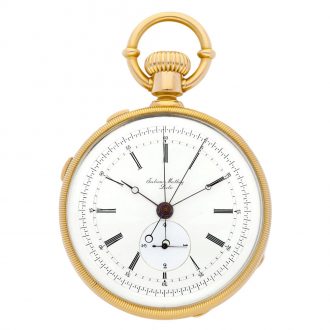
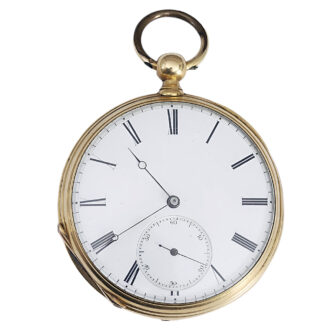
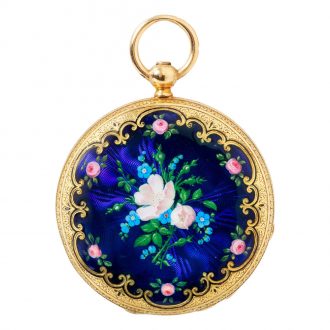
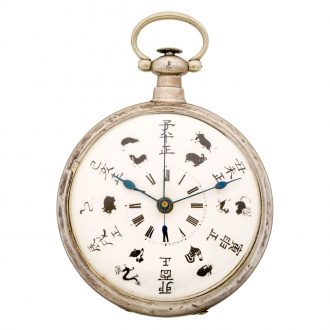
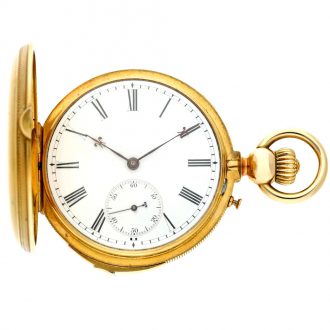
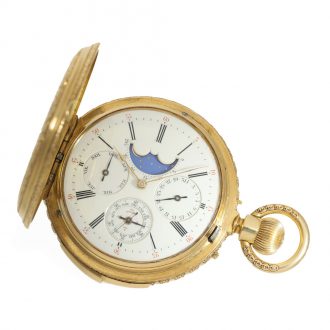
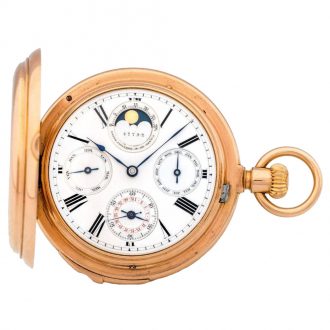
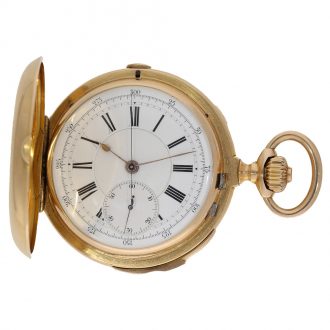
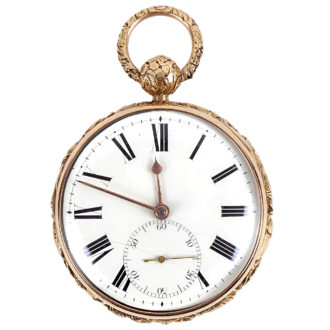
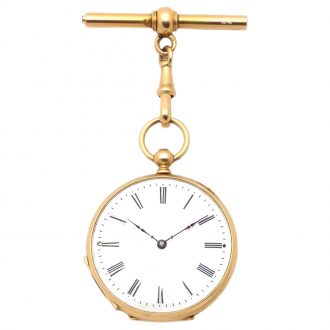
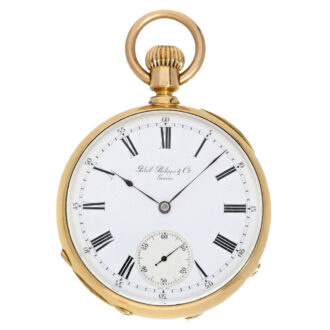
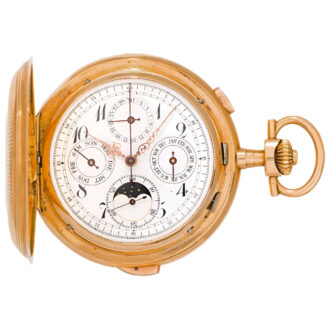
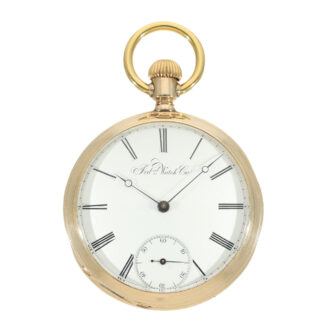
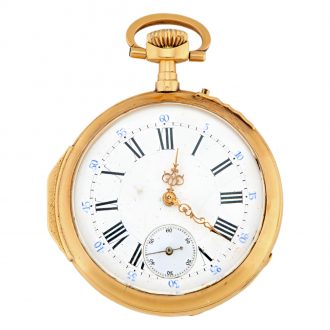
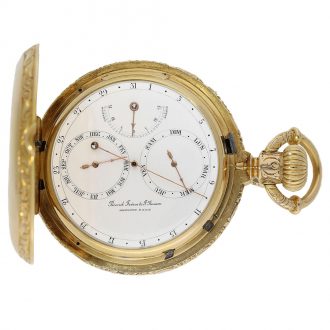
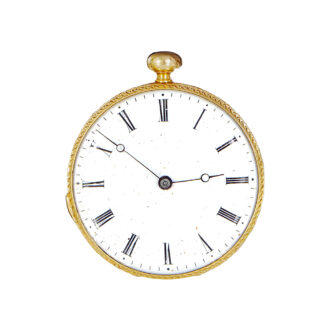
Swiss pink gold perpetual calendar five minute repeater Circa 1875
- Kenmerk
- AA0361
- Diameter
- 55 mm
- Estimate
- € 50.000 - 90.000
- Price sold
- € 54.000
Gold important repeating calendar watch
–
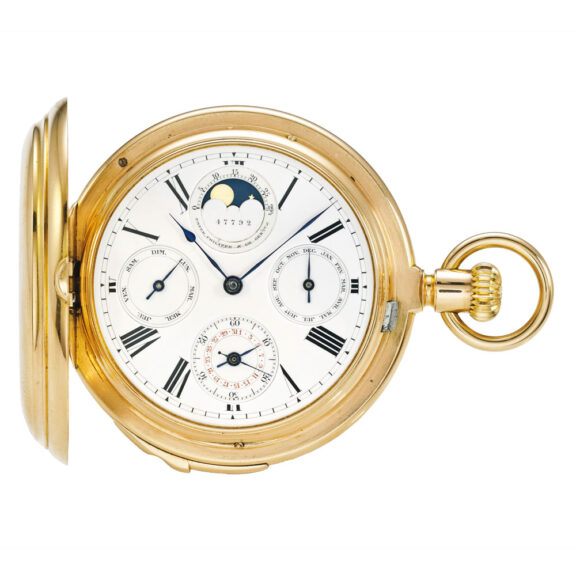
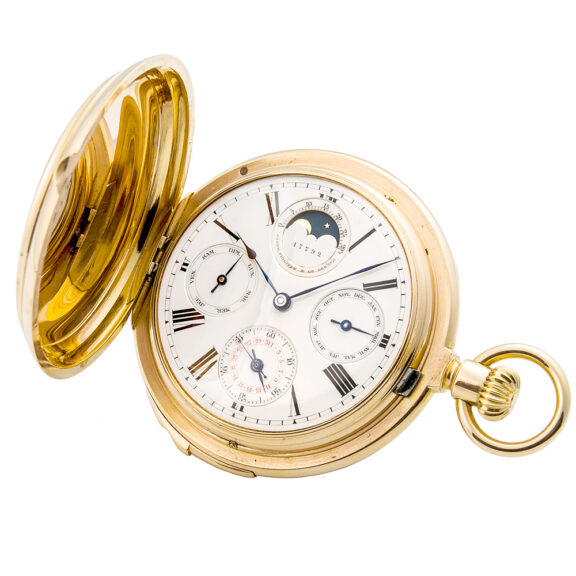
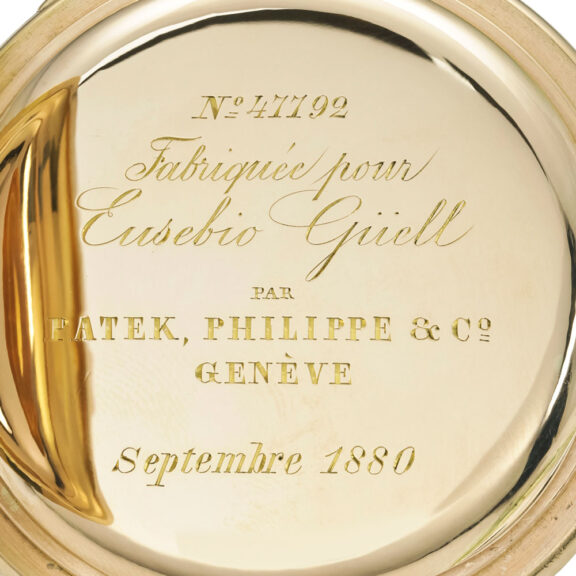
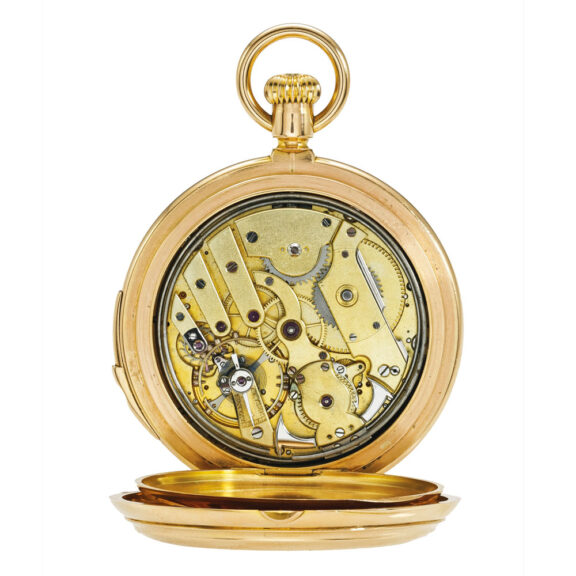
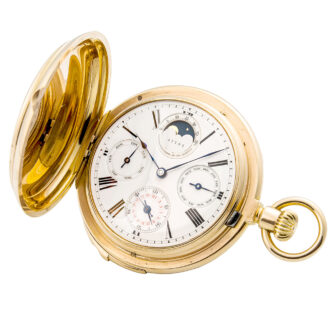
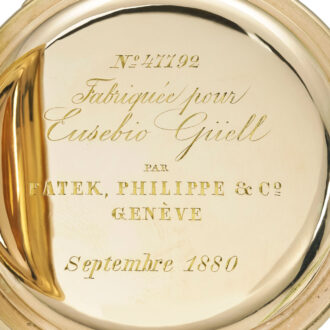
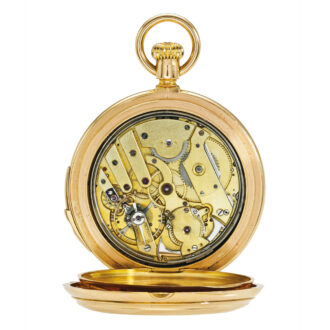
An important and rare Swiss 18 carat pink gold hunting cased five minute repeating keyless pocket watch with perpetual calendar, and age and phases of the moon made by Patek Philippe in Geneva, circa 1875. The jewelled nickel lever movement with a cut bimetallic compensation balance, repeating on two steel gongs activated by the slide at six o’clock. White enamel dial with Roman hour numerals, an outer minute track, subsidiary seconds with concentric date at 6 o’clock, days of the week at 9, age and phases of the moon at 12, the months at 3 and blued spade hands. The plain case with a hinged 18K pink gold cuvette, engraved Fabriquée pour Eusebio Güell par Patek Philippe & Co Genève Septembre 1880. Dial, case and cuvette signed, dial and cuvette numbered.
–
Diameter: 55 mm
–
Signed: Patek Philippe & Co Genève
–
–
An important and rare Swiss 18 carat pink gold hunting cased five minute repeating keyless pocket watch with perpetual calendar, and age and phases of the moon made by Patek Philippe in Geneva, circa 1875. The jewelled nickel lever movement with a cut bimetallic compensation balance, repeating on two steel gongs activated by the slide at six o’clock. White enamel dial with Roman hour numerals, an outer minute track, subsidiary seconds with concentric date at 6 o’clock, days of the week at 9, age and phases of the moon at 12, the months at 3 and blued spade hands. The plain case with a hinged 18K pink gold cuvette, engraved Fabriquée pour Eusebio Güell par Patek Philippe & Co Genève Septembre 1880. Dial, case and cuvette signed, dial and cuvette numbered.
–
Diameter: 55 mm
–
Signed: Patek Philippe & Co Genève
–
The cuvette of this watch states that Patek Philippe made it for Eusebio Güell.
–
Patek Philippe watches with perpetual calendar
Research shows that, from 1874 to 1889, Patek Philippe perpetual calendar movements were all slightly different from each other as the company worked towards perfecting the complication. Consequently, watches with perpetual calendars made during the 1874-1889 period can all be considered unique.
In this field, Jean-Adrien Philippe’s work (1815-1894) led to a new invention in 1889: the instantaneous and simultaneous jump of the calendar discs. The Genevan manufacturer obtained Swiss invention patent No. 1 018 for this very clear improvement on May 23, 1889.
The system of the present watch, made in 1875, is already with an early instantaneous device, probably after an ebauche of D.L. Golay from Geneva or Vallée de Joux. It is one of the stages from the perpetual calendar with retrograde (flyback) date leading to the invention of 1889.
–
Former property of Eusebio Güell
Eusebio Güell i Bacigalupi was born in Barcelona, December 15th, 1846 and also died in Barcelona on July 8th, 1918. Eusebio wass the son of Joan Güell i Ferrer (1800-1872), a wealthy industrialist from Torredembarra, Tarragona, who amassed a considerable fortune on the island of Cuba and ran several commercial activities in the city of Barcelona. His mother is Francisca Bacigalupi i Dolcet, a descendant of an ancient family of Italian merchants from the Republic of Genoa who immigrated to Catalonia at the end of the 18th century.
Eusebio Güell was an entrepreneur who profited greatly from the industrial revolution in Catalonia in the late 19th century. He’s known for his friendship with architect Antoni Gaudí (1852-1926). Güell used Gaudí’s unique architectural vision to build a romantic town on the outskirts of Barcelona, including Gaudí’s crypt of the Colònia Güell and the famous park Güell. In 1919, he build the Pedralbes Palace, which he later donated to Alfonso XIII (1886-1941), King of Spain (1886-1931).
Eusebio was knighted Count of Güell in 1908. In 1871, he married Luisa Isabel López Bru (1851-1924), daughter of the Marquis de Comillas, with whom he has ten children: Isabel, Maria Lluïsa, Juan Antonio, Maria Cristina, Eusebi, Claudi, Santiago, Francesca, Josefina and Mercè. His elder daughter, Isabel Güell y Lopez (1872-1956) became a noted composer. His third child, Juan Antonio Güell y López (1874-1958), inherited the titles of Count of Güell, Earl of Ruiseñada and Marquis de Comillas before embarking on politics and becoming Mayor of Barcelona.
ada and Marquis de Cormillas before embarking on politics and becoming Mayor of Barcelona.
Signed: Patek Philippe and Cie. Geneva
Share this page: