Exceptional Swiss gold ultra high precision deck watch Circa 1924
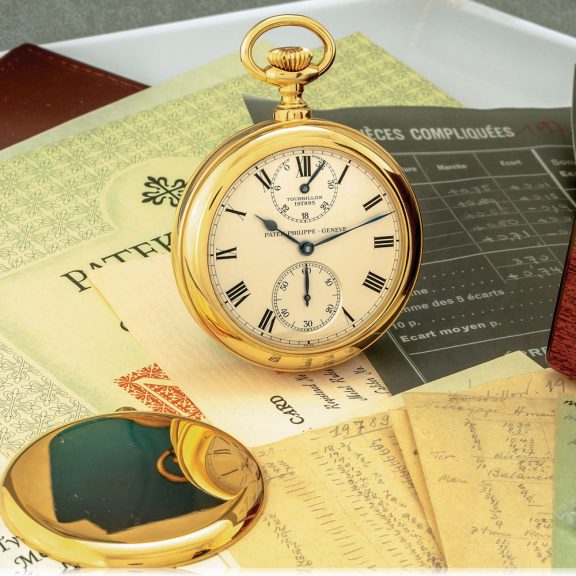
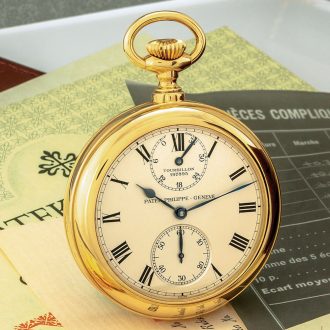

- Kenmerk
- TA4551
- Diameter
- 56 mm
- Estimate
- € 200.000 - 400.000
- Price sold
- € 234.000
Private museum collection by Patek Philippe
–
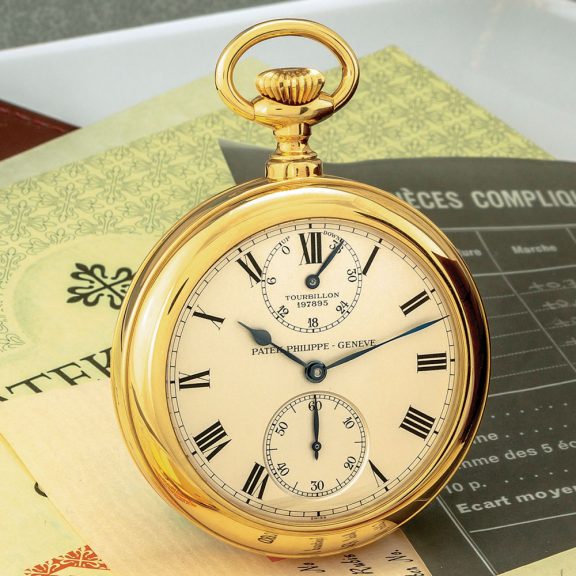
An exceptional and historic Swiss 18k yellow gold tourbillon chronometer deck watch, circa 1924
–
This keyless, ultra-high-precision lever chronometer has a one-minute tourbillon, a Guillaume balance and a power reserve indicator. It won first prize in Category B at the Geneva Observatory twice. The first was in 1929, with a record score of 834 points, when it was regulated by François Modoux. The second was in 1934. It went on to perform strongly in further Observatory trials until 1939.
–
The movement was built between 1927 and 1929 from an ébauche begun in 1924. The tourbillon was made by the celebrated master watchmaker James Pellaton. The case was made in 1989.
–
The watch comes with:
- a Patek Philippe box and hang tag
- an additional solid gold case back
- a Certificate of Origin and a handwritten Certificate of Origin
- an Extract from the Archives
- a Patek Philippe Japan Service Center guarantee
- a handwritten history of the watch
- annual and daily rating records from February 1928 to 1958
–
Description:
Case: Large and polished, with a sapphire crystal and a transparent case back that shows the movement.
–
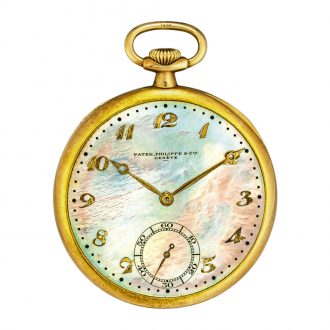
Dial: Matte silver, with painted radial Roman numerals and an outer minute track. It has subsidiary dials for the power reserve and the seconds. The hands are blued steel poire hands.
–
Movement: Nickel, with 20 jewels, Geneva striping and oeil-de-perdrix decoration. It carries the Geneva Seal twice. The steel one-minute tourbillon carriage by James Pellaton has three polished, evenly spaced arms. The movement has a lateral lever escapement and a Guillaume balance with temperature and mean-time adjustment screws. It is adjusted to heat, cold, isochronism and five positions. It has a blued steel balance spring with a Phillips terminal curve and an index regulator on the carriage. The upper balance and centre wheel pivots run in jewels set in gold chatons, each held by three screws.
–
Signatures: The dial, case and movement are signed.
–
Thickness: 16 mm
–
Diameter: 56 mm
–
Signed: Patek Philippe Genève
–
A magnificent and historic unique tourbillon watch
This tourbillon was one of the most accurate mechanical precision watches of the early 20th century. It won first prize at the Geneva Observatory twice: in 1929, with a record score of 834 points, and again in 1934. It comes with a remarkable collection of daily testing records from 1928 to 1952.
–
Provenance
Patek Philippe & Cie owned the watch until 26 June 1939, when it was sold to a private individual. Patek Philippe bought it back in 1942 for its private museum collection, where it was No. 428. In 1989 the present owner made a special request, and Patek Philippe agreed to sell the watch from the museum. The 18k gold case was then specially designed and made to house the movement.
–
The history of Patek Philippe movement No. 197895
Patek Philippe tourbillon No. 197895 is an important part of the history of mechanical precision timekeeping. Patek Philippe made the movement between 1927 and 1929 from an ébauche begun in 1924. The steel tourbillon carriage was made by James Pellaton. It is fitted with a Guillaume balance, which reduces timekeeping errors caused by changes in temperature (the “middle temperature error”).
–
The movement did remarkably well at the Geneva Observatory and was tested extensively between 1928 and 1958. For the 1929 trial it was regulated by François Modoux, one of Patek Philippe’s most famous régleurs, or precision timers. With this watch he set a record of 834 points and won first prize. The tourbillon competed again in 1934 and once more won first prize in its category. It kept performing strongly in observatory competitions until 1939, when it was sold.
–
Modoux was one of the two régleurs who regulated most of the watches Patek Philippe made for Henry Graves Jr., the legendary and demanding collector. Régleurs were the highest-paid workers in the watch industry. Observatory success brought a brand reputation and prestige, and with them greater commercial success.
Signed: Patek Philippe Genève
Share this page: