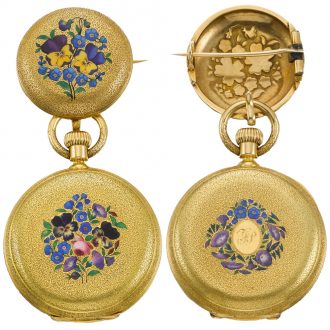
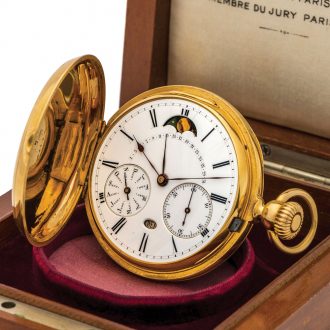
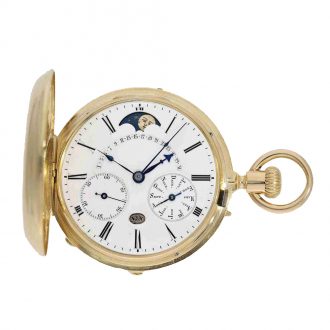
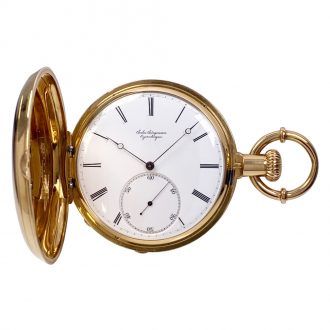
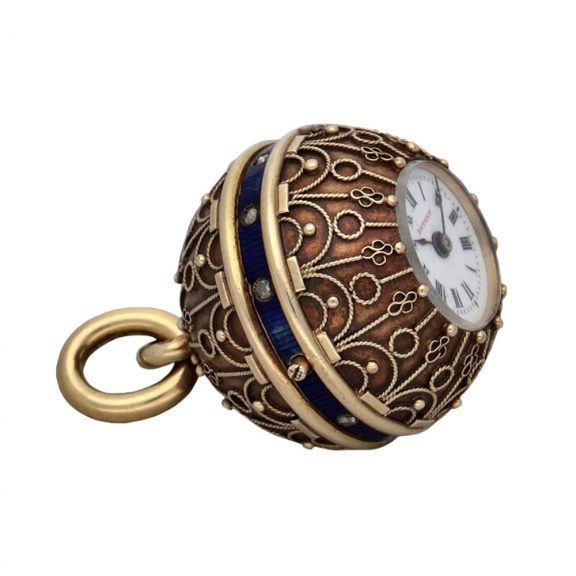
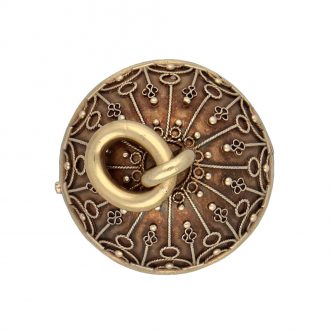
Swiss gold, enamel and diamond set ball form watch Circa 1867
- Kenmerk
- SB1716
- Diameter
- -
- Estimate
- € 3.000 - 6.000
- Price sold
- € 4.100
Gold decorative Boule de Genève
–
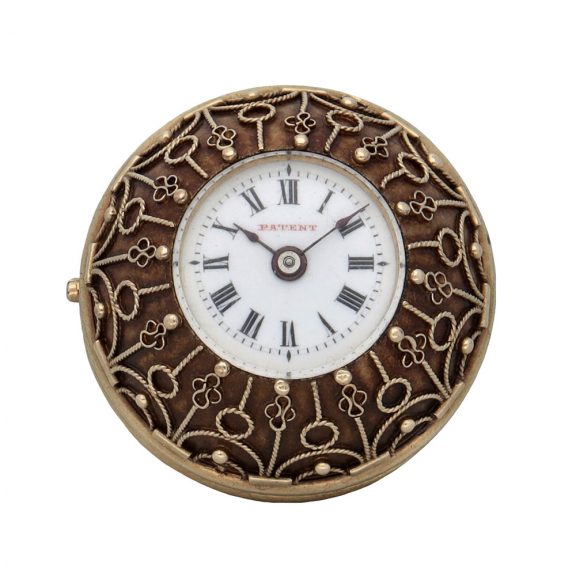
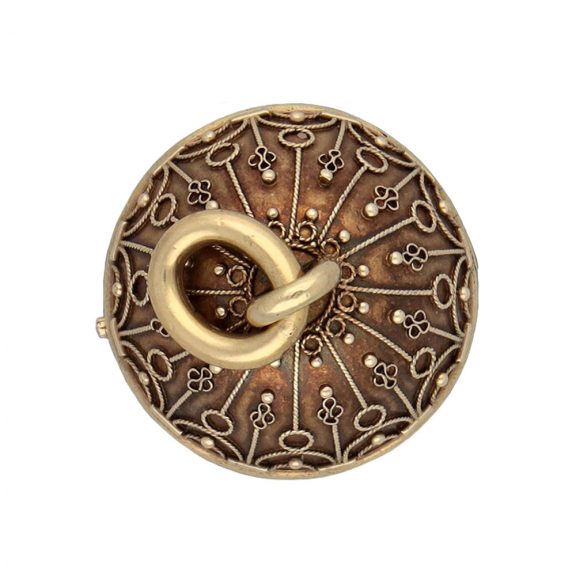
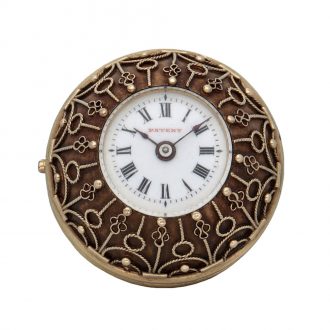
An early Swiss 18 carat gold, enamel and diamond set ball shaped pendant watch made by Patek Philippe in Geneva, circa 1867. The jewelled manual winding movement with a cylinder escapement. White enamel dial with Roman hour numerals, an outer minute track and spade hands. The ball form case with raised ornamentation and blue enamelled, diamond set band. Dial, case and movement signed Patent, case and movement with matching numbers. Comes with an Extract from the Patek Philippe Archives.
–
Dimensions excluding chain loops: 22 x 20 mm
–
Signed: Patek Philippe
–
A Boule de Genève (Geneva ball) is a type of pendant watch in the shape of a small ball or sphere originating from Geneva, Switzerland. The dial is usually at the bottom of the sphere facing the floor, at the opposite side of the jump ring on the upper part of the sphere. Although there are examples with a front view face. Usually, they were Arabic numeral dials, sometimes Roman and from the 1950s different types of hour markers were also used. This ‘objet de vertu’ frequently came with a matching brooch, chain or chatelaine.
–
The term Boule de Genève is generic, it doesn’t mean that a given watch was necessarily made in the city or Canton of Geneva. Geneva balls were crafted in different sizes, styles, materials and decorative techniques, such as gold, silver, other metals, guilloché enamel, enamel, cloisonné, adorned with diamonds, pearls, etc. They were intended as an accessory mainly for women.
–
The first Boules de Genève date from the 1860s, marketed by firms such as Patek Philippe from 1866. They featured the winding mechanism invented by Marius Lecoultre (1847-1915) of Geneva and patented in Switzerland in 1889 (the Swiss patent office was not created until 1888). Winding by rotating the hemisphere containing the dial and time-setting by pressing the protruding, cylindrical-shaped button at one side of the orb while turning the hemisphere clockwise or counterclockwise. These watches have no key or crown. Lecoultre’s winding system was also used in some ring watches and wristwatches of the time.
–
In the 1878 Paris Exposition Universelle, Patek Philippe devoted a showcase to these ball-form timepieces. Years later they sold pieces to royalty such as Sultan Hussein Kamel of Egypt in 1887 and Empress Teresa of Brazil in 1888.
Signed: Patek Philippe
Share this page: