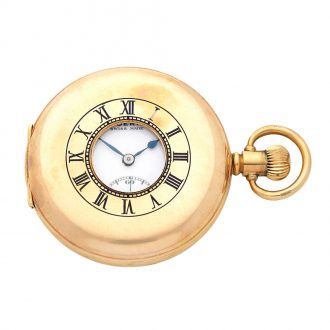
Swiss 9 carat gold half hunting cased lever watch Circa 1955
- Kenmerk
- BB1006
- Diameter
- 49 mm
- Estimate
- € 1.250 - 2.000
- Price sold
- € 650
Gold half hunter
–
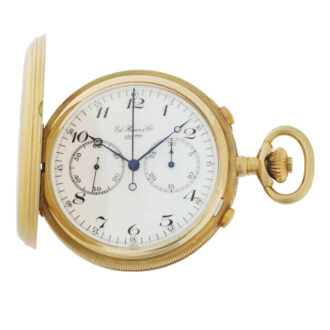
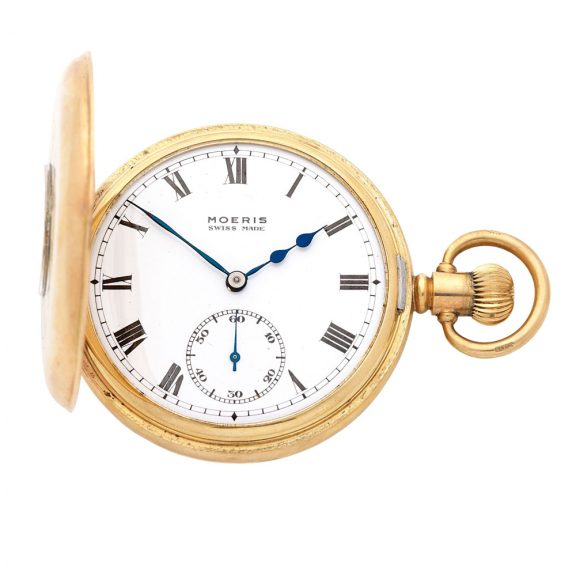
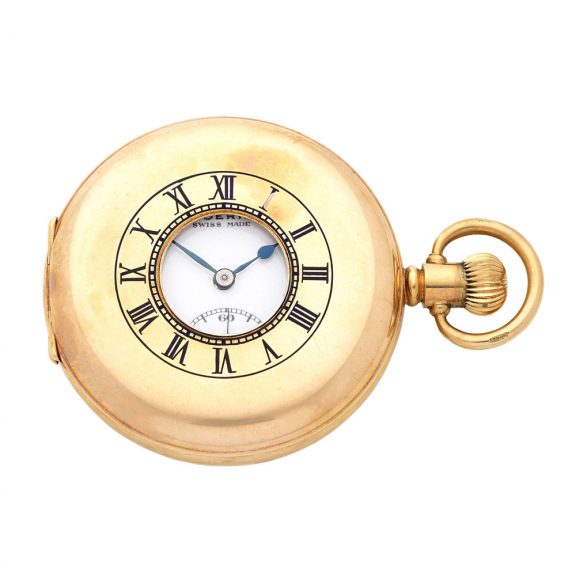
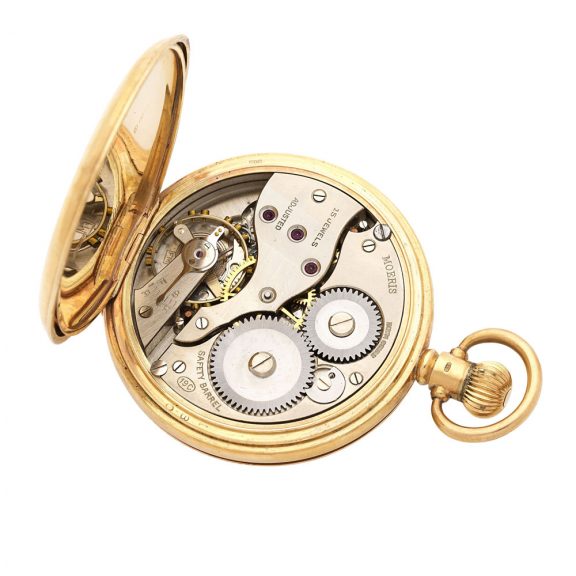
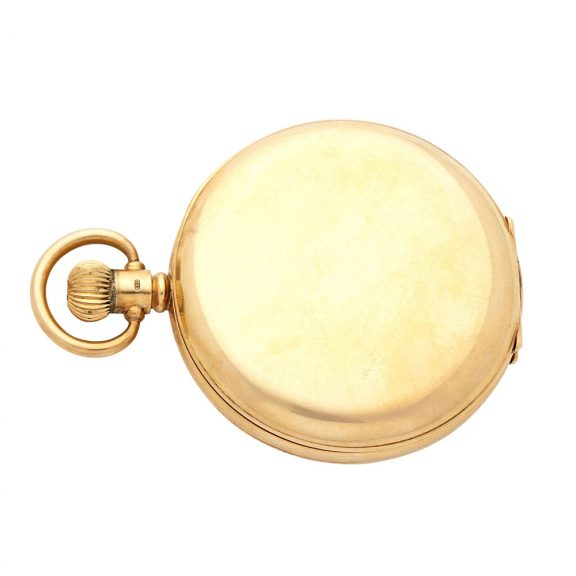
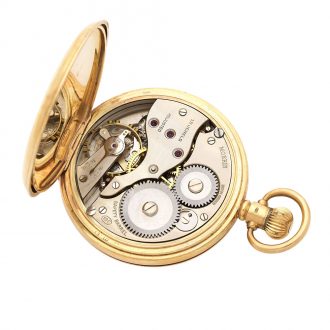
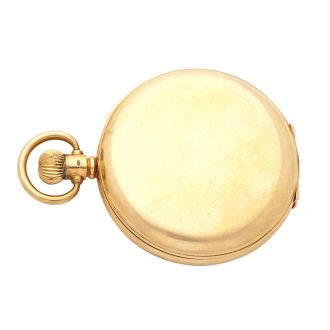
A Swiss 9 carat gold half hunting cased keyless pocket watch made by Fabrique des Montres SA Moeris in Saint-Imier, Birmingham Hallmarked for 1955. The adjusted movement with a Swiss lever escapement and 15 jewels. White enamel dial with Roman hours, an outer minute track, subsidiary seconds at 6 o’clock and blued double spade hands. The cuvette of the polished hinged case with a presentation inscription. Dial and movement signed, case numbered and stamped A.L.D.
–
A Swiss 9 carat gold half hunting cased keyless pocket watch made by Fabrique des Montres SA Moeris in Saint-Imier, Birmingham Hallmarked for 1955. The adjusted movement with a Swiss lever escapement and 15 jewels. White enamel dial with Roman hours, an outer minute track, subsidiary seconds at 6 o’clock and blued double spade hands. The cuvette of the polished hinged case with a presentation inscription. Dial and movement signed, case numbered and stamped A.L.D.
–
Diameter: 49 mm
–
Diameter: 49 mm
–
Signed: Moeris Swiss made
–
Fritz Moeri and Julius Frederic Jeanneret from Saint-Imier, Switzerland, founded a watch company in 1883. Their company was dissolved after the sudden death of Jeanneret in 1899. Moeri subsequently started a new business under the name Fabrique des Montres SA Moeris.
–
In 1904, Moeri filed a patent for his caliber 19’’’ movement called the ‘Non-magnetic’. This movement was the basis of future production.
–
The Swiss physicist Charles Eduard Guillaume (1861-1938), who came from a family of watchmakers, discovered Invar, a nickel-iron alloy, in 1896. A material with the same characteristics as, but with a coefficient of linear expansion of less than ten times compared to steel. A particular variant of Invar, known as FeNi36, with 36% nickel, had an even better behaviour, but was very difficult to work. The complication of the mechanical processing of the alloy led Guillaume to organize a group of companies that had experience in this area. Moeri took part in this trial, achieving excellent results.
–
By 1957, Fabrique des Montres SA Moeris produced more than 10 million watches. At that time, they made upscale timepieces with 17 or 25 jewels and Incabloc shock protection.
–
In 1966, they marketed a licensed watch with the likeness of James Bond. This watch featured a rectangular case with chamfered corners, giving it an octagonal look. The round dial featured the James Bond 007 logo above the date window at 6 o’clock and the reverse an engraving of Sean Connery. The crown was square and also engraved 007.
–
Moeris, alongside Blancpain, became part of Rayville in 1974. At this time, the company pivoted to focus on historic replica pocket watches and so for the next decade, the Moeris brand was found on many timpieces with historic designs. In 1976, the company listed its address as Villeret, the premises of Rayville, however, in 1978, it closed its doors.
–
In 1980, ownership of Moeris passed to Tissot. By this point, the company specialized in skeletonized pocket watches and quartz pendant watches for ladies. Soon, the company was located in Le Locle, the home base of Tissot. It appears to have ceased production after 1985.
–
Fritz Moeri and Julius Frederic Jeanneret from Saint-Imier, Switzerland, founded a watch company in 1883. Their company was dissolved after the sudden death of Jeanneret in 1899. Moeri subsequently started a new business under the name Fabrique des Montres SA Moeris.
–
In 1904, Moeri filed a patent for his caliber 19’’’ movement called the ‘Non-magnetic’. This movement was the basis of future production.
–
The Swiss physicist Charles Eduard Guillaume (1861-1938), who came from a family of watchmakers, discovered Invar, a nickel-iron alloy, in 1896. A material with the same characteristics as, but with a coefficient of linear expansion of less than ten times compared to steel. A particular variant of Invar, known as FeNi36, with 36% nickel, had an even better behaviour, but was very difficult to work. The complication of the mechanical processing of the alloy led Guillaume to organize a group of companies that had experience in this area. Moeri took part in this trial, achieving excellent results.
–
By 1957, Fabrique des Montres SA Moeris produced more than 10 million watches. At that time, they made upscale timepieces with 17 or 25 jewels and Incabloc shock protection.
–
In 1966, they marketed a licensed watch with the likeness of James Bond. This watch featured a rectangular case with chamfered corners, giving it an octagonal look. The round dial featured the James Bond 007 logo above the date window at 6 o’clock and the reverse an engraving of Sean Connery. The crown was square and also engraved 007.
–
Moeris, alongside Blancpain, became part of Rayville in 1974. At this time, the company pivoted to focus on historic replica pocket watches and so for the next decade, the Moeris brand was found on many timpieces with historic designs. In 1976, the company listed its address as Villeret, the premises of Rayville, however, in 1978, it closed its doors.
–
In 1980, ownership of Moeris passed to Tissot. By this point, the company specialized in skeletonized pocket watches and quartz pendant watches for ladies. Soon, the company was located in Le Locle, the home base of Tissot. It appears to have ceased production after 1985.
Signed: Moeris Swiss made
Share this page: