Swiss exceptional gold complicated lever watch Circa 1912
- Kenmerk
- BB1206
- Diameter
- 54 mm
- Estimate
- € 55.000 - 110.000
- Price sold
- € 69.050
Gold presentation watch
–
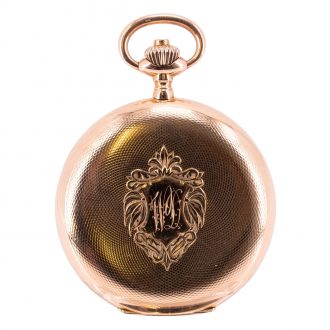
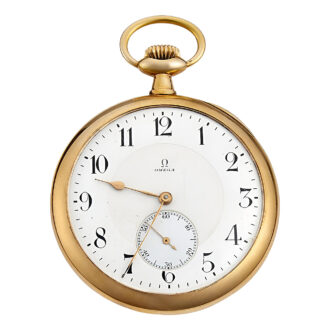
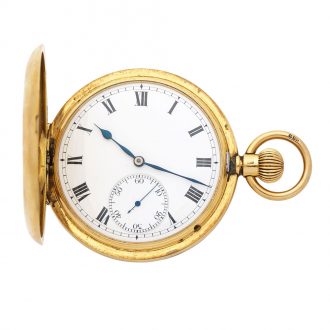
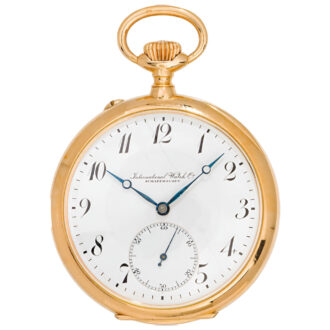
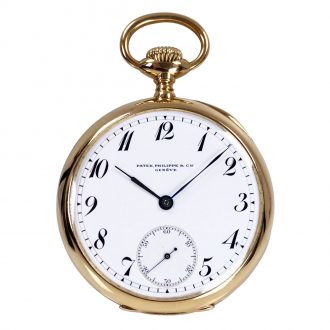
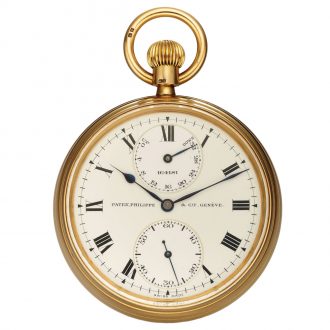
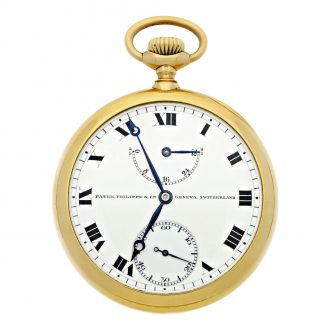
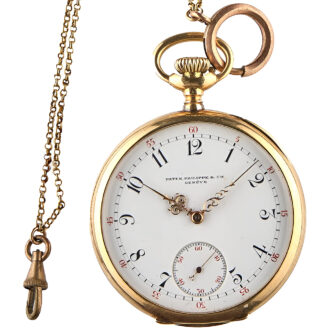
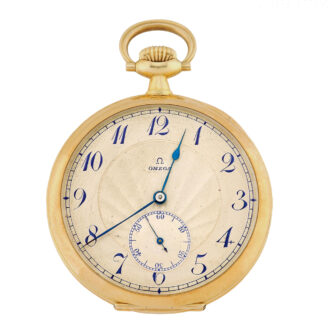
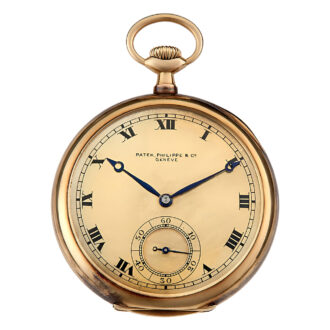
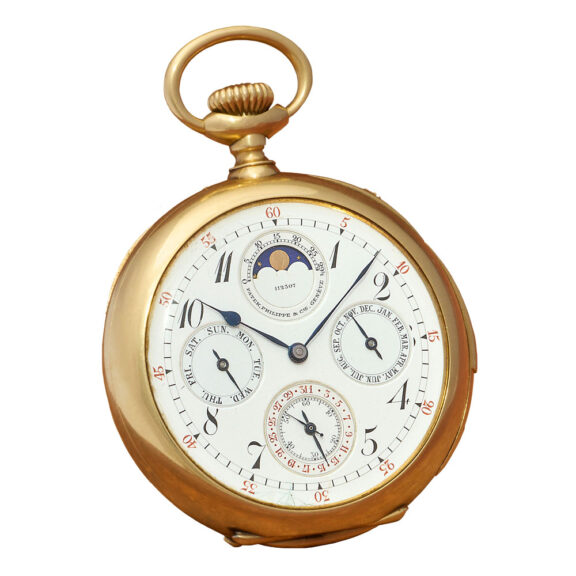
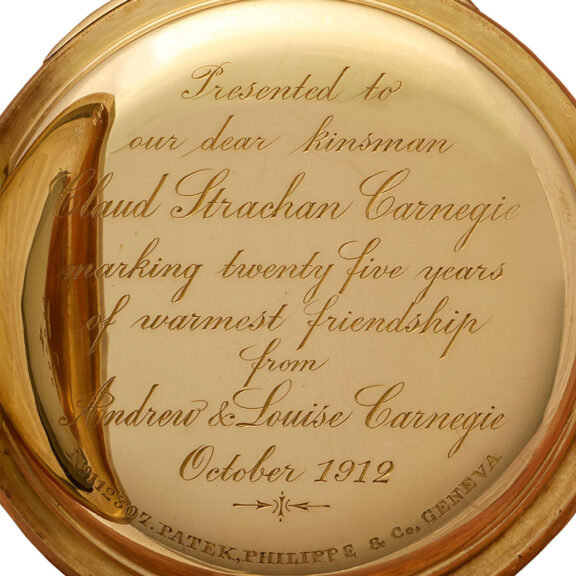
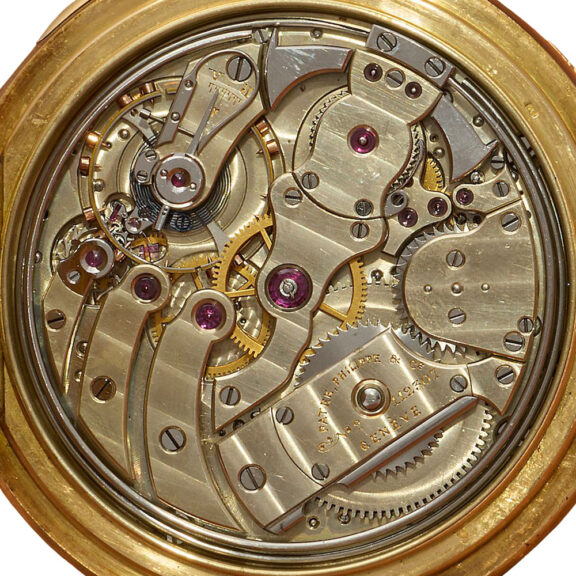
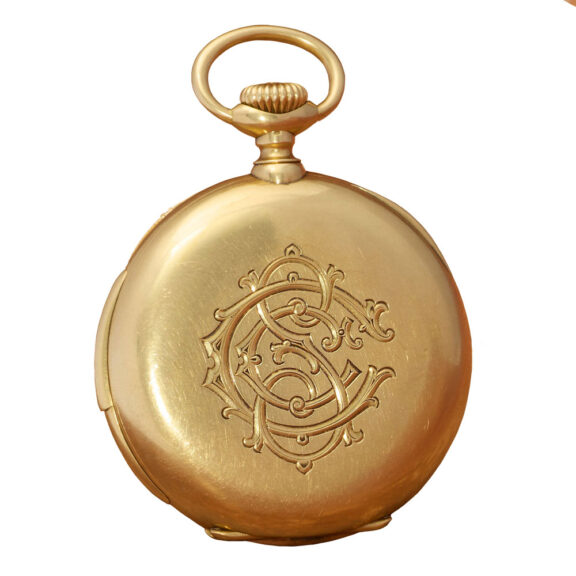
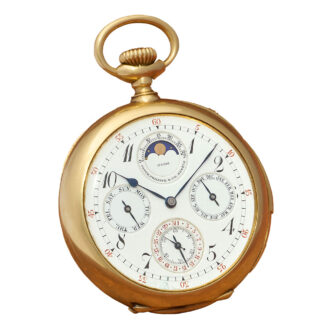
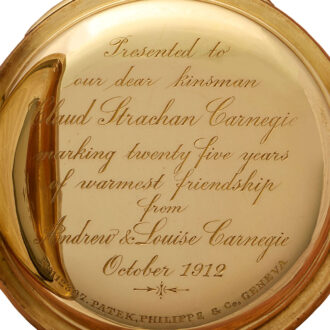
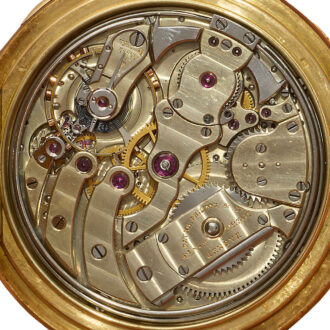
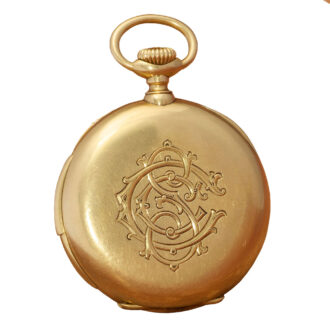
An exceptional, fine and rare Swiss 18 carat gold open faced minute repeating keyless pocket watch with perpetual calendar, phases of the moon and moon age, gifted by Scottish-American Industrialists Andrew & Louise Carnegie to their kinsman in 1912, made by Patek Philippe in Geneva, 1902. Sold on October 17th, 1912. The Swiss lever movement with Geneva striping, a cut and compensated bimetallic balance, wolf’s tooth winding, swan neck regulation and two polished hammers striking on two gongs. White enamel dial with Arabic hour numerals, an outer minute track with red Arabic five minute numerals, subsidiary seconds with concentric date at 6 o’clock, moon phases combined with moon age at 12, days of the week at 9, the months at 3 and blued steel spade hands. A polished case with monogram CSC on the back, a presentation inscription on the cuvette reading Presented to my dear kinsman Claud Strachan Carnegie marking twenty five years of warmest friendship from Andrew & Louise Carnegie October 1912, quick set buttons to the band at 6 and between 11 and 12 o’clock, and a repeat slide at 3. Dial signed Patek, Philippe & Cie – Genève, case numbered, cuvette signed Patek, Philippe & Co Geneva, movement signed Patek Philippe & Ce Genève, dial, cuvette and movement with matching numbers. Comes with an Extract from the Archives.
–
An exceptional, fine and rare Swiss 18 carat gold open faced minute repeating keyless pocket watch with perpetual calendar, phases of the moon and moon age, gifted by Scottish-American Industrialists Andrew & Louise Carnegie to their kinsman in 1912, made by Patek Philippe in Geneva, 1902. Sold on October 17th, 1912. The Swiss lever movement with Geneva striping, a cut and compensated bimetallic balance, wolf’s tooth winding, swan neck regulation and two polished hammers striking on two gongs. White enamel dial with Arabic hour numerals, an outer minute track with red Arabic five minute numerals, subsidiary seconds with concentric date at 6 o’clock, moon phases combined with moon age at 12, days of the week at 9, the months at 3 and blued steel spade hands. A polished case with monogram CSC on the back, a presentation inscription on the cuvette reading Presented to my dear kinsman Claud Strachan Carnegie marking twenty five years of warmest friendship from Andrew & Louise Carnegie October 1912, quick set buttons to the band at 6 and between 11 and 12 o’clock, and a repeat slide at 3. Dial signed Patek, Philippe & Cie – Genève, case numbered, cuvette signed Patek, Philippe & Co Geneva, movement signed Patek Philippe & Ce Genève, dial, cuvette and movement with matching numbers. Comes with an Extract from the Archives.
–
Diameter: 54 mm
–
Signed: Patek, Philippe & Cie Genève
–
Andrew Carnegie (1835-1919), once the richest man in the world, was a pioneer in the iron and steel industry and helped build much of the infrastructure that is part of the American identity. From exceptionally humble beginnings, Carnegie would use a combination of ruthless efficiency, creative thinking and opportunity seeking to establish his industrial empire before embracing an era of philanthropy.
–
Born in 1835, Carnegie grew up in near poverty in Dunfermline, Scotland. Times were hard, and whilst Carnegie was very young, the struggles to find local work led the family to emigrate to the US in 1848. It was in Pittsburgh that Carnegie first demonstrated his mettle and under the mentorship of Pennsylvania Railroad General Superintendent Thomas A. Scott (1823-1881) the foundations were laid that turned him from messenger boy to famous Industrialist.
–
As Scott’s personal secretary and with his ability to spot opportunities during the American Civil War, it was not long before Carnegie’s connection to the iron and steel industries began in earnest. Bridge building, along with mining and rail building, would go on to be the three cornerstones of his monumental empire.
–
By 1901, nearing the age of 70, Carnegie’s ethos on life had changed. He craved more family time and thus sold Carnegie Steel to John Pierpont Morgan for a staggering $480 million dollars. It was this deal that catapulted him to the position of wealthiest man in the world. From this point on Carnegie devoted his time and energy to donating his vast wealth to charitable organisations and initiatives. As well as the world famous Carnegie Hall in New York he also left over 2500 public libraries, numerous organisations dedicated to the pursuit of science, peace and education, and the remaining $135 million of his fortune to the Carnegie Corporation of New York as part of his legacy.
–
It was in this era of giving that the present watch was gifted by Carnegie and his wife Louise to Claud Strachan Carnegie. Little is known about who Claud was but most likely it refers to Claud Cathcart Rennie-Strachan-Carnegie of Seaton House, Angus. Claud had left a strong impression on Carnegie and this is reflected in the engraving on the cuvette. With an eye for the finer things in life, it is not unsurprising that they chose a Patek Philippe to represent their gratitude.
–
Patek Philippe have produced some of the finest ultra complicated watches in history with fantastic examples on either side of the introduction of computer aided design. This timepiece features a perpetual calendar, moon age, phases of the moon and also repeats the minutes. This was not some throwaway token but a real execution of fine and complicated timekeeping that demonstrated a true appreciation of friendship.
–
This watch represents the fusing of horological accomplishment, philanthropic endeavour and industrial legacy.
Diameter: 54 mm
–
Signed: Patek, Philippe & Cie Genève
–
Andrew Carnegie (1835-1919), once the richest man in the world, was a pioneer in the iron and steel industry and helped build much of the infrastructure that is part of the American identity. From exceptionally humble beginnings, Carnegie would use a combination of ruthless efficiency, creative thinking and opportunity seeking to establish his industrial empire before embracing an era of philanthropy.
–
Born in 1835, Carnegie grew up in near poverty in Dunfermline, Scotland. Times were hard, and whilst Carnegie was very young, the struggles to find local work led the family to emigrate to the US in 1848. It was in Pittsburgh that Carnegie first demonstrated his mettle and under the mentorship of Pennsylvania Railroad General Superintendent Thomas A. Scott (1823-1881) the foundations were laid that turned him from messenger boy to famous Industrialist.
–
As Scott’s personal secretary and with his ability to spot opportunities during the American Civil War, it was not long before Carnegie’s connection to the iron and steel industries began in earnest. Bridge building, along with mining and rail building, would go on to be the three cornerstones of his monumental empire.
–
By 1901, nearing the age of 70, Carnegie’s ethos on life had changed. He craved more family time and thus sold Carnegie Steel to John Pierpont Morgan for a staggering $480 million dollars. It was this deal that catapulted him to the position of wealthiest man in the world. From this point on Carnegie devoted his time and energy to donating his vast wealth to charitable organisations and initiatives. As well as the world famous Carnegie Hall in New York he also left over 2500 public libraries, numerous organisations dedicated to the pursuit of science, peace and education, and the remaining $135 million of his fortune to the Carnegie Corporation of New York as part of his legacy.
–
It was in this era of giving that the present watch was gifted by Carnegie and his wife Louise to Claud Strachan Carnegie. Little is known about who Claud was but most likely it refers to Claud Cathcart Rennie-Strachan-Carnegie of Seaton House, Angus. Claud had left a strong impression on Carnegie and this is reflected in the engraving on the cuvette. With an eye for the finer things in life, it is not unsurprising that they chose a Patek Philippe to represent their gratitude.
–
Patek Philippe have produced some of the finest ultra complicated watches in history with fantastic examples on either side of the introduction of computer aided design. This timepiece features a perpetual calendar, moon age, phases of the moon and also repeats the minutes. This was not some throwaway token but a real execution of fine and complicated timekeeping that demonstrated a true appreciation of friendship.
–
This watch represents the fusing of horological accomplishment, philanthropic endeavour and industrial legacy.
Signed: Patek, Philippe & Cie Genève
Share this page: