Extremely rare Swiss gold and enamel cylinder watch Circa 1850
- Kenmerk
- BA1606
- Diameter
- 37 mm
- Estimate
- € 10.000 - 20.000
- Price sold
- -
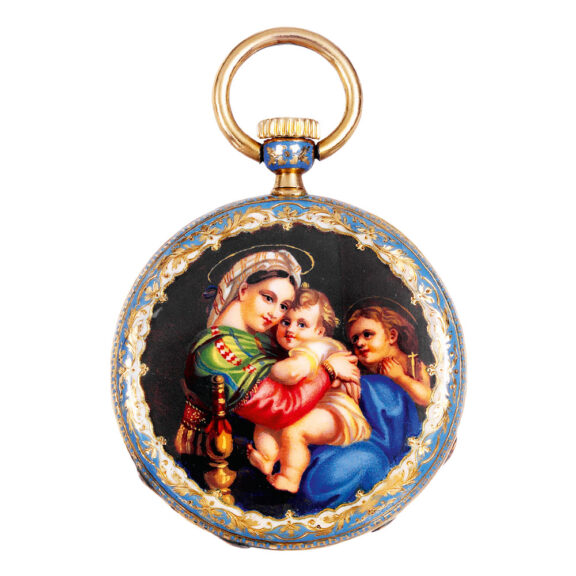
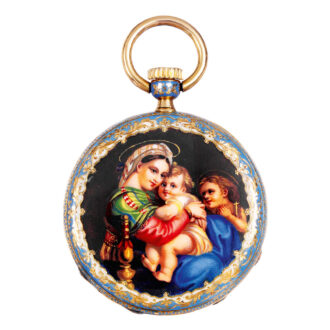
Gold watch with the depiction of the Madonna della Sedia
–
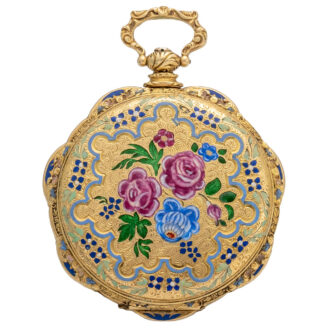
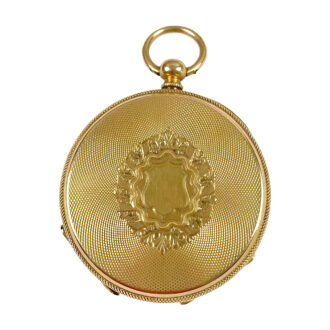
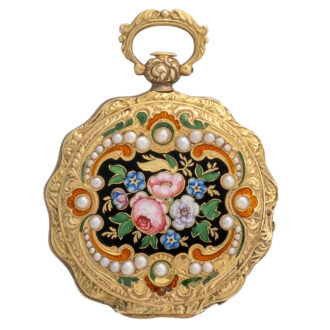
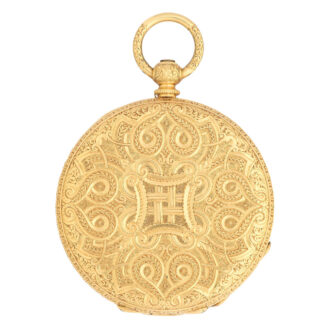
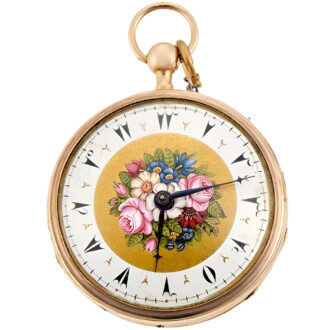
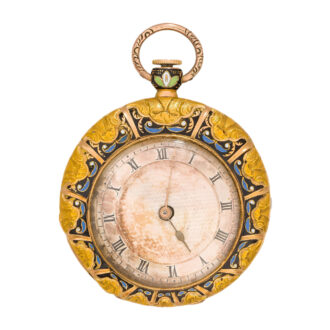
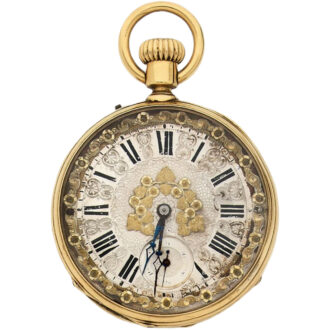
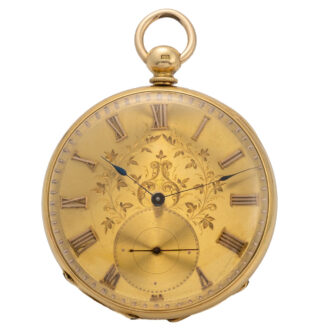
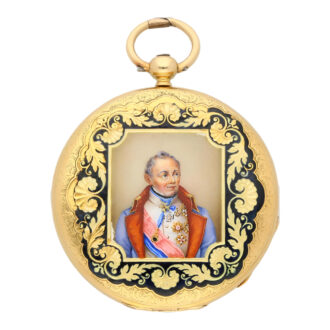
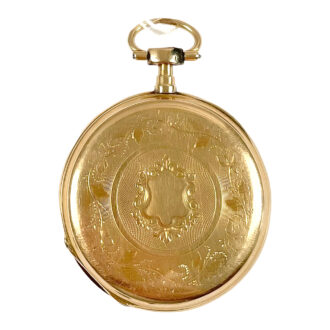
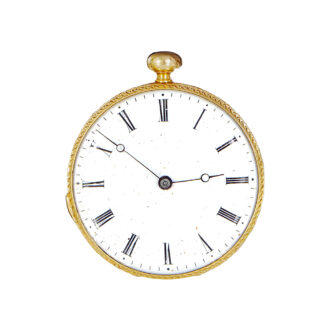
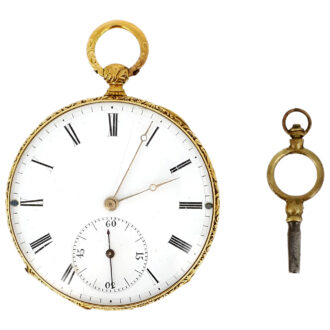
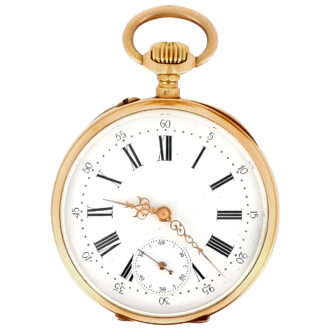
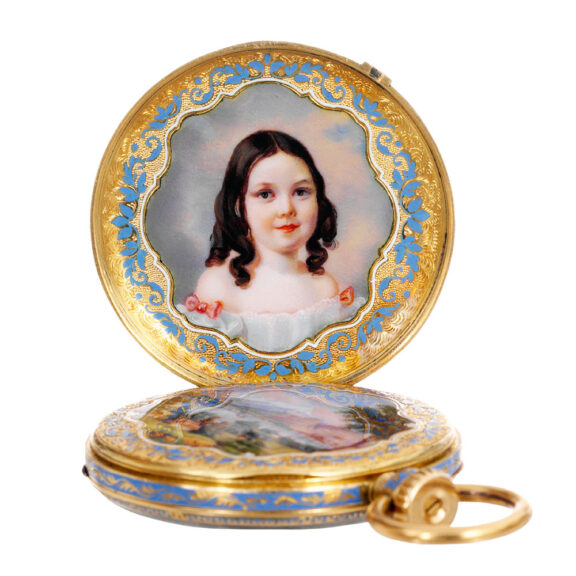
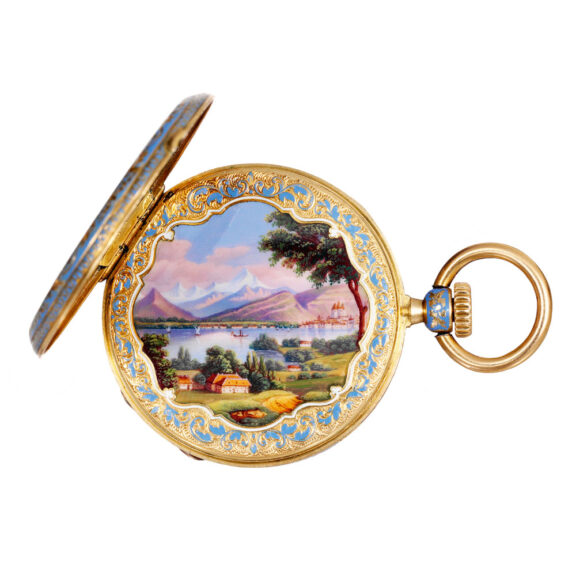
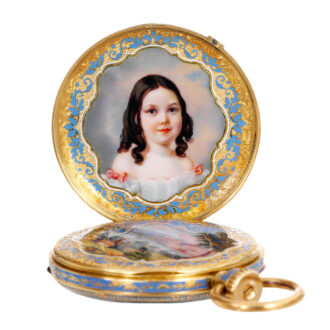
A very fine and extremely rare Swiss 18 carat gold and enamel pocket watch with Adrien Philippe’s first patented stem-wind and hand-setting system, patent No. 1317 of 22 April 1845 without coasting, circa 1850. Frosted gilt movement, bar calibre, 8 jewels, wolf’s tooth winding, cylinder escapement, gilt three-arm flat-rim balance, blued steel flat balance spring, index regulator, Adrien Philippe’s first patented stem-wind and hand-setting system. Hinged gold cuvette decorated with a very fine polychrome enamel view over Lac Leman (Geneva) to the Alps beyond, border to match the interior of the back cover. White enamel dial secured by two screws, with radial Roman numerals, outer minute divisions, subsidiary seconds and original gold Breguet hands. The bezel, stem, and band are decorated with pale blue champlevé enamel and gold leaves, a flat-top winding crown, the case back is decorated with a polychrome enamel depiction of the Madonna della Sedia after the original by Raphael, within a white and pale blue champlevé enamel border with gold leaves, the interior with a very fine painted on enamel portrait miniature of a young girl within a pale blue enamel and matted foliate border. Movement numbered on the dial plate.
–
Diameter: 37 mm
–
Signed: No name
–
This piece can confidently be attributed to Czapek & Cie because, apart from Patek Philippe themselves, nobody else was permitted to use Adrien Philippe’s patent winding and hand-setting system in their watches. Also, Czapek, when using this system made a small change to the design of the check spring which is unique to Czapek and is present in this watch. Nothing is known of the arrangement whereby Czapek was permitted to use the patent winding system and no record of any license payments exists but it seems he was nonetheless entitled to use it. In his book, Czapek states that in his shop he used only this design. The French patent No. 1317 of April 22, 1845, was for Adrien Philippe’s winding and hand-setting system. The winding pinion is fixed to the winding shaft, for winding the crown must be turned clockwise and cannot be turned back with that typical ratchet noise. To disengage the winding in order to set the hands, the winding crown can be pulled out. Very few watches survive with this early winding mechanism without coasting and the present watch is particularly rare in also having such an exquisitely decorated case.
–
Czapek & Cie. Franciszek Czapek was a Polish emigrant who arrived in Switzerland in 1832 after the fall of the Polish insurrection against Russia. On May 1, 1839, Antoni Patek and François Czapek (his name having been gallicized) established a business in Geneva under the name of Patek et Czapek. The partnership lasted six years, during which some exceptional watches were produced. After the dissolution, Patek established Patek, Philippe Co. with a new partner, Adrien Philippe, and Czapek founded ‘Czapek et Cie’, also with a new partner, Juliusz Gruzewski. Czapek’s new company did well. Gruzewski was a personal friend of Napoleon III, and Czapek quickly became watchmaker to the court of the Emperor (Unger’s calendar for 1850, Warsaw, 1850). He had a factory in Geneva, a shop in Warsaw, and another in Paris. He wrote a small book about watches and watchmaking in which he announced that he was working on a larger volume, but he, unfortunately, died before publishing it.
–
The Madonna della Sedia. The enamel scene on this watch is after Raphael’s ‘Madonna Della Sedia’ painted in 1514, today in the Pitti Palace in Florence.
Share this page: