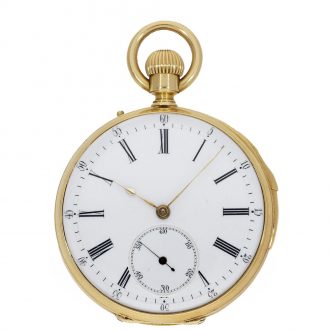
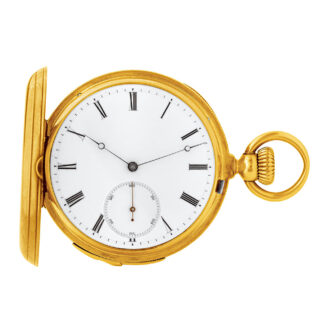
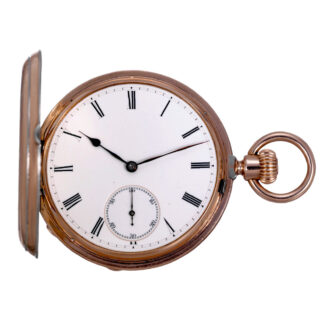
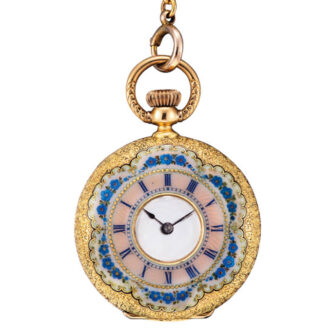
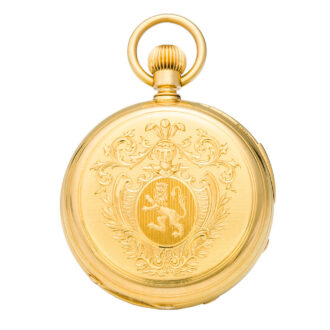
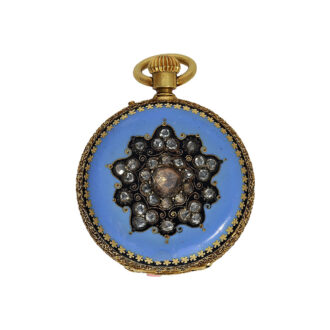
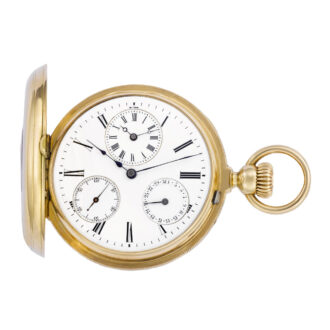
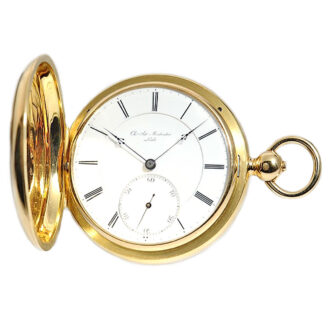
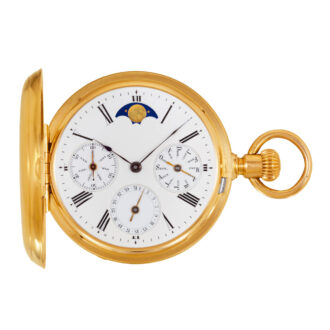
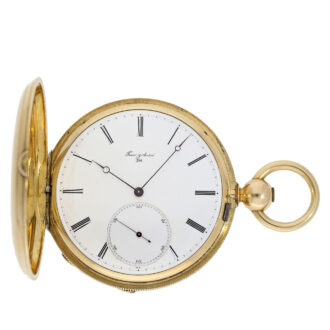
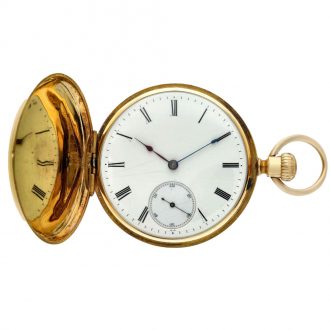
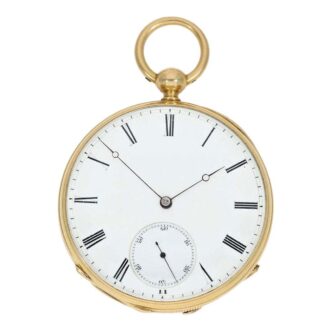
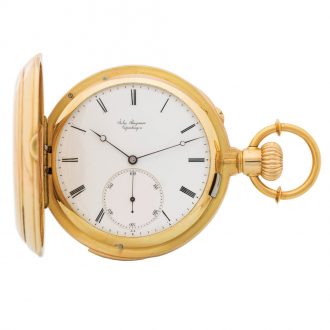
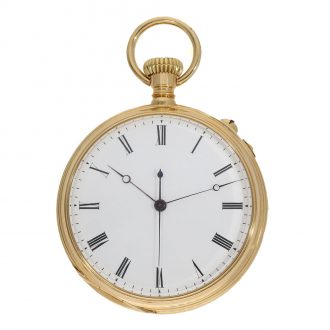
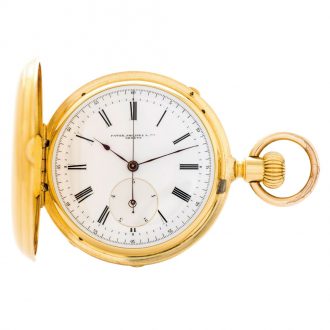
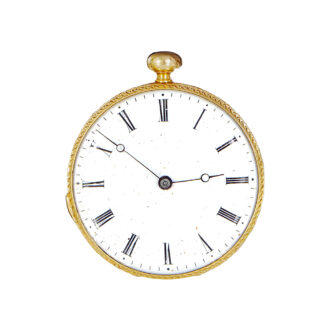
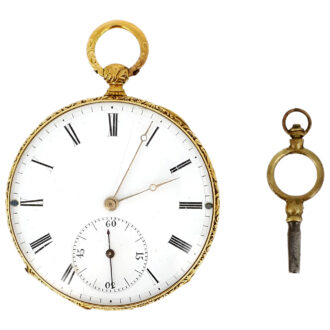
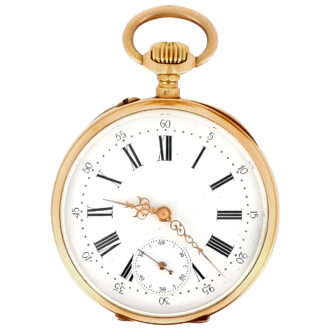
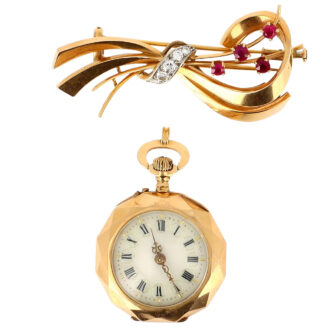
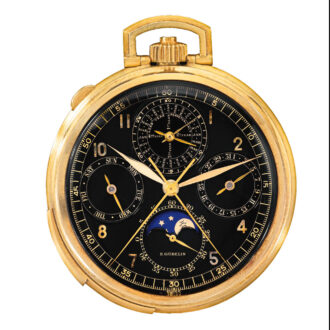
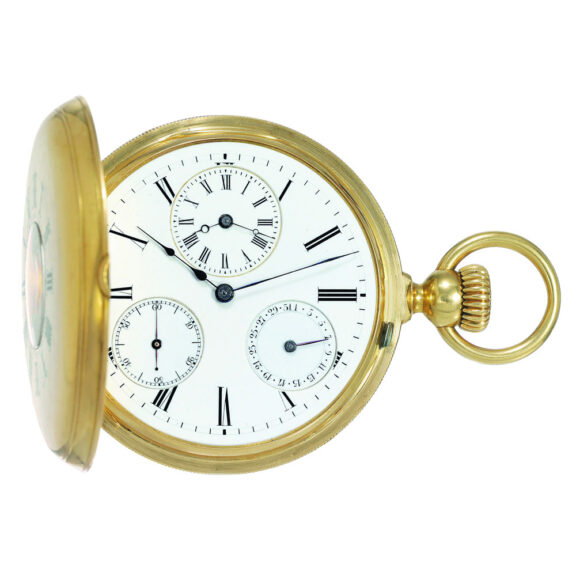
Swiss gold half hunting cased two time zone lever Circa 1868
- Kenmerk
- BA0503
- Diameter
- 51 mm
- Estimate
- € 15.000 - 30.000
- Price sold
- -
Independently adjustable dual time zone perpetual calendar by Patek Philippe
–
A very fine, exceptionally rare and early Swiss 18 carat gold and enamel half hunting cased independently adjustable two time zone keyless lever pocket watch with perpetual calendar with indication of days only, circa 1868. Sold on January 7, 1879 to Baron Albert Salomon von Rothschild, given to Baron Charles Freiherr von Schroeder. Frosted gilt movement, 15 jewels, wolf’s tooth winding, straight-line moustache lever, cut bimetallic compensation balance with gold meantime and temperature adjustment screws, blued steel flat balance spring, index regulator, hand setting nut for the second time zone mounted above the centre wheel and geared by an extra wheel mounted on the plate. Gold hinged cuvette with aperture for the second time zone hand setting disc, engine turned border and cartouche engraved Petites Aiguilles. White enamel dial with Roman numerals, outer minute track, subsidiary dials for the second time zone with Roman numerals and outer minute divisions, the seconds at 8 o’clock and the perpetual date at 4, original blued steel double pear hands for the local time, blued steel Breguet hands for the meantime. Polished case, glazed aperture and unusual blue champlevé enamel Roman numerals to the front, inner minute divisions, the back decorated with blue champlevé enamel monogram ASR for Albert Salomon von Rothschild, beneath a coronet, flat topped crown for winding and setting the main time zone hands, reeded band. Cuvette and case signed. Accompanied by the Extract from the Archives.
–
Diameter: 51 mm
–
Signed: Patek, Philippe & Co Genève
–
Albert Salomon von Rothschild (1844 – 1911) was a member of the Rothschild banking family of Austria. Born in Vienna, the youngest child of Anselm von Rothschild (1803-1874) and Charlotte von Rothschild (1807-1859), he was educated in Vienna and Brünn/Brno. In 1876, Albert von Rothschild married Baroness Bettina Caroline de Rothschild (1858-1892) of France, the daughter of Alphonse James de Rothschild. Their children were: Georg Anselm Alphonse (March 22, 1877 – January 10, 1934), Alfons Maier (1878-1942), Charlotte Esther (1879-1885), Ludwig (Louis) Nathaniel (1882-1955), Eugène Daniel (1884-1976), Valentine Noémi (1886-1969) and Oskar Ruben (1888-1909). Albert von Rothschild owed several large properties, including the Palais Albert Rothschild at Prinz-Eugen-Straße 20-22, designed by French architect Gabriel-Hippolyte Destailleur. In December of 1887 Albert and his wife were accorded the right to be presented at Court, the first time such a privilege had been granted in Austria to persons of the Jewish faith. Albert continued the family tradition of philanthropy and patronage of the arts. An avid chess player, he sponsored tournaments and in 1872 became president and patron of the Vienna chess society. Following his wife’s death in 1892 at the age of thirty-four, Albert von Rothschild built the Bettina Frauenspital (Bettina Hospital for Women) in her memory. Albert was awarded the Iron Cross of Merit in 1893 for his role in Austro-Hungarian monetary reform. When his brother Nathaniel died in 1905, Albert inherited the Palais Rothschild in Vienna, along with its large art collection, later plundered by the Nazis. Albert Salomon von Rothschild died in Vienna in 1911.
–
Baron Charles Freiherr von Schroeder (1826 – 1909) was a member of an important German banking family that founded the Schroeder Bank, which possessed branches in Hamburg, London and New York. The Schroeder family created a unique international banking institution, with merchant firms extending from Russia to Latin America, and including the United States. Before World War I Schroeders were arguably one of the most important merchant banks in London. According to the descendants of the original owner, close ties existed between the von Schroeder and the Rothschild families and Albert Salomon von Rothschild is said to have worked for a time at the Schroeder Bank in Hamburg.
The present watch is extremely unusual for two reasons, firstly it has provision for two independently adjustable time zones before the adoption of hourly time zones. Secondly, the perpetual calendar is of a very unusual and rare type, the dial only showing the date, with no days of the week or month indications. In effect, this means that the calendar must be set by a watchmaker and then kept going so that the calendar stays in sequence.
Before the adoption of time zones, people used local solar time (originally apparent solar time, as with a sundial and, later, mean solar time). Mean solar time is the average over a year of apparent solar time. Its difference from apparent solar time is the equation of time This became increasingly awkward as railways and telecommunications improved, because clocks differed between places by an amount corresponding to the difference in their geographical longitude, which was usually not a convenient number. This problem could be solved by synchronizing the clocks in all localities, but then in many places the local time would differ markedly from the solar time to which people are accustomed. Time zones were first proposed for the entire world by Canada’s Sir Sandford Fleming in 1876 as an appendage to the single 24 hour clock he proposed for the entire world (located at the center of the Earth and not linked to any surface meridian). In 1879 he specified that his universal day would begin at the Patek Philippe anti-meridian of Greenwich (now called 180°), while conceding that hourly time zones might have some limited local use. He continued to advocate his system at subsequent international conferences. In October 1884, the International Meridian Conference did not adopt his time zones because they were not within its purview. The conference did adopt a universal day of 24 hours beginning at Greenwich midnight, but specified that it “shall not interfere with the use of local or standard time where desirable”. Nevertheless, most major countries had adopted hourly time zones by 1929. Today, all nations use standard time zones for secular purposes, but they do not all apply the concept as originally conceived. Newfoundland, India, Iran, Afghanistan, Burma, the Marquesas, as well as parts of Australia, use half hour deviations from standard time, and some nations, such as Nepal and the Chatham Islands use quarter hour deviations.
–
Greenwich Meantime (GMT) was established in 1675, when the Royal Observatory was built, as an aid to determine longitude at sea by mariners. The first time zone in the world was established by British Railways on December 1, 1847, with GMT hand carried chronometers. About August 23, 1852, time signals were first transmitted by telegraph from the Royal Observatory, Greenwich. Even though 98% of Great Britain’s public clocks were using GMT by 1855, it was not made Britain’s legal time until August 2, 1880. Some old clocks from this period (as with the present watch) have two dials or two sets of hands, one for the local time, one for GMT.
Signed: Patek, Philippe & Co Genève
Share this page: