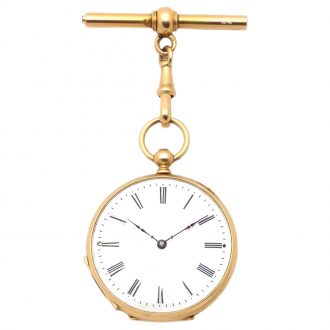
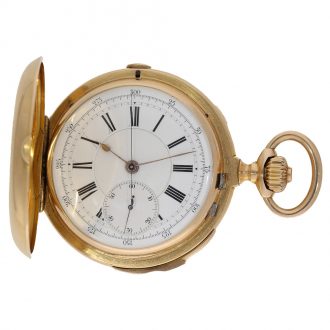
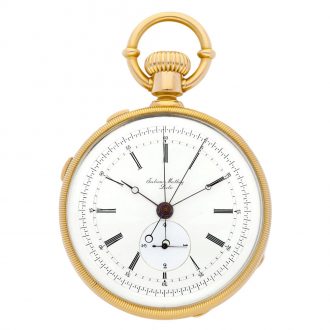
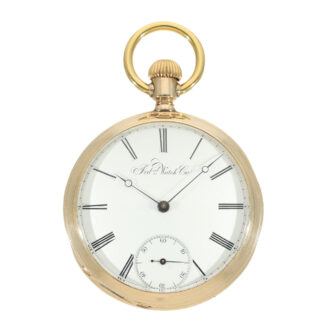
Swiss 18k gold two time zone centre seconds lever Circa 1875
- Kenmerk
- BA0755
- Diameter
- 51 mm
- Estimate
- € 6.000 - 12.000
- Price sold
- € 14.800
Gold lever with independent dead centre seconds by Louis Audemars
–
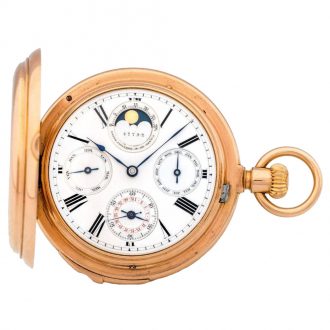
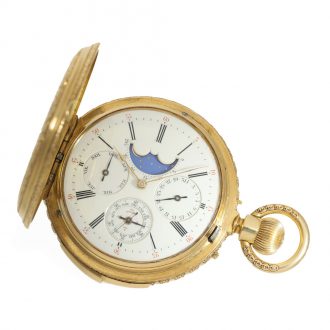
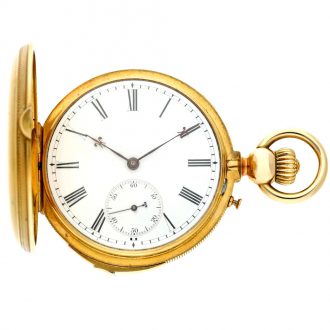
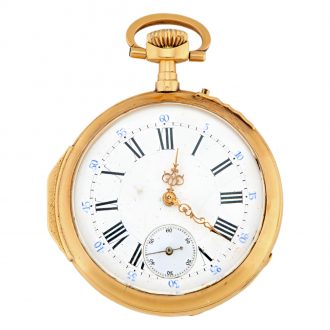
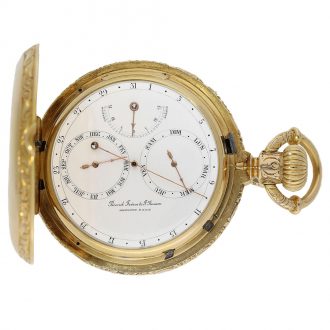
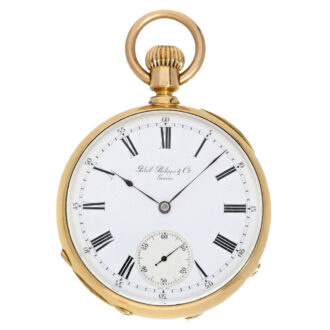
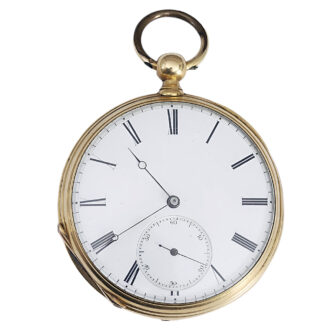
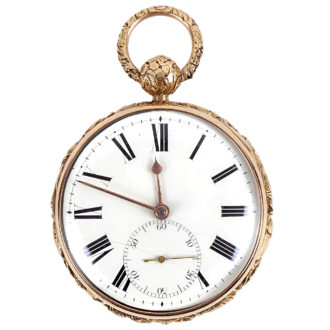
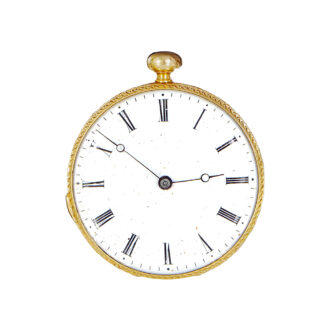
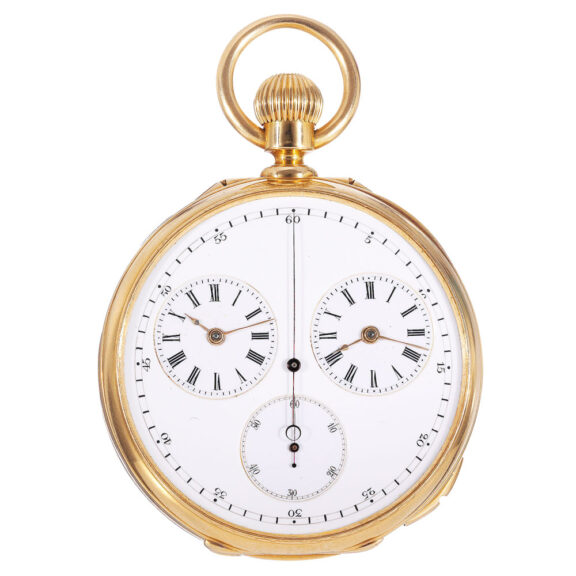
A very fine and extremely rare Swiss 18 carat gold open faced two train two time zone independent dead centre seconds keyless lever pocket watch, circa 1875. Frosted gilt movement, 25 jewels, two train with tandem winding, counterpoised straight-line lever escapement with S shaped counterpoise, cut bimetallic compensation balance with gold screws, blued steel Breguet balance spring with overcoil, index regulator. Gold hinged cuvette engraved with ‘difference d’Heure sur le Meridien de Paris’ listing the names of twenty cities and their respective time differences to Paris. White enamel dial, two meantime dials with Roman numerals and outer minute track, subsidiary constant seconds, outer seconds track with Arabic five second numerals and original gold spade hands. Case back engraved with a foliate monogram, bolt between 4 and 5 to lock the centre seconds, nibs for setting the hands for each time zone at each side of the pendant. Cuvette signed by Louis Audemars, Louis Audemars’ trademark punched inside the back of the case.
–
Diameter: 51 mm
–
Signed: Louis Audemars Brassus
–
This watch is extremely unusual because it not only featured a provision for two independently adjustable time zones before the adoption of hourly time zones, but it also lists the time differences between Paris and 20 other cities. Before the adoption of time zones, people used local solar time (originally apparent solar time, as shown by a sundial) and, later, mean time. Mean time is the average over a year of apparent solar time, its difference from apparent solar time is the equation of time. As railways and telecommunications flourished, the fact that time in various places differed according to the difference in their longitude became a problem. This could have been solved by universally synchronizing clocks, but then in many places local time would differ markedly from the solar time to which people are accustomed. Time zones for the entire world were first suggested in 1876 by Canadian Sir Sandford Fleming. He suggested a single 24 hour clock (to be located at the centre of the Earth and not linked to any surface meridian). In 1879 he specified that his universal day would begin at the Greenwich meridian (now 180°), while conceding that hourly time zones might have limited local use. Although the International Meridian Conference of October 1884 did not adopt his time zones, it did adopt a universal 24 hour day beginning at Greenwich midnight, specifying that it ‘shall not interfere with the use of local or standard time where desirable’. Nevertheless, by 1929 most countries had adopted hourly time zones. Today, all nations use standard time zones, but all do not apply the concept as originally conceived.
–
Greenwich Mean Time (GMT) was established in 1675, when the Royal Observatory was built, as an aid to determining longitude at sea. The first time zone in the world was established by British Railways on December 1, 1847 – with GMT hand-carried chronometers. About August 23, 1852, time signals were first transmitted by telegraph from the Royal Observatory in Greenwich. Although 98% of Great Britain’s public clocks were using GMT by 1855, it did not become Britain’s legal time until August 2, 1880. Some clocks from this period (such as the present watch) have two dials or two sets of hands – one for the local time, one for home time.
Signed: Louis Audemars Brassus
Share this page: