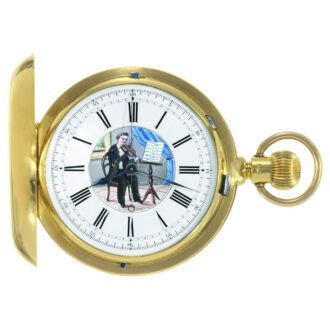
Unique Swiss 18k gold complicated lever watch Circa 1884
- Kenmerk
- BA0803
- Diameter
- 42 mm
- Estimate
- € 30.000 - 55.000
- Price sold
- -
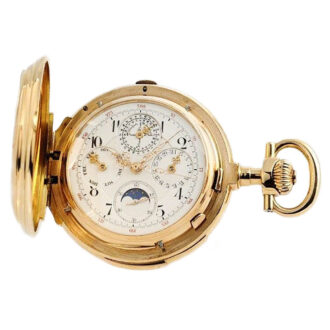
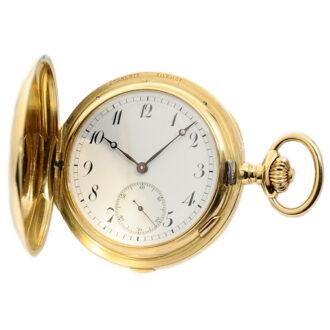
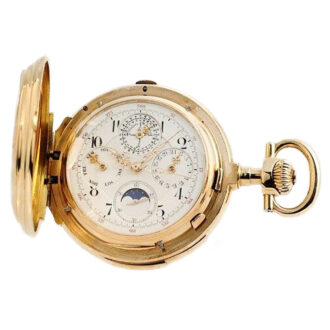
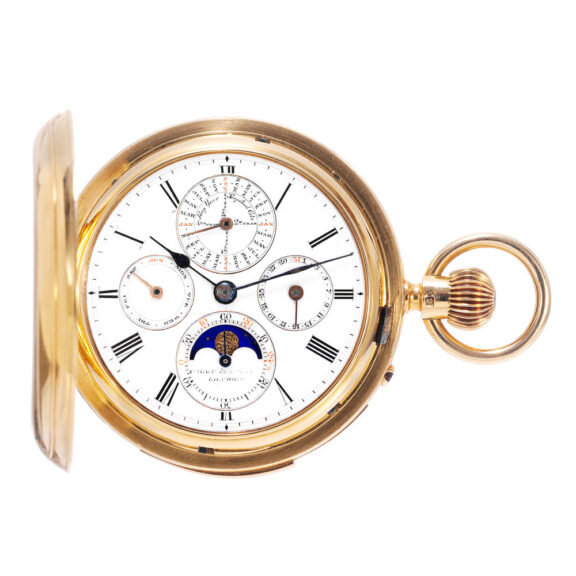
Gold full hunter with perpetual calendar, moon phase and lunar calendar
–
A unique and exceptionally fine Swiss 18 carat gold hunting cased minute repeating miniature astronomic keyless lever pocket watch with perpetual calendar, moon phase and lunar calendar, Hallmarked London 1884. Made for Cooke & Kelvey, London. Frosted gilt 3/4 plate, calibrated lateral lever escapement fully jeweled in screwed chatons, going train jeweled to the center in screwed chatons, diamond endstone, cut bimetallic compensation balance, freesprung blued steel Breguet balance spring, repeating on gongs activated by a slide on the band. White enamel enameldial with Roman numerals, outer minute track, four subsidiary dials for days of the week, date, months, four year cycle and subsidiary seconds concentric with phases of the moon aperture and lunar calendar, original blued steel spade hands. Polished case by Alfred Stram (master mark), the back engraved with a monogram. Dial and movement signed, punched AP on the pillar plate.
–
Diameter: 42 mm
–
Signed: Cooke & Kelvey London – Audemars Piguet Brassus & Genève
–
Audemars Piguet was founded in 1875 by Jules Audemars and Edward Piguet. The two opened a branch in Geneva in 1880. Jules Audemars was the technical manager and Edward Piguet the financial specialist of the firm. The two managed the company until 1918, when Jules Audemars died at the age of 67, Piguet died the following year. The name Audemars Piguet became synonymous with watches of exceptional quality, superb complications and very thin movements. They manufactured many of the world’s most complicated watches, the majority of which were sold to other manufacturers, who in turn sold them as their own watches. Famous examples are the Universal-Uhr of Uhrenfabrik Union, and the so called ‘grosse piece’ which was sold as the ‘Astronomical Watch’ by Smith & Son Ltd, London, both of which were the most complicated watches in world when they were sold, in 1899 and 1914 respectively. They produced the world’s smallest five minute repeating watch (7″‘), and in 1915, the first wristwatches with perpetual calendar and moon phases. In 1924, a pocket watch with a movement 1.32 mm thick in 1925, the thinnest lady’s watch in 1960, the thinnest automatic watch, 2.24 mm in 1967, followed by an automatic jump hour watch with a thickness of 3.05 mm. The finest example of Audemars Piguet’s quest for thinness came in 1986 with the launching of an automatic watch with Tourbillion regulator. Its overall thickness of 4.8 mm was achieved by setting jewels into the case back and utilizing it as a plate.
Signed: Cooke & Kelvey London – Audemars Piguet Brassus & Genève
Share this page: