Swiss oval pocket watch with Réaumur thermometer Circa 1884


- Kenmerk
- AS1785
- Diameter
- -
- Estimate
- € 100.000 - 200.000
- Price sold
- € 82.000
Gold and silver calendar watch with thermometer by Breguet
–
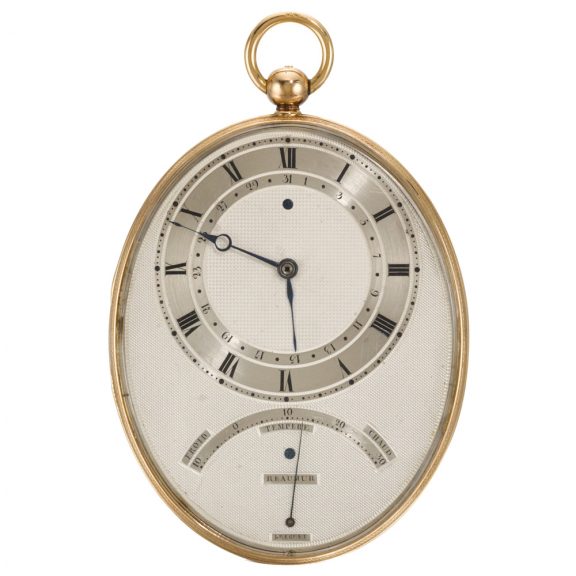
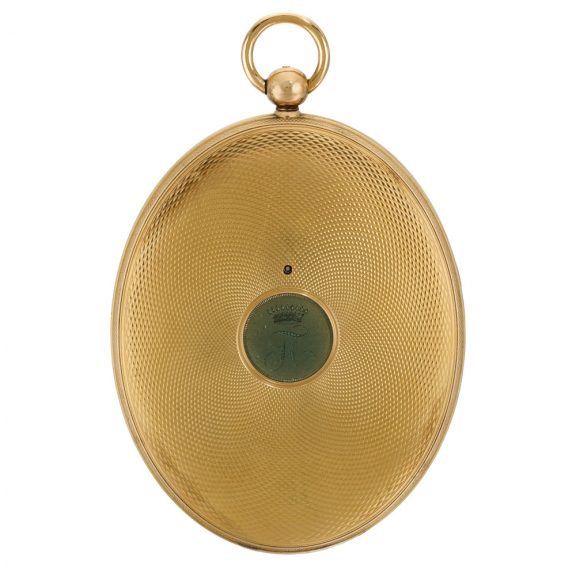
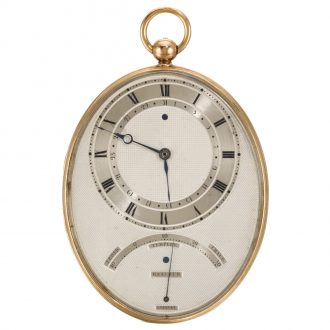
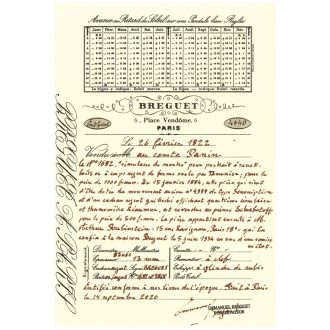
A large, fine, and highly unusual Swiss gold and silver oval calendar watch with a thermometer, circa 1884. It was delivered to Comte Panin as a simulated watch with a secret portrait miniature on February 26, 1822, and later completed as a watch with a thermometer on January 15, 1884, with souscription movement at the request of Prince Scherbatoff for the sum of 500 francs, later the property of the pianist Arthur Rubinstein (1822–1884).
–
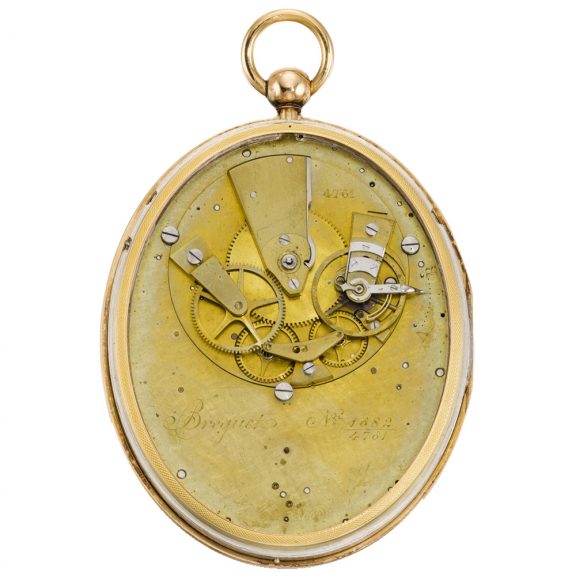
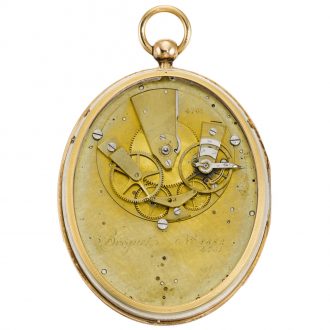
The watch features a circular souscription calibre movement with an underslung ruby cylinder escapement, a flat three-arm balance with a bimetallic compensation curb, and a parachute suspension. The movement backplate is numbered 4761, while the surrounding oval plate is signed and numbered Breguet No. 1682/4761. Additionally, it includes a bimetallic thermometer mounted to the front plate beneath the dial and a double rack and pinion to control the temperature hand. The silver engine-turned oval dial has an off-set satin-finished chapter ring with Roman numerals, an outer minute ring, an inner date ring, a sector for temperature calibrated in Réaumur beneath, a single blued steel time hand, a blued steel date hand, and a banner at the base signed Breguet.
–
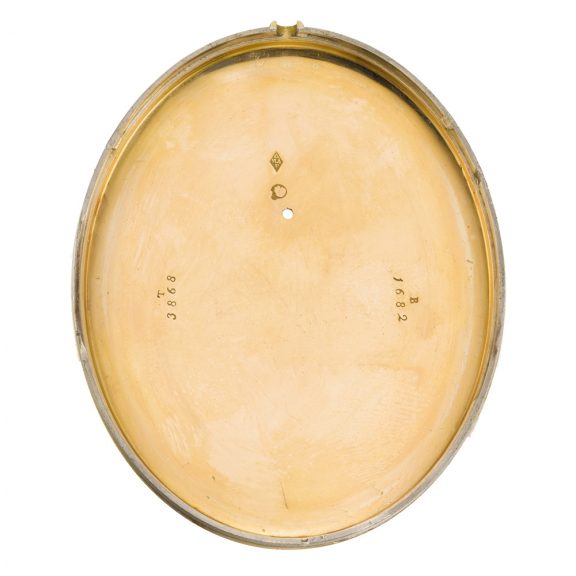
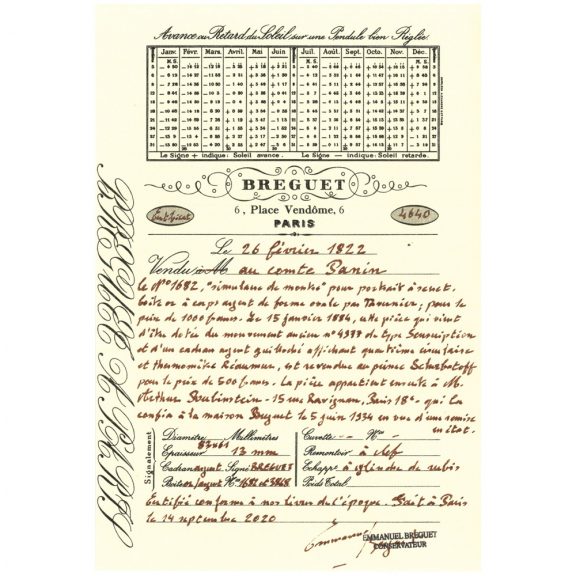
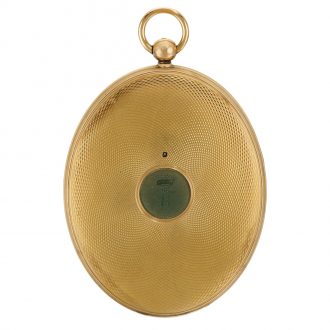
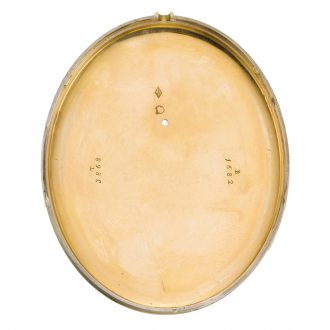
The gold case is engine-turned, back centred with a Cyrillic initial P beneath a ducal crown under grey translucent soft enamel, with an aperture for winding above, engine-turned silver band, gold hinged engine-turned front bezel, date corrector beneath case back at 12 o’clock, pusher through pendant to release back cover, case back numbered B 1682, and with maker’s mark MAB beneath a triangle for Tavernier, Tavernier number 3868, and French control marks. Accompanied by a Breguet certificate dated September 14, 2020.
–
Dimension: 93 x 61 mm
–
Signed: Breguet
–
The movement has not been tested due to a lack of the correct key size. It appears tarnished, with some spotting. The date corrector slide intermittently advances the date. The dial has light scuffs and scratches. The case’s engine-turned decoration retains good definition with some light scuffs and scratches. The grey enamel above the monogram appears soft.
–
This unique timepiece by Breguet was created as a ‘simulacre de montre’ (mock watch) intended to hold a portrait miniature. Later, in 1884, Prince Scherbatoff requested Breguet to fit the watch with a slim souscription calibre movement that included a date indication. Additionally, a thermometer with Réaumur calibrations was incorporated, and a silver engine-turned dial was produced to display all indications. The watch was eventually owned by the renowned pianist Arthur Rubinstein, as confirmed by Breguet’s workbooks, which noted that Rubinstein returned the watch to Breguet on 5 June 1934 for servicing.
–
Arthur Rubinstein, a celebrated pianist of the 20th century, was a frequent visitor to Breguet in Paris. Over the years, he assembled a small collection of Breguet watches, with the present piece, no. 1682, being the most famous. Rubinstein was born in Łódź, Poland, in 1887 and gave his first public performance at the age of 7. He moved to Berlin at the age of 10, and by 1900, while still a teenager, he had performed for the first time at the Berlin Philharmonic. After moving to Paris in 1904, he made his debut at New York’s Carnegie Hall in 1906 and went on to tour the US, Austria, Italy, and Russia. During World War One, Rubinstein lived in London, and in his thirties, he returned to Paris, where he befriended, among others, Picasso and Jean Cocteau. Following the Second World War, the United States became Rubinstein’s permanent home.
Signed: Breguet
Share this page: