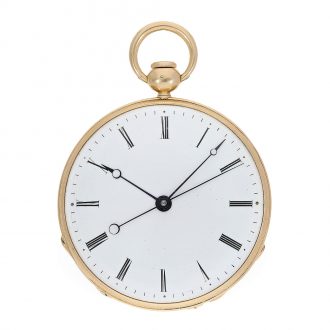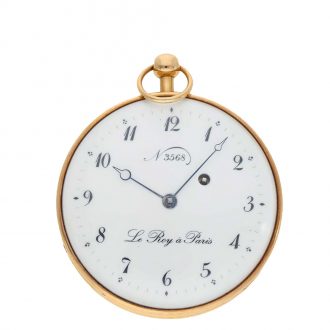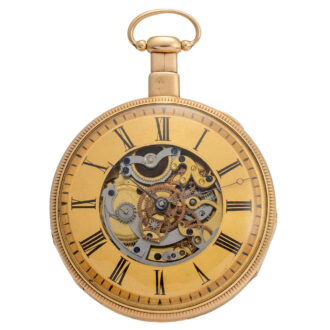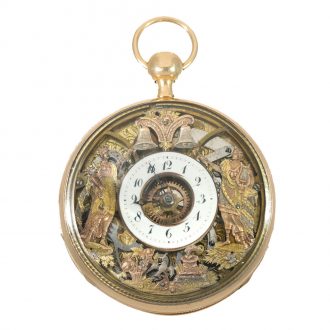
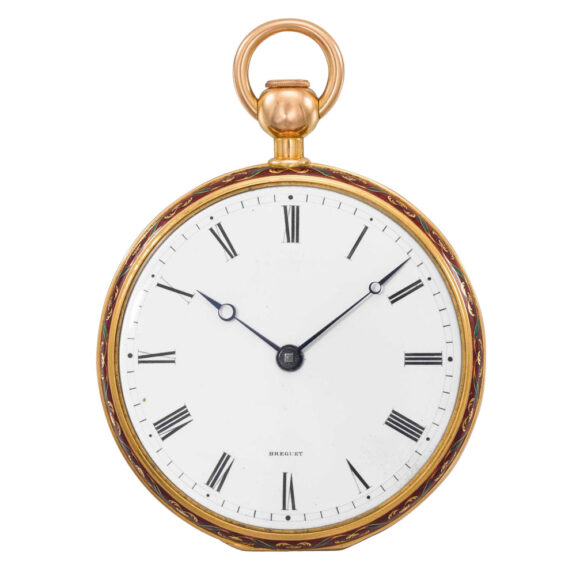
Highly important French duplex for Russian market Circa 1810
- Kenmerk
- CH1823
- Diameter
- 56 mm
- Estimate
- € 250.000 - 500.000
- Price sold
- € 250.150
Gold and enamel repeating cabriolet watch by Breguet
–
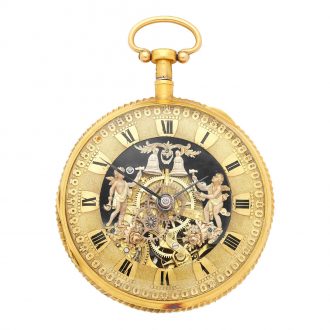
A highly important and unique French 20-carat gold and enamel pair-cased quarter-repeating cabriolet watch for the Russian market, Breguet No. 4384, circa 1810
The watch was sold on 31 December 1810 through Moreau / Maison de Russie for 3,070 francs, apparently to Tsar Alexander I.
–
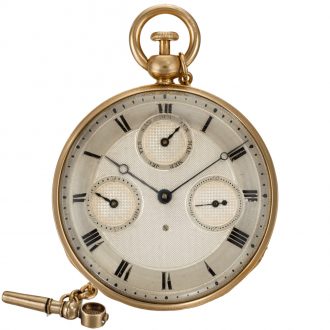
The gilt-brass movement has a double ruby duplex escapement with two polished steel escape wheels. The large bimetallic compensation balance has sliding weights and platinum mean-time screws, with a parachute shock protection on the pivot. It also has a flat blued steel balance spring and a diamond endstone. The watch repeats the quarters with two polished steel hammers striking a gong. The gold inner cover is engraved with a table of the months and the equation of time.
–
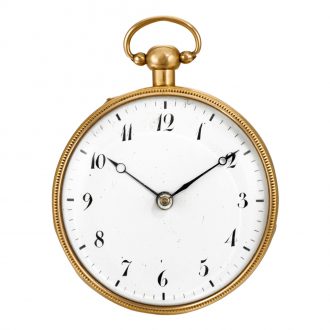
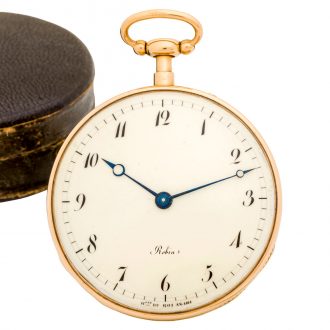
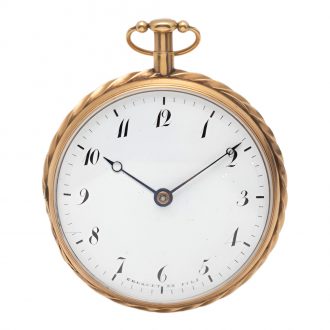
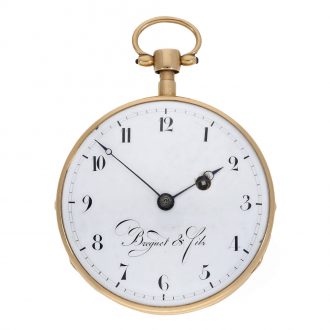
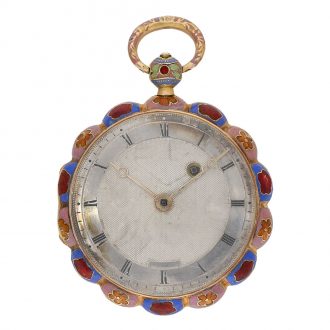
The white enamel dial has Roman hours, an outer minute track and blued steel Breguet hands. The secret signature “No. 4384 Breguet” is below 12 o’clock.
–
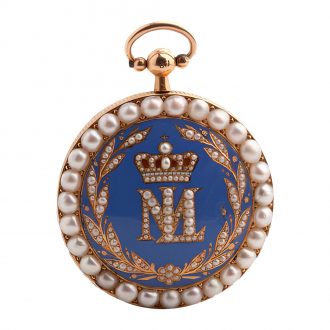
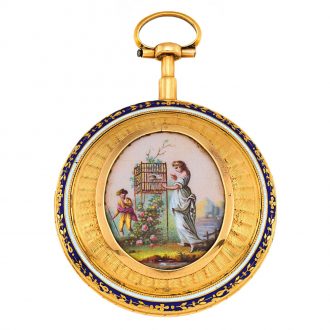
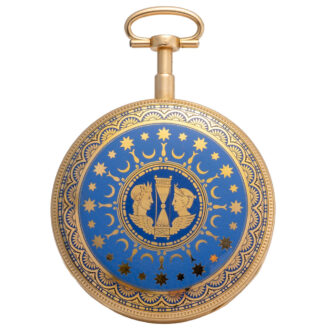
The inner case is decorated with translucent red champlevé enamel over sunburst engine-turning, with gold foil flowers and a gold foil rosette at the centre. Its rims have scrolls and foliage in translucent red and green champlevé enamel, and the band is decorated in royal blue and white enamel. The outer case has translucent red champlevé enamel over sunburst engine-turning, with a gold grapevine pattern and a gold rosette at the centre. Its rims have scrolls and foliage in translucent red, blue and green champlevé enamel. The repeater is worked by a pull-and-twist push-piece in the pendant.
–
The cases are numbered by the case maker Pierre Benjamin Tavernier. The inner cover is signed “Breguet No. 4384” and the dial is signed “Breguet”.
–
Diameter outer case: 55.5 mm
–
Signed: Breguet
–
Provenance
1810-1822: Apparently Tsar Alexandre I of Russia, as a present for a Turkish dignitary;
1822: returned by the above via General Levasheff in exchange for a non-Turkish watch;
1822-1825: Breguet;
1825: sold to M. Villaret de Joyeuse, now under No. 1795/4384;
1830: sold to Wenham, Breguet’s agent in Russia;
1870-1879: George Arnold Hearn whose collection is now housed in the Metropolitan Museum of Art in New York;
1879: sold by Hearn to Russia, possibly to the firm of Henry Moser & Cie., who adds the present box;
1879-1920: in a Russian collection;
1920-1954: Gunnar Jacobsson (1882-1967) who worked for the Nobel Brothers;
1954-1960: in the family of Christian Gjestvang, one of Sweden’s first automobile enthusiasts who introduced Ford and Hudson cars to Sweden. His daughter Alexandra apparently was Sweden’s first woman to obtain a driving licence;
1960-1982: Bo Lindh (1908-1982), the son of Alexandra, a well-known art collector (Bo & Margareta Lindh Collection);
1982-2014: Descendants of the above.
–
Alexander I of Russia|
Alexander I (1777–1825, or perhaps 1864) is seen as one of Russia’s greatest emperors. After defeating Napoleon in 1812, he became one of the most powerful rulers in Europe. He was brought up by his free-thinking grandmother, Catherine the Great. It is said she wanted Alexander, not her son Paul, to succeed her. Her sudden death in 1796 ended that plan, and Alexander became Tsar only after his father was murdered in 1801. Catherine had married him at 15 to Princess Louise of Baden, and their two children died young. Six years later, two years before he took the throne, he met Princess Maria Naryshkina. She was his mistress for the next twenty years, and they had at least five children.
–
He had qualities rare in a monarch. In private he was charming, as both his friends and his enemies agreed. He loved music and more than once regretted in public that Catherine had never let him learn the violin. According to the Comtesse de Choiseul-Gouffier, Napoleon called him “the philosopher on the throne.” Alexander was known for his excellent memory. He joked that he needed it because his generals were destroying theirs with vodka. In politics he was shrewd and often controlled even the smallest details. His letters to his army commanders show that he regularly helped plan their campaigns down to the last detail. In 1812, talking with General Balashov, Napoleon expressed surprise that Alexander troubled to command his armies in person. “That is well enough for an old corporal like me,” he added. Napoleon recognised Alexander’s talent and power, but thought himself the greater man. History proved him wrong.
–
The Congress of Vienna confirmed Russia as one of Europe’s great powers. Alexander attended it with Princess Naryshkina, and afterwards his life changed. In 1824 he mourned the death of Sofia, his beloved daughter with Naryshkina. The next year he travelled to southern Russia, where he is said to have died. A persistent legend claims that, overcome by grief, he faked his death and became a hermit called Feodor Kuzmich, whose handwriting is said to match Alexander’s exactly. The future Alexander II is said to have visited Kuzmich in 1837, and the future Nicholas II visited his grave in 1891.
Signed: Breguet
Share this page: