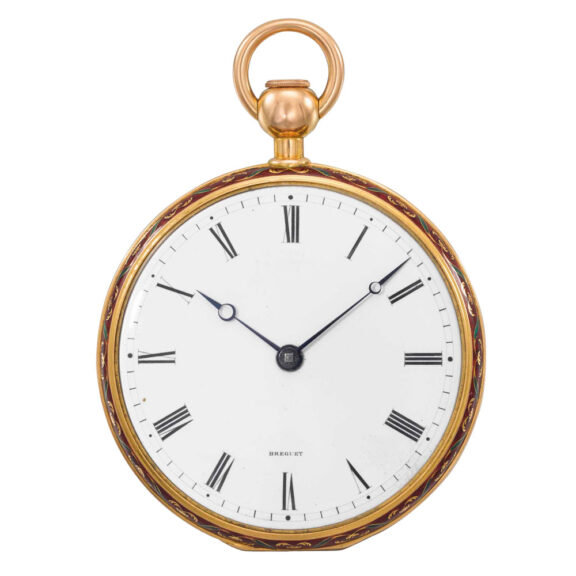
Highly important French duplex for Turkish market Circa 1810
- Kenmerk
- CH1823
- Diameter
- 56 mm
- Estimate
- € 250.000 - 500.000
- Price sold
- € 250.150
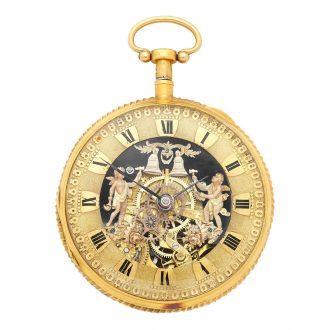
Gold and enamel repeating cabriolet watch by Breguet
–
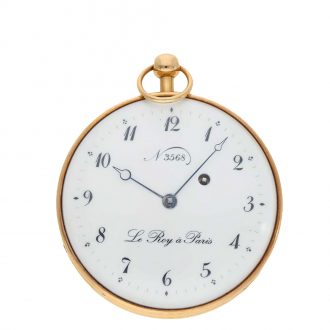
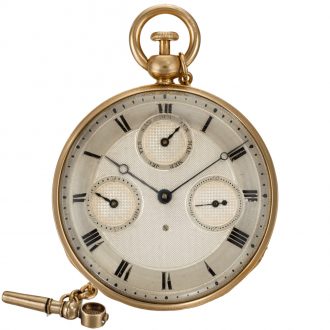
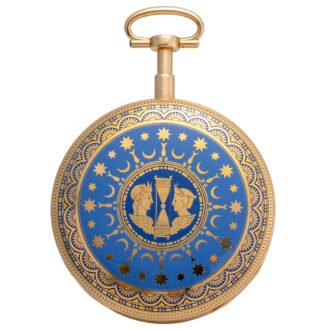
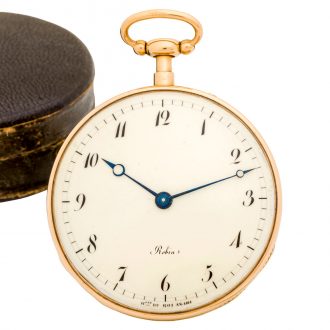
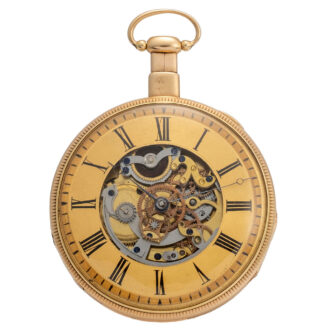
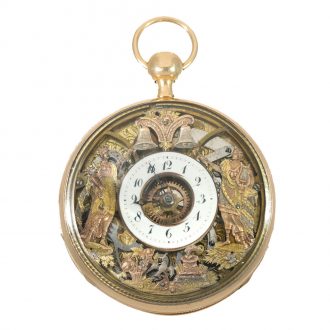
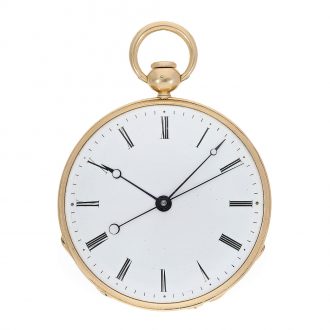
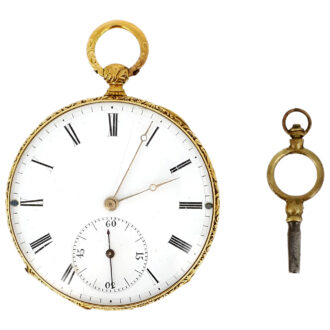
A highly important and unique French 20 carat gold and enamel pair cased quarter repeating cabriolet watch made for the Turkish market, circa 1810. Sold on December 31, 1810 via Moreau/Maison de Russie, apparently to Tsar Alexander I for the sum of 3,070 Francs. Gilded brass movement, a double ruby duplex escapement, double polished steel escape wheels, large bimetallic compensation balance with sliding weights and platinum mean time adjustment screws, parachute suspension on the pivot, blued steel flat balance spring and diamond endstone, quarter repeating on two polished steel hammers onto a gong. Gold cuvette engraved with the tables for the months and the equation of time.
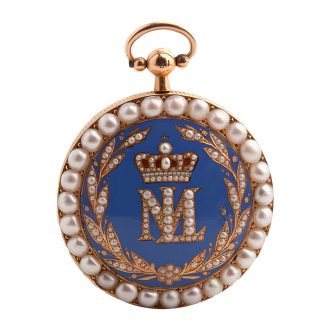
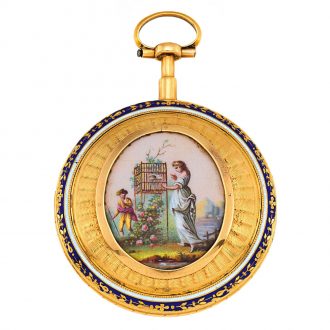
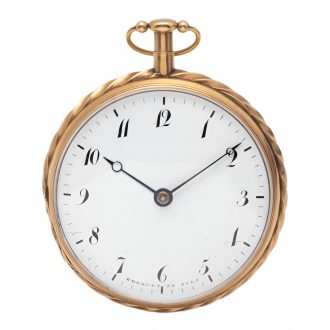
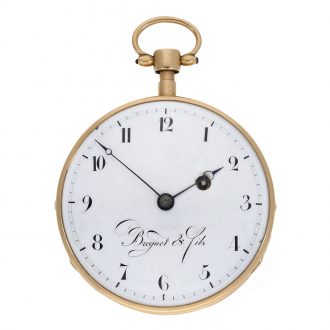
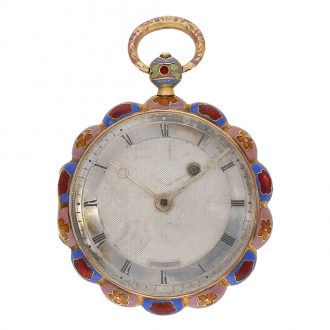
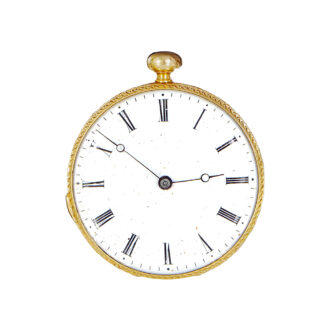
White enamel dial with Roman hour numerals, an outer minute track, the secret signature No. 4384 Breguet below 12 o’clock and blued steel Breguet hands. Inner case with red translucent champlevé enamel over sunburst engine turning with gold paillon and floral motifs, centred by a gold paillon rosette, red and green translucent champlevé scroll and foliage decorated rims, royal blue and white enamel decorated band, the outer case with red translucent champlevé enamel over sunburst engine turning with gold grape vine motif, centred by a gold rosette, red, blue and green translucent champlevé scroll and foliage decorated rims, quarter repeating pull-twist push-piece in the pendant. Cases numbered by Pierre Benjamin Tavernier, cuvette signed Breguet No. 4384, dial signed Breguet.
–
Diameter outer case: 55.5 mm
–
Signed: Breguet
–
Provenance
1810-1822: Apparently Tsar Alexandre I of Russia, as a present for a Turkish dignitary;
1822: returned by the above via General Levasheff in exchange for a non-Turkish watch;
1822-1825: Breguet;
1825: sold to M. Villaret de Joyeuse, now under No. 1795/4384;
1830: sold to Wenham, Breguet’s agent in Russia;
1870-1879: George Arnold Hearn whose collection is now housed in the Metropolitan Museum of Art in New York;
1879: sold by Hearn to Russia, possibly to Henry Moser, who adds the present box;
1879-1920: in a Russian collection;
1920-1954: Gunnar Jacobsson (1882-1967) who worked for the Nobel Brothers;
1954-1960: in the family of Christian Gjestvang, one of Sweden’s first automobile enthusiasts who introduced Ford and Hudson cars to Sweden. His daughter Alexandra apparently was Sweden’s first woman to obtain a driving licence;
1960-1982: Bo Lindh (1908-1982), the son of Alexandra, a well-known art collector (Bo & Margareta Lindh Collection);
1982-2014: Descendants of the above.
–
Alexander I of Russia
Alexander I (1777-1825 (or 1864)) is considered one of the greatest Russian Emperors of all time and, after crushing Napoleon in 1812, as one of the most powerful sovereigns in Europe. He was raised by his free thinking grandmother, Catherine the Great who, it is said, planned not that her son Paul, but her grandson Alexander was to become her successor. Her premature death thwarted those plans and Alexander became a Tsar only after his father’s murder in 1801. He was married off by Empress Catherine when he was only 15 to Princess Louise of Baden. Their two children died young. Six years later, two years before becoming the Emperor, he met Princess Maria Naryshkina who, for the next twenty years, became his mistress and with whom he had at least five children.
He had rare traits for a monarch. In private he was amiable as confirmed not only by his friends but also by adversaries. He enjoyed music, he more than once publicly regretted that the Empress Catherine had never allowed him to learn the violin. Napoleon called him The philosopher on the throne, as conveyed by Comtesse de Choiseul-Gouffier. Alexander was reported to have an outstanding memory. He joked that he needed it because his generals were killing theirs with vodka. In politics he was shrewd and often controlling to the smallest details. His letters to the commanders of his armies show that regularly he took part in planning every detail. Napoleon, in a conversation with General Balacheff in early 1812 expressed his astonishment that Alexander took the trouble to command his armies in person. “That is well enough for an old corporal like me.” he added. Although Napoleon acknowledged Alexander’s talents and power, he considered himself to be greater. History proved him wrong.
After securing the position of Russia as one of the greatest powers in Europe at the Congress of Vienna, in which he participated with his mistress Princess Naryshkina, Alexander’s life had changed. In 1824 he mourned the death of his beloved daughter, Sofia, whom he had with his mistress. The next year he took a trip to the south of Russia where he supposedly died. A well substantiated rumor circulated that in his sorrow he simulated his death and became a monk, taking the name of Feodor Kuzmich, whose handwriting is described to be identical to Alexander’s. Kuzmich (or Alexander I) was visited by Emperor Alexander II in 1837 and his grave was visited by Nicholas II in 1893.
Signed: Breguet
Share this page: