Exceptional and historically important lever watch Circa 1800
- Kenmerk
- CH1015
- Diameter
- -
- Estimate
- € 1.000.000 - 2.500.000
- Price sold
- € 2.956.500
Gold self winding à toc quarter repeating lever by Breguet
–
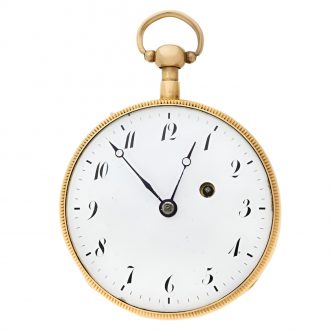
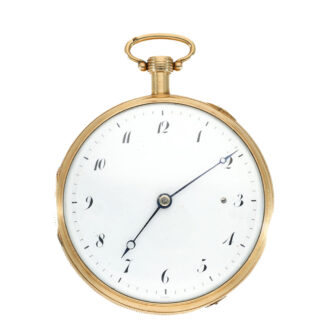
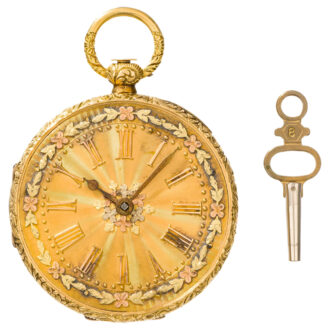
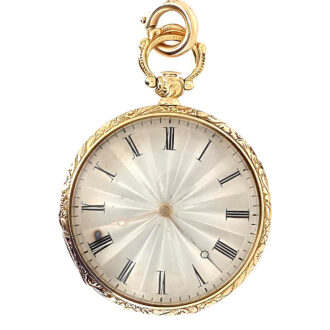
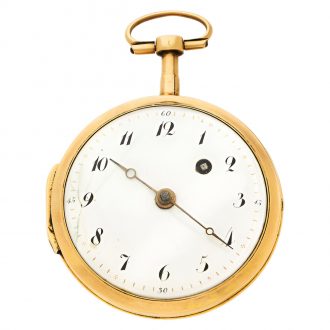
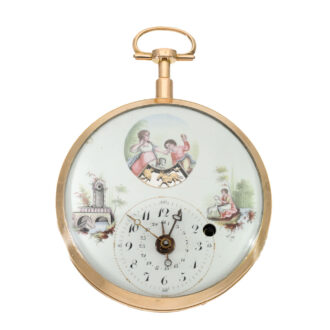
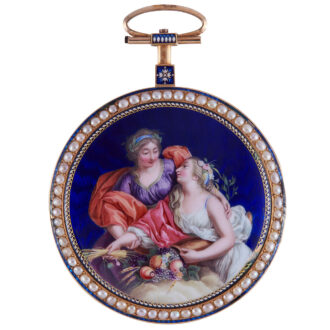
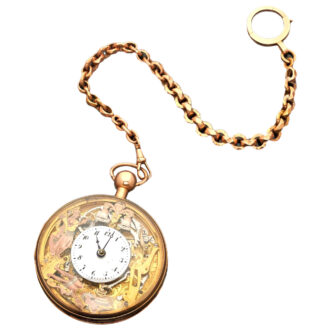
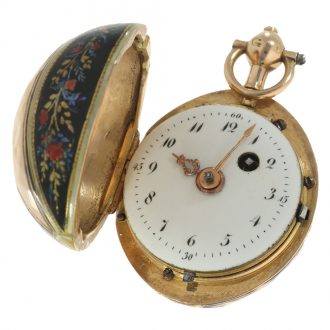
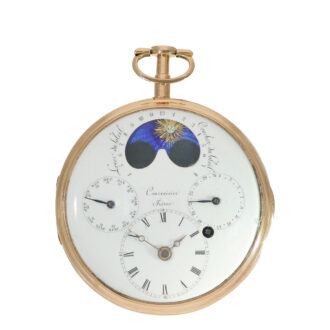
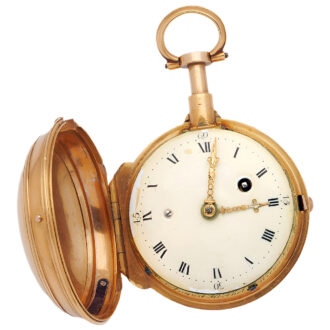
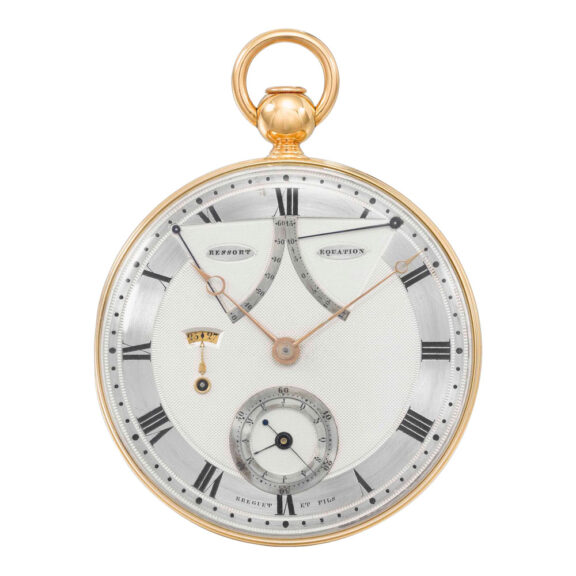
An exceptional and historically important, probably unique Swiss 18 carat gold self winding à toc quarter repeating lever watch with sectoral equation of time, day and month calendar and sectoral power reserve indication, constructed on the principals of the garde temps, circa 1800. Sold in Germinal an 8 (1800) to Général Moreau for the sum of 3,600 Francs, resold to Mr. Havas on 31st December 1817 for 4,800 Francs. Gilded brass movement with two mainspring barrels, early jewelled lever escapement with steel lever and pallet frame, brass escape wheel, four armed compensation balance supporting two compensating affixes with adjustable weights on screws at the free ends, platinum shield shaped oscillating weight, blued steel helical balance spring with terminal curves and screw stud, parachute suspension, equation of time cam mounted on the month calendar wheel, à toc quarter repeating with one hammer onto the case, weight lock and advance/retard levers in the band. Engine turned silver dial with Roman numerals on plain chapter ring, outer dot minute divisions, gold Breguet hands, two fan shaped sectors for 60 hours power reserve and equation of time calibrated from +15 to -15 minutes, large subsidiary seconds concentric to the month ring and aperture for the date with gold arrow pointer. Polished case with concealed hinge, back secured by two screws in the band, quarter repeating pull-twist push-piece in the pendant. Dial signed Breguet et Fils, the reverse punched B 217 T for Tavernier, dial plate edge signed Breguet No. 217, case numbered. Comes in a Desoutter gold tooled red morocco fitted box.
–
Diameter: –
–
Signed: Breguet et Fils – Breguet No 217 ‘montre perpétuelle à répétition à quantième de mois et dates et équation, échappement libre à ancre’
–
Jean Victor Marie Moreau (14 February 1763 – 2 September 1813)
Moreau was a French general and sincere republican who helped Napoleon Bonaparte come to power. Eventually he became a rival to Napoleon and for this was exiled to the United States of -America where he arrived in 1805.
It was the Battle of Tourcoing in 1794 that established Moreau’s military fame, this led to his appointment as commander of the Army of the Rhine-and-Moselle in 1795. He crossed the Rhine and advanced into Germany at the head of the army, the subsequent retreat of which became a model for such operations and at the same time greatly enhanced his own reputation, all the more because he brought back with him more than 5000 prisoners.
Back in Paris, Moreau had become very disillusioned with the Directory government and was ready to give his assistance to Napoleon, upon his return from the French campaigns in Egypt and Syria, in the coup d’etat of 18 Brumaire. In fact Moreau led the force which confined two of the directors in the Luxembourg Palace. As a reward, Napoleon put him again in command of the Army of the Rhine with which he forced back the Austrians. Upon returning to Paris he married a friend of Joséphine de Beauharnais called Mlle Hullot, she became the dominant force in his life from then on. Madame Moreau was the ringleader of a group of influential people who had become irritated by the grandeur of Napoleon, this became known as the “Club Moreau” which encouraged the monarchist cause. Napoleon knew that Moreau would be no party to any plan to restore the monarchy but could not allow him to remain in a position of power. Other conspiritors were imprisoned but in a show of supposed leniency by the First Consul, Moreau’s sentence was one of banishment and in 1804 he embarked for America arriving in New York in August 1805. In 1812, President Madison offered him command of the U.S. troops which he was about to accept when he heard that the Grande Armée in Russia had been decimated. Instead he decided to return to Europe. On his return he again became involved with republican intriguers supporting the Prussians and Austrians in leading an army against Napoleon. Moreau, who wished to see Napoleon defeated and a republican government installed, gave advice to the Swedish and Russian leaders about how best to defeat France. However, he was mortally wounded while talking to the Tsar at the Battle of Dresden in 1813 and died six days later from his injuries. His wife received a pension from the Tsar and Moreau was postumously given the rank of Marshal of France by Louis XVIII.
–
Charles Louis Havas (1783-1858)
‘The free communication of ideas and of opinions is one of the most precious rights of man. Any citizen may therefore speak, write and publish freely, except what is tantamount to the abuse of this liberty in the cases determined by Law’.
Adopted by the French National Assembly on 26 August 1789, particularly article 11 of the Declaration of the Rights of Man and of Citizen had a significant impact on French press and consequently on the later life of Charles-Louis Havas: within 6 months after its approval nearly 1,500 newspapers had been published.
Charles Louis Havas was born in Rouen, France, on 5 July 1783 into a wealthy Jewish family of Hungarian descent, his father trading in land and cotton futures during the French Revolution. Young Charles in return became a notable merchant, banker and publisher while learning a number of languages, a very useful tool for his future business.
In August 1832 he opened his own office in Paris, supplying news about France to foreign customers and translating articles from foreign papers and selling the translations to bankers, businessmen and politicians.
He soon noticed the difficulties of employing a large team of reporters, impossible for the around 600 smaller newspapers and periodicals in France at the time, all hungry for the kind of information he could provide. In 1835 he restructured his operation and launched the world’s first news agency which he called Agence Havas, ‘the first information bureau for the press’. Located at rue Jean-Jacques Rousseau, the agency’s news dispatches comprised a wide range of bulletins for politicians, bankers and industrialists titled ‘Vite et Bien’, fast and good. To fullfil this promise Havas employed every form of information technology available at the time, including hundreds of carrier pigeons delivering daily information on London stock exchange prices and news on war and various conflicts. He was the first to use Samuel Morse’s invention, installing electromagnetic telegraph machines as of 1845, revolutionizing the distribution of news.
With the growth of the agency, now with correspondents reporting from Crimea, Italy, Mexico and the United States, expenses grew. To cover cost, the pioneering Charles-Louis Havas was also an early adopter of advertising, creating an internal advertisement division in 1852.
His concept of an agency distributing news to the media was quickly adopted in other countries, notably by his most prominent employees or rather protégés, Paul Julius Reuter and Bernhard Wolff. The experience in the field gained while being trained and working with Havas allowed them to found their own news agencies: Reuters in the United Kingdom and Wolff in Germany, third largest news agency of the time and forerunner of Deutsche Presse Agentur.
The 1859 agreement between the three major agencies – Reuter, based in London, Wolff in Berlin, and Havas – divides the world between them for the collection and dissemination of information.
Charles-Louis Havas passed away on 21 May 1858, leaving behind two of the most used inventions of all times: advertisement and communication.
In 1879 the Havas family sold its interests and Agence Havas became a publicly limited company, today Havas, one of the world’s largest global communications groups. On 25 November 1940 the News section of Havas is nationalised and becomes a government agency. Two laws establish the separation between the Advertising branch – which retains the name Havas – and the News branch – which becomes state property named Office Français d’Information (OFI), French Information Office. On 20 August 1944, a group of journalists seized the offices of the OFI and issued the first news dispatch from the liberated city under the name of Agence France-Presse. Today Agence France-Presse (AFP), headquartered in Paris, is the world’s third largest international news agency (after Associated Press and Reuters).
–
Masterpieces from the workshops of Abraham-Louis Breguet
The present watch is an example made by one of the workshops of Abraham-Louis Breguet (1747-1823) and his successors, widely acknowledged for having set the standard by which all fine watchmaking has been judged ever since.
This watch is amongst the rarest and most complicated Breguet watches ever made. Indeed, after the legendary ‘Marie Antoinette’, it is the only Breguet perpétuelle featuring an equation of time function.
–
Abraham-Louis Breguet (1747-1823)
Breguet was born in Neuchâtel, Switzerland, but it was in Paris that he spent most of his productive life. No aspect of watchmaking escaped his study, and his inventions were as fundamental to horology as they were varied. His career started with a series of breakthroughs: the development of the successful self winding perpétuelle watches, the introduction of the gongs for repeating watches and the first shock protection for balance pivots.
Louis XVI and his Queen, Marie-Antoinette, were early enthusiasts of Breguet’s watchmaking. Each watch from his workshops demonstrated the latest horological improvements in an original movement, mostly fitted with lever or ruby cylinder escapements that he perfected. Breguet took refuge in Switzerland from the perils of the French Revolution. He returned to Paris overflowing with the ideas that produced the Breguet balance spring, his first carriage clock (sold to Bonaparte), the ‘sympathique’ clock and its dependent watch, the tact watch and finally the tourbillon, patented in 1801.
Breguet became the indispensable watchmaker to the scientific, military, financial and diplomatic elites of the age. His timepieces ruled the courts of Europe. For his most celebrated clients, Breguet designed exceptional timepieces. For Caroline Murat, queen of Naples, he conceived in 1810 the world’s very first wristwatch. Honours saluted his enormous contribution to horology. Appointed to the Board of Longitude and as chronometer maker to the navy, he entered the Academy of Sciences and received the Legion of Honour from the hands of Louis XVIII.
When he died in 1823, all mourned the architect of the greatest revolution in the science and art of time-keeping.
Signed: Breguet et Fils – Breguet No 217 montre perpétuelle à répétition à quantième de mois et dates et équation, échappement libre à ancre
Share this page: